
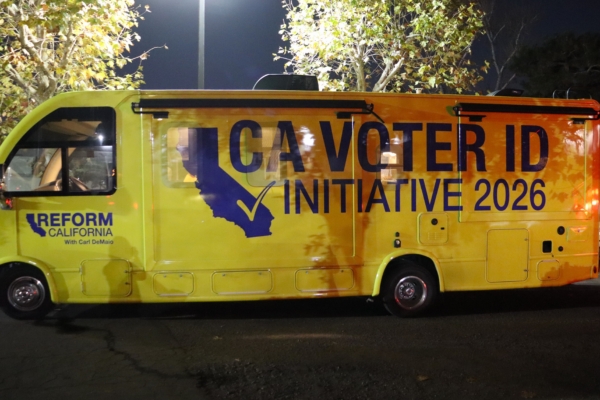
California will hold midterm elections on November 3 this year. Among them, Proposition 39, the “Voter ID Proposal” that received over 1.3 million supporting signatures and successfully made it onto the ballot, had its title and summary found to be modified in the election guide issued by the Secretary of State on July 21. The proposers criticized this as misleading the voters and manipulating the election; while the state Attorney General responded that adjusting the wording is a normal procedure.
One of the initiators of the “Voter ID” ballot proposition, State Assemblyman Carl DeMaio from the 75th District, expressed in a statement on the same day, “California politicians are once again trying to manipulate our elections through biased and dishonest ballot titles.”
DeMaio criticized Attorney General Rob Bonta for changing the title of Proposition 39 at the last minute, aiming to obstruct voter approval of this bipartisan-supported proposal. He pointed out that Bonta had provided the ballot title (as below) at the beginning of the signature drive in September 2025, which was printed on the petition papers and expressed in a relatively fair and objective manner:
Original Title (September 19, 2025): Establish additional voter identification and citizenship verification requirements. Constitutional amendment proposal.
Original Summary: This proposal would amend the California Constitution:
Require voters to present government-issued identification when voting in person at polling places, or provide the last four digits of that ID when voting by mail;
Require the state government to provide free voter identification cards;
Require election officials to report the percentage of verified citizen voters in each county annually.
However, the latest published version has undergone significant changes:
Revised Title (July 21, 2026): Prohibit citizens from voting without presenting government-issued identification. Citizen-initiated constitutional amendment.
Revised Summary: Prohibit voters from voting in person without presenting government-issued identification; a mail-in ballot without the designated ID last four digits on the envelope would be deemed invalid (e.g., if a voter registered with a social security number but wrote down the Real ID number on the envelope, the ballot would be invalid).
In the revised wording, the original “requirements” have been changed to “prohibit voting” or “ballot invalid.” Several Republican state legislators immediately condemned the change in the language on the ballots, with Congressman Kevin Kiley from the 3rd District also stressing that the modifications in the ballot language are purely intended to “manufacture panic and mislead voters.”
In response, Attorney General Bonta said that the modification is a routine, legal, and accurate operation, aimed at clarifying the key points and purposes of the Proposition to the voters in a manner that is “accurate, fair, descriptive, and informative,” to reflect updates in the legal details. He also criticized the opponents who labeled this action as “election manipulation” as inappropriate, regrettable, and unfounded accusations.
Bonta’s office spokesperson Walter Garcia added, “It is not uncommon for the titles and summaries of ballot propositions to differ from previous versions, with 9 out of the 14 propositions undergoing modifications this year. Our office properly exercises discretion to further explain the main purpose and voting focus of Proposition 39 to the voters.”
DeMaio cited the example of Proposition 6 in 2018 to illustrate: the original title was “Repeal the Gas Tax Advocacy,” but then-Attorney General Xavier Becerra changed it at the last minute to “Repeal the recently imposed road repair and transportation funding.”
“Due to the biased title attached to Proposition 6, politicians successfully lowered the support rate from 65% to 45%, causing it to ultimately fail, leading California drivers to still endure the highest gasoline prices in the country,” DeMaio stated. While politicians trying to intervene was anticipated, the current behavior undoubtedly “escalates election manipulation to new heights.”
California voters are no strangers to such controversies. The most famous case was the passage of Proposition 47 in 2014 with a 59.61% approval rate, which reduced certain non-violent drug and property crimes (such as theft under $950) from felonies to misdemeanors to alleviate prison overcrowding. Due to the ballot title, the “Safe Neighborhoods and Schools Act,” many voters mistakenly believed that the act could enhance public safety, sparking subsequent disputes. It was not until 10 years later in 2024 that California voters passed Proposition 36 with a high support rate of 68.4%, reinstating penalties for drug-related crimes and repeat theft.
To avoid such controversies, Republican lawmakers in California have been continuously proposing to transfer the responsibility of naming and summarizing ballot propositions to the nonpartisan Legislative Analyst’s Office, but this proposal has been repeatedly rejected by the majority Democratic lawmakers in the legislature.