
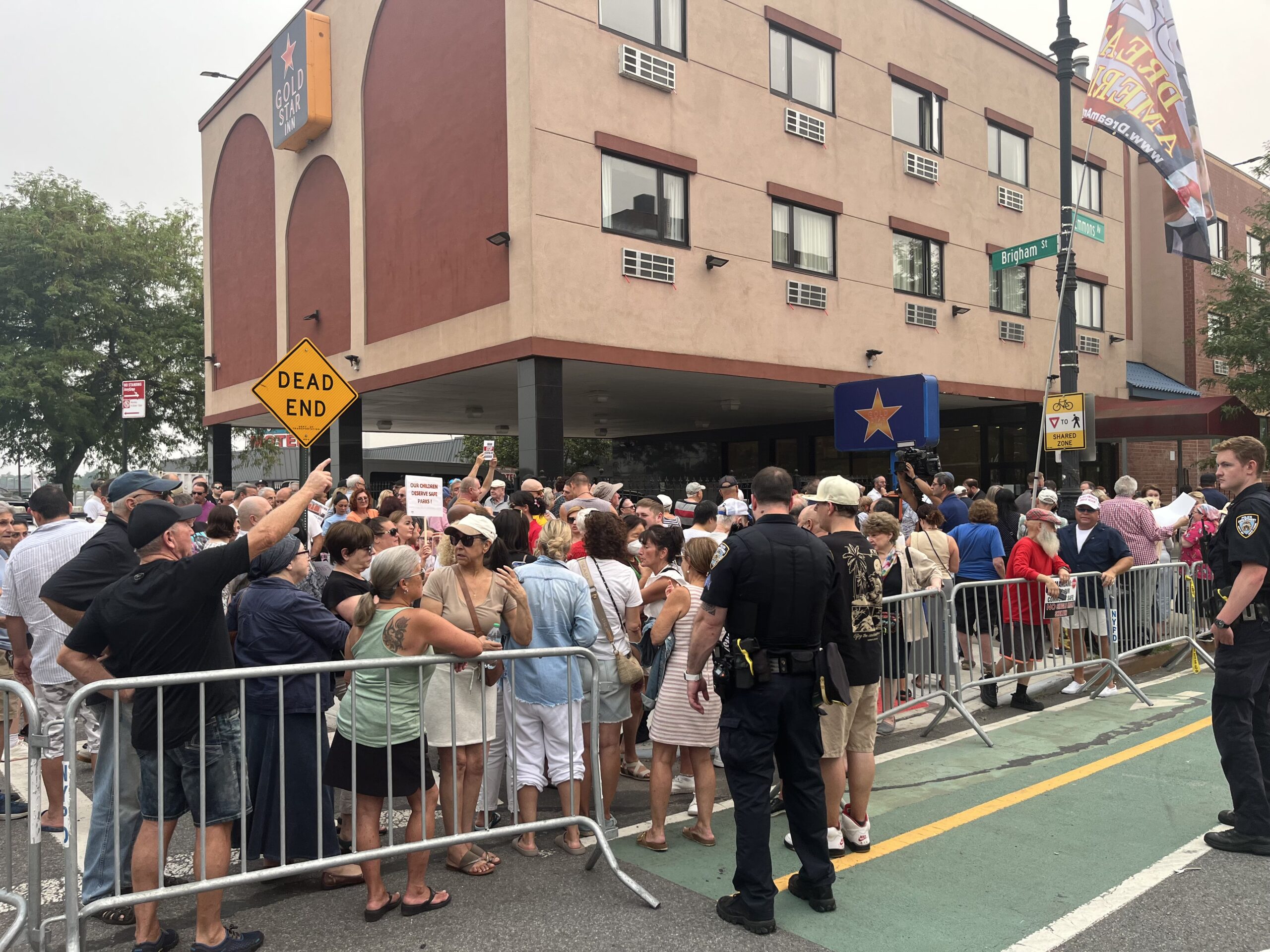
Inna Vernikov, a city council member, along with state assemblyman Kalman Yeger, filed a lawsuit under CPLR 78 in the New York State Court on Friday to halt the conversion of the “Gold Star Inn” in the southern end of Sheepshead Bay, Brooklyn, from a family shelter to a homeless shelter for 110 single men. The plan has sparked local backlash as they claim the city government did not follow proper legal notification and public participation procedures before proceeding with the renovation.
Vernikov stated that she did not receive any formal notice about the conversion but rather learned about it through constituents. In a recent letter to the city government, she expressed concerns that displacing families already integrated into the Sheepshead Bay community would not only be inhumane but also have a significant impact on the local community.
Both Vernikov and Yeger argue that the city government violated Section 21-324 of the New York City Administrative Code. The law mandates that elected officials and community boards affected by the establishment of a new homeless shelter must be notified and at least one public hearing must be held to allow residents to voice their opinions.
According to the lawsuit, the Gold Star Inn is located in a core residential area of Sheepshead Bay, facing a park and in close proximity to schools, senior housing, nursing homes, and businesses. Therefore, nearby residents, businesses, and community organizations are considered stakeholders who should have been consulted according to the law.
The plaintiffs emphasized that their opposition is not against the city government fulfilling its statutory duty to shelter the homeless but rather questions whether the city can use an “emergency state” as a basis to permanently circumvent legal requirements for notification and public participation.
At the heart of the case is a legal issue: whether the city government can establish a shelter under emergency authorization in response to the 2022 immigration crisis and subsequently treat the location as an “existing shelter” permanently, exempting it from Section 21-324 of the Administrative Code regarding future changes in use.
Even if the court determines that the site was originally a shelter, the plaintiffs argue that the exemption obtained in 2022 due to an emergency should not permanently apply to all future changes in use, as it would render Section 21-324 ineffective and deprive the community of its rights to notification, consultation, and public participation as provided by law.
Vernikov had previously inquired about the renovation plan, to which the Department of Social Services (DSS) commissioner responded on July 20 that Section 21-324 did not apply because the Gold Star Inn was considered an “existing shelter.”
The city government argued that the facility was established under emergency authorization in 2022 and therefore did not require a Fair Share procedure at the time; it currently operates under a hotel occupancy permit and has been approved by the New York State Office of Temporary and Disability Assistance (OTDA).
However, the plaintiffs pointed out that the city government has failed to provide any regulations, statutes, or formal legal interpretations to prove the existence of exceptions for “existing shelters” or “service recipient transitions” under Section 21-324 of the Administrative Code.
Both elected officials requested a Temporary Restraining Order (TRO) from the court to maintain the status quo pending the resolution of the case and to halt the shelter renovation plan. They hope the court will first clarify whether the city government’s legal interpretation of Section 21-324 is correct before deciding on the redevelopment.
The city government’s legal department sent a letter to the court on the same day representing New York City, the Department of Social Services, the Department of Homeless Services (DHS), and the commissioner, opposing the plaintiffs’ application for a TRO and requesting the opportunity to present their arguments before any ruling is made.
The city government stated that they are willing to hold an online or in-person hearing on the TRO next week and will promptly submit formal written opposition.