
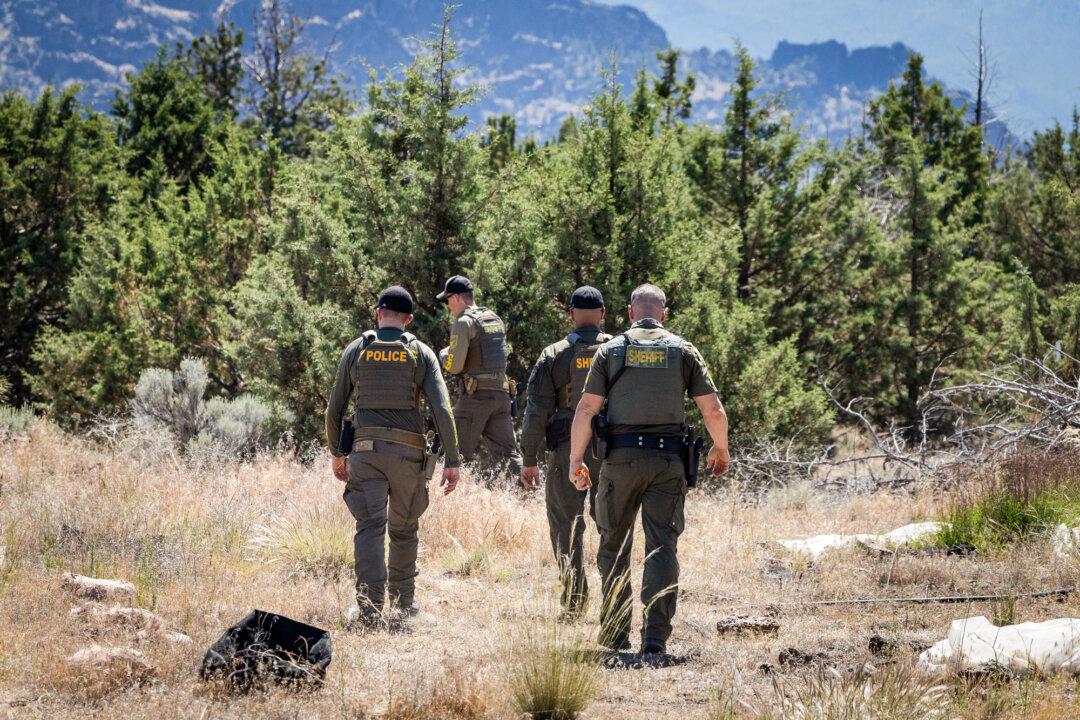
In Siskiyou County, California, local law enforcement officers are investigating a large illegal marijuana cultivation network near the foothills of Mount Shasta. Driving into a dusty campsite, they found trash and empty plastic containers of fertilizers littering the once-scenic area. Sheriff Jeremiah LaRue mentioned that the county always has thousands of temporary “hoop houses” operating, each housing hundreds of illegal marijuana plants. While his deputies were searching the Mount Shasta Vista area northeast of Weed, California, satellite imaging identified 2,732 hoop houses in the residential area.
When they arrived on June 4th, all personnel at the illegal marijuana cultivation site had already fled. Surrounding residents reported that lookouts, sometimes armed with AK-47s and rifles, would alert workers to leave the camp when officers approached. The site was deserted except for a few animals, indicating that the illegal growers were familiar with evading detection.
In two 30 ft by 100 ft hoop houses, around 430 flowering marijuana plants were found. In a larger greenhouse, officers from the North State Marijuana Investigation Team weighed freshly harvested marijuana plants, totaling around 900 pounds. All the marijuana was destroyed, and no arrests were made during the operation.
The marijuana industry experts estimate that over 30 million pounds of illegal marijuana are cultivated annually in the United States. In Siskiyou County alone, around 17.8 million pounds of illegal marijuana are produced each year, with a conservative street value estimate of approximately $3.6 billion.
Despite the increasing potency of marijuana products, the black market prices have remained stable. The underground marijuana industry in California is linked to organized crime and human trafficking from China. Chinese and other Asian crime groups have controlled the black market marijuana trade in the past two decades.
According to the Drug Enforcement Administration (DEA), Chinese transcontinental crime organizations now oversee marijuana cultivation and distribution across the US, funding purchase locations through family and community relationships in both China and the US.
The complex money laundering network involving “using straw buyers to register marijuana grow sites, casinos, and mortgage fraud” funnels illegal marijuana profits back to mainland China through a shadow banking system based in New York City.
In 2024, Oklahoma accounted for 66% of the total illegal marijuana seized nationally, with California making up 15%, and states like Maine, Missouri, and Indiana accounting for 3% each.
Large quantities of marijuana are transported using semi-trucks within the US, while smaller quantities are moved in vehicles using a “shotgun approach” to minimize risks during transportation.
This new method sees multiple cars each carrying a few hundred pounds of marijuana to the same location, avoiding the risk of losing a large shipment in one go.
Sheriff LaRue discovered a bag of insecticide labeled in Chinese, containing three individually packaged insecticide bags found in one of the hoop houses. He expressed concern over the new packaging, emphasizing that 80% of cultivation sites for black market marijuana use toxic, foreign-labeled banned pesticides, primarily smuggled from China.
These pesticides pose significant risks not only to users but also to the individuals growing marijuana and law enforcement personnel in contact with them. Prompt destruction was necessary due to their high toxicity.
The site was littered with beer and soda cans with tops cut off, used to hold toxic substances that growers burned inside the greenhouse to eliminate pests. After harvest, toxins remain on the plants, contaminating both legal and black markets and reaching users who consume the tainted marijuana.
After thorough analysis, contaminated marijuana was found slipping through licensed retail points. According to the sheriff’s office, 27 pesticides were discovered at the illegal cultivation site, with 17 not within the testing range by the California Department of Cannabis Control. These pesticides included 12 acetylcholinesterase inhibitors affecting the nervous system and presenting serious health risks.
Under the Safe Drinking Water and Toxic Enforcement Act of 1986, eight of the pesticides found were carcinogens, seven were restricted in the US, six were groundwater pollutants, and the fumigants were classified as toxic air pollutants.
During a raid on June 4th, an unapproved fumigant-based pesticide was discovered, posing additional health risks. Additionally, twine similar to fishing line was used in some hoop houses to support plant growth, a traditional method adopted by Hmong American planters in California, Oregon, and Washington outdoor and greenhouse marijuana cultivation.
Between 2016 and 2019, about 2,000 people, mostly Hmong individuals, moved to Siskiyou County, engaging in illegal black market marijuana cultivation and sales. These individuals bought cheap volcanic soil not suitable for most agricultural purposes due to its high acidity.
Property sizes vary from one acre to a hundred acres, with even the smallest plots containing at least two hoop houses and outdoor planting areas. Each plot can average 2,017 plants, yielding three to four harvests annually, with each plant producing one to five pounds of flowers per growth cycle.
Community leaders estimate that there are 5,000 to 8,000 individuals working at these illegal grows in the county, especially within the Hmong and Chinese communities. The increase in black market cultivation areas has led to issues of human trafficking that are challenging to monitor, prosecute, or provide evidence for.
Sheriff LaRue observed that the workers living conditions were deplorable, lacking food and income, no vehicles, and frequently moved from one grow site to another. Many workers are simultaneously coerced and victimized, facing threats and limited communication with law enforcement.
Many are brought in under false pretenses, working off debts owed to Mexican drug trafficking groups. They fear retaliation and are reluctant to speak with authorities about their circumstances.
Sheriff LaRue received a letter from a worker who escaped from one grow site, stating the workers fled in the middle of the night, fearing death if they tried to leave. Investigators search workers’ living quarters to assess which might be victims stuck in exploitative situations and rescue them.
In one trailer, a propane tank used as a heater was found, posing fire and carbon monoxide poisoning risks, alongside a water delivery company’s business card. Water bottles stacked in a communal shed indicated that the workers refrained from using truck-delivered water for fear of contamination.
The American Civil Liberties Union (ACLU) filed a collective lawsuit against Siskiyou County and Sheriff LaRue, accusing them of issuing ordinances restricting water supply to illegal marijuana cultivation sites in the Mount Shasta Vista area. The ACLU alleged Sheriff LaRue of racial discrimination against the Asian (primarily Hmong) community.
In August 2022, the ACLU Foundation of Northern California, Asian Americans Advancing Justice-Asian Law Caucus, and Covington and Burling LLP filed a lawsuit on behalf of four Asian Americans, claiming systematic racism and persecution by county officials, including restricting Asian Americans’ access to water and enforcing illegal traffic stops, searches, and detentions.
On June 30th, the Siskiyou County Board of Supervisors agreed to pay a $650,000 settlement to resolve remaining claims in Mathis et al. v. County of Siskiyou et al., after a $350,000 partial settlement in December of the previous year.
The DEA stated in its 2025 National Drug Threat Assessment that Chinese cross-continental crime organizations control marijuana cultivation and distribution across various states, working with Mexican drug cartels to profit from illegal cultivation. Sheriff LaRue shared that around 60% of illegal growers in the Mount Shasta area are of Chinese descent, with 40% being Hmong individuals.
Sheriff LaRue emphasized that the county’s funds were being funneled back to China, and property titles often listed multiple owners, complicating enforcement efforts. Participants often kept changing locations, rebuilding, using intermediaries, and diverse transport routes, minimizing the impact of individual busts on the broader criminal network.
Although state authorities purportedly focus on combating the black market, Sheriff LaRue contended otherwise, alleging that the reported amount of illegal marijuana seized pales in comparison to the actual market volume.
In July, Governor Gavin Newsom allocated $227 million to “combat illegal marijuana activities and protect California communities,” emphasizing the need to ensure that the legal, regulated marijuana market operates as intended. The allocation focused on improving law enforcement efforts, preventing youth drug access, enhancing public health conditions, and promoting community safety.
While the funds appeared to target youth education about marijuana and drug abuse, they mainly amounted to $135 million dedicated to public safety and law enforcement. The California Board of State and Community Corrections stressed that Siskiyou County does not qualify for Proposition 64 funding as it does not permit storefront cannabis retail.
The Hmong people, with deep cultural ties to China, have long been part of the marijuana cultivation landscape, cooperating with Chinese operators and now utilizing the same banned pesticides. Despite strict environmental regulations in California, illegal growers continue to exploit resources, perpetuating environmental degradation.
Regarding human trafficking concerns, the state and community correctional board acknowledged that these issues should be addressed at a local enforcement level with evidence-based support for criminal prosecutions. Investigations into exploitation, organized crime, human trafficking, illegal confinement, and financial crimes represent extensive criminal activities requiring collaboration with local law enforcement.
The problem persists, with challenges in monitoring, evidence collection, and prosecution of those involved in environmental crimes related to illegal marijuana operations. Striving to uphold legal markets and dismantle the black market, law enforcement agencies are pivotal in reducing illegal profits and societal tolerance toward black market activities.
Despite efforts to combat illegal marijuana grows, the termination of the special task force assistance three years ago in Siskiyou County hindered significant progress. Sheriff LaRue called for more robust state-led actions and coordination between various agencies to tackle illegal cultivation and trafficking effectively.
California’s Department of Cannabis Control and California Department of Fish and Wildlife provided responses to the claims, asserting that they do not condone illicit water usage at illegal grow sites, and illegal growers do not receive leniency for unauthorized water use.
Efforts remain focused on investigating organized crime networks involved in illegal marijuana activities, including funds sourcing and marijuana flows. Transcontinental crime participation, primarily by Chinese and Asian criminal groups, represents a significant concern in the state’s illegal marijuana cultivation and money laundering activities.
While local enforcement authorities are urged to play a more active role to address the exploitation issues linked to illegal marijuana cultivation, state and federal agencies must collaborate to combat cross-border criminal activities effectively. The primary objective is not only to penalize after illegal activities but to stabilize legal markets, enhance competition, trustworthiness, minimize illegal market profits, and entry barriers.