
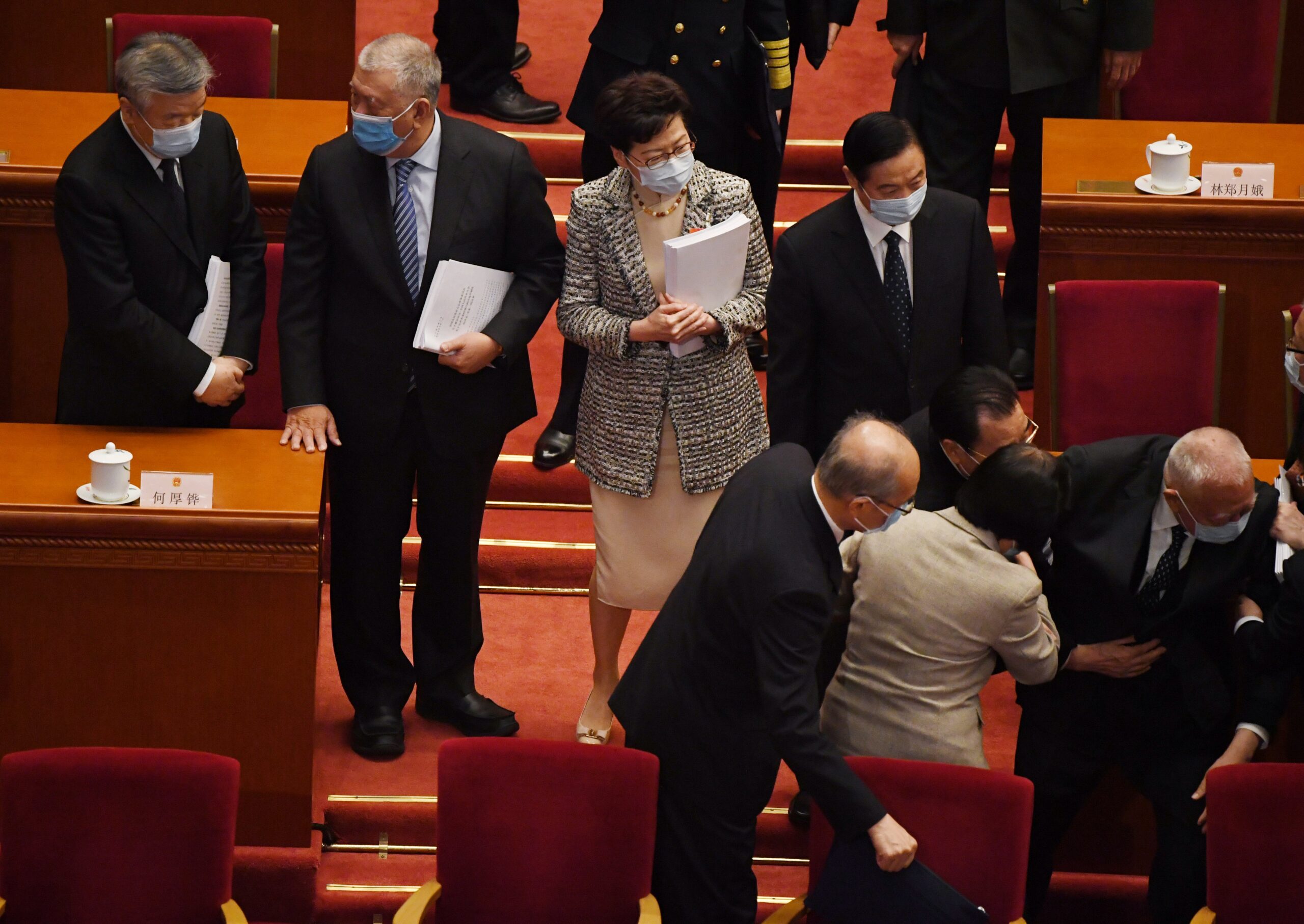
On September 8, 2026, Tung Chee-hwa, the first Chief Executive of the Hong Kong Special Administrative Region and former Vice Chairman of the National Committee of the Chinese People’s Political Consultative Conference (CPPCC), passed away at the age of 89. Tung had a close relationship with the current Chinese Communist Party leader Xi Jinping. Before Xi came to power in November 2012, there was intense power struggle at the top level, and he even mysteriously disappeared at one point, with various versions of the incident circulating, in which Tung Chee-hwa also played a role in providing information.
Tung Chee-hwa was the first Chief Executive of Hong Kong after the handover of sovereignty and also the first former Chief Executive of Hong Kong to pass away. After Tung’s death, there was immediate attention from the public on how the authorities would organize and where they would hold memorial events, as well as whether Xi Jinping would attend.
According to reports from Bloomberg, Tung Chee-hwa had a significant relationship with Xi Jinping. After 1997, Xi, who was the Governor of Fujian at the time, had frequent interactions with then Hong Kong Chief Executive Tung. In 2001, Xi led an economic and trade delegation to Hong Kong and received a high-level reception from Tung. The following year, Xi invited Tung and his wife to a vacation in Fujian. When Xi became the Secretary of the Zhejiang Provincial Committee, in January 2005, he led a delegation from Zhejiang to Hong Kong for activities, and despite Tung being ready to step down, he still hosted Xi at the Government House. Tung resigned from office on March 10, 2005, and later that year, he was appointed as the Vice Chairman of the CPPCC.
Even after Xi became the “heir apparent” of the Chinese Communist Party in 2007, he maintained a private friendship with Tung. In August 2011, when Xi hosted the visiting US Vice President Joe Biden in Beijing, Tung was a key accompanying member. In February 2012, when Xi visited the United States, Tung was one of the members of the delegation.
In early 2012, there was a seismic event within the party involving the then member of the Politburo and Secretary of the Chongqing Municipal Committee, Bo Xilai. Bo’s subordinate, Wang Lijun, entered the US consulate seeking asylum, leading to political turmoil.
On September 1, 2012, Xi Jinping, who was preparing to take over as the CCP leader, attended the opening ceremony of the Autumn Semester at the Central Party School and made a speech, but then disappeared from public view. On the 5th, Xi unusually canceled meetings with US Secretary of State Hillary Clinton, Singaporean Prime Minister Lee Hsien Loong, and a Russian delegation. He also did not meet with the Danish Prime Minister on the 10th. It wasn’t until May 15 of that year that Xi reappeared at an agricultural university event, with no official explanation from the CCP, leading to various speculations.
Regarding Xi’s disappearance, there were multiple insider versions circulating at the time.
The first version was that Xi “survived an assassination attempt”, with reports suggesting that a military officer had attempted to assassinate Xi.
The second version was that Xi was “resting due to a back injury”. The Wall Street Journal reported on September 5, 2012, that Xi Jinping canceled a meeting with Hillary Clinton due to a back injury, but the severity and cause of his injury were unclear.
However, there were two other versions regarding the “back injury”: one being a “back strain from swimming”. Tung Chee-hwa mentioned in an interview with CNN that Xi Jinping had strained his back while swimming.
Tung Chee-hwa confidently responded that Xi had injured himself during exercise but had since recovered and resumed work. When asked “where was injured”, Tung pointed to his own back and said, “back problem.” The host further asked, “how did it happen?” Tung promptly replied, “I believe it was during swimming.”
When asked if Xi Jinping would succeed as the next leader of the CCP, Tung replied, “I have no doubt.”
Tung Chee-hwa also revealed at that time that the then President Hu Jintao would continue to serve as the Chairman of the Central Military Commission for some time after stepping down.
At the time, overseas commentators speculated that Tung Chee-hwa’s disclosure was not mainly about Xi Jinping’s “back injury” but was intended to convey the message through semi-official channels that Hu Jintao would retain the position of Chairman of the Central Military Commission.
However, Hu Jintao did not stay on as Chairman of the Central Military Commission.
There were rumors regarding Xi’s “disappearance” before the 18th National Congress of the CCP, suggesting that he was “injured by a chair” during a meeting of the ‘Red Second Generation’.
Mark Kitto, a Beijing-based reporter for The Washington Post, revealed that there was a “real story” behind Xi Jinping’s disappearance and that “someone having contact with the top echelons of the CCP” disclosed that there was a dispute and violence at an internal meeting of the ‘Red Second Generation’, where a chair was thrown and injured Xi’s back.
Another more common explanation was that Xi had a tantrum due to dissatisfaction with political arrangements at the time. Insider sources mentioned that Xi only found out close to his succession that he was not the ultimate decision-maker, with elders intervening in the arrangements. Xi then refused to go along with the plan, creating a standoff that made the elders anxious. Driven by the shared interest of preserving the party, the elders compromised, placated Xi Jinping, who then reappeared.
The above information couldn’t be independently verified, but during the 18th National Congress of the CCP, then CCP leader Hu Jintao announced to Xi Jinping face-to-face that he had decided to relinquish all his positions and transfer power completely. Xi Jinping praised Hu’s “integrity” and expressed sincere thanks.