
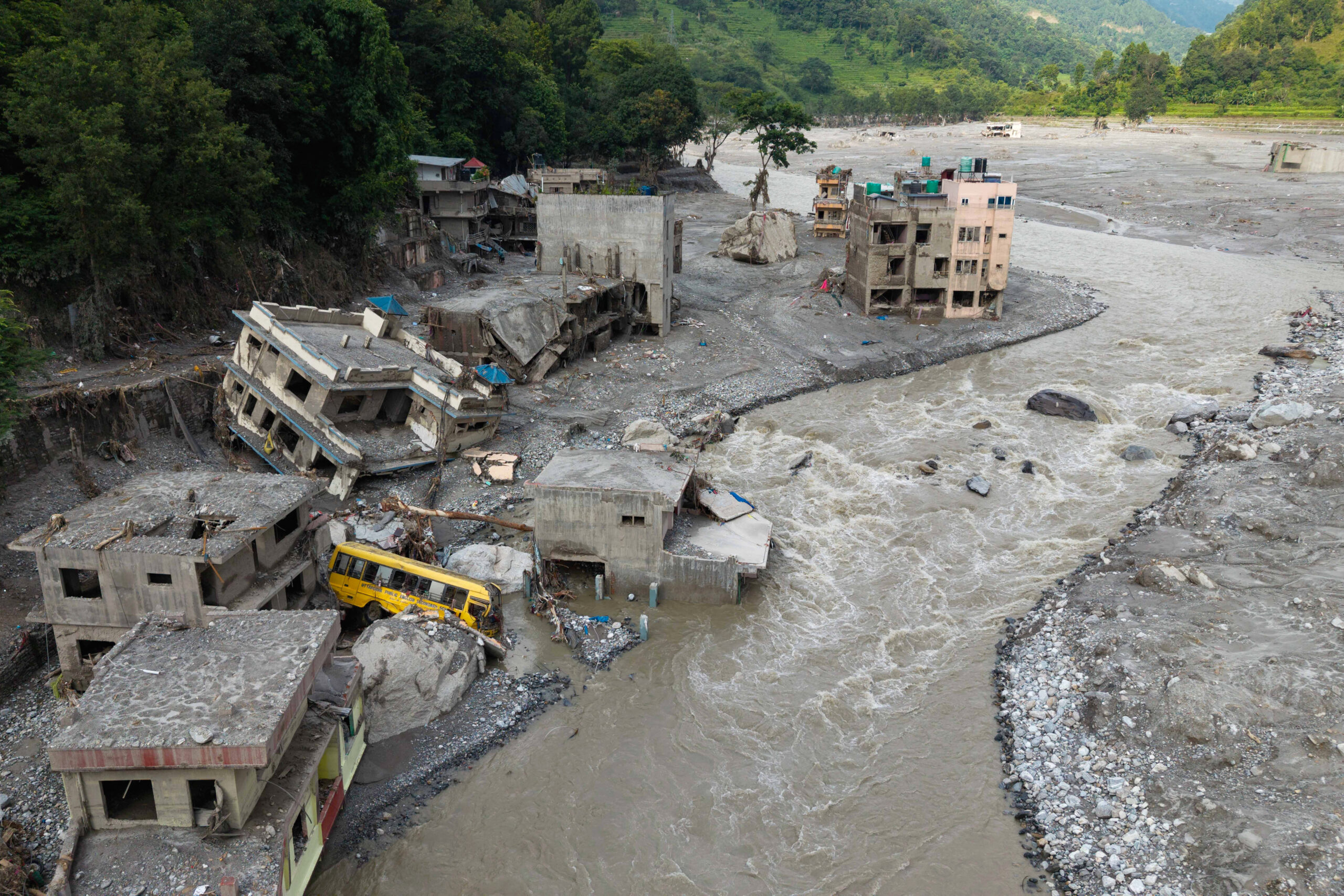
The ongoing impact of the border floods between China and Nepal continues to draw concern from industry experts and analysts. They warn that this disaster may halt trade development efforts between Nepal and China, leading Nepal to rely more heavily on India to the south.
On August 26, floods and mudslides swept through the border areas of Nepal and China, damaging the customs facilities at the Rasuwagadhi border crossing in Nepal and washing away 45 out of 145 kilometers of the road connecting this border crossing to Kathmandu.
On the other side of the border, the Gyirong port in Tibet has been completely destroyed by this disaster, leaving only a landscape covered in rubble, stones, and mud. The five-story customs building is now in ruins, with only remnants of its foundation left. A bridge connecting China and Nepal has also been washed away.
This disaster comes just over a year after cross-border floods in the same region led to 11 fatalities, the destruction of the Nepal-China Friendship Bridge, damage to land ports, and a six-month closure of transit points. These recurring disasters have exposed the vulnerabilities of Nepal’s Himalayan trade route.
According to Nikkei Asia, customs clearance operations in Nepal have been suspended. Surya Raj Acharya, an infrastructure engineer and policy analyst, stated that the intermittent disruptions at the northern China-Nepal transit points will deepen Nepal’s reliance on India.
Acharya told Nikkei Asia, “If the current situation persists, such events and the resulting supply chain uncertainties will undoubtedly make Nepal more dependent on trade with India.”
The massive disaster on August 26 caused significant trade losses for Nepal. Approximately 200 containers were swept away by the floods, with most of the goods ordered for Nepal’s largest Hindu festival in October. Ram Hari Karki, Chairman of the Nepal Trans-Himalayan Border Commerce Association, stated that customs duties have been paid for around 70 containers, each valued between 4 million to 20 million Nepalese Rupees (approximately $26,500 to $133,000). He estimates losses in the industry to be as high as 1 billion Nepalese Rupees.
Karki mentioned that 76 businessmen and their staff are currently missing.
There exists a significant trade imbalance between Nepal and China. According to Nepal’s customs department data, in the fiscal year until mid-July, Nepal imported goods worth 425.24 billion Nepalese Rupees (approximately $2.9 billion) from China, while its exports to China only amounted to 18.9 billion Nepalese Rupees, making imports about 225 times higher than exports. Nepal’s imports from India reached 1.21 trillion Nepalese Rupees, with export total at 258.65 billion Nepalese Rupees, making imports about 4.68 times higher than exports. In fact, some Chinese goods enter Nepal through Indian ports.
Nepal, being a landlocked country with no access to the sea, conducts 65% of its international trade with India. Surrounded by India on three sides, it provides Nepal with a route to sea ports.
Nepal faces tough choices ahead. Rebuilding the existing roads can expedite trade recovery but also make them susceptible to further disasters. Constructing a safer route will require more time and funds.
Acharya emphasized that Nepal should not solely focus on reducing construction costs by choosing to build cross-border roads in valleys prone to disasters. Instead, he suggested utilizing more tunnels and elevated bridges to protect roads from floods and landslides.
According to data from the Kathmandu-based think tank South Asia Watch on Trade, Economics and Environment, in the fiscal year 2025-2026, Nepal imported goods worth around $3 billion from China, with approximately one-fourth entering Nepal through three northern border crossings.
Among these three crossings, Rasuwagadhi is the largest, accounting for 10.7% of Chinese imports to Nepal and serving as the gateway for 47% of exports from Nepal to China.
This trade corridor is crucial for China’s efforts to enhance connectivity with Nepal. China has invested in building a border check post and land port in Timure, Rasuwa, and reconstruction of the Nepal-China Friendship Bridge after it was washed away last year.
Following the closure of Tatopani border post due to the 2015 Nepal earthquake, Rasuwagadhi became the primary trade gateway between Nepal and China, with Tatopani taking four years to reopen. In 2017, China designated Kyirong on the opposite side of Rasuwagadhi as an international port and constructed roads and logistics facilities in Tibet.
The three major trade routes in northern Nepal are currently restricted, with China recently closing the Tatopani border pass without specifying reasons, and Korala port in Mustang, western Nepal, processing only two to three trucks per day.
Attention has now shifted to the Korala port, located at an altitude of about 4,650 meters with limited customs and transport facilities. Karki mentioned that around 176 containers bound for Nepal are stuck in Tibet, valued at about 2 billion Nepalese Rupees. If these goods were to be re-routed via Korala, it would take weeks and increase transportation costs.