
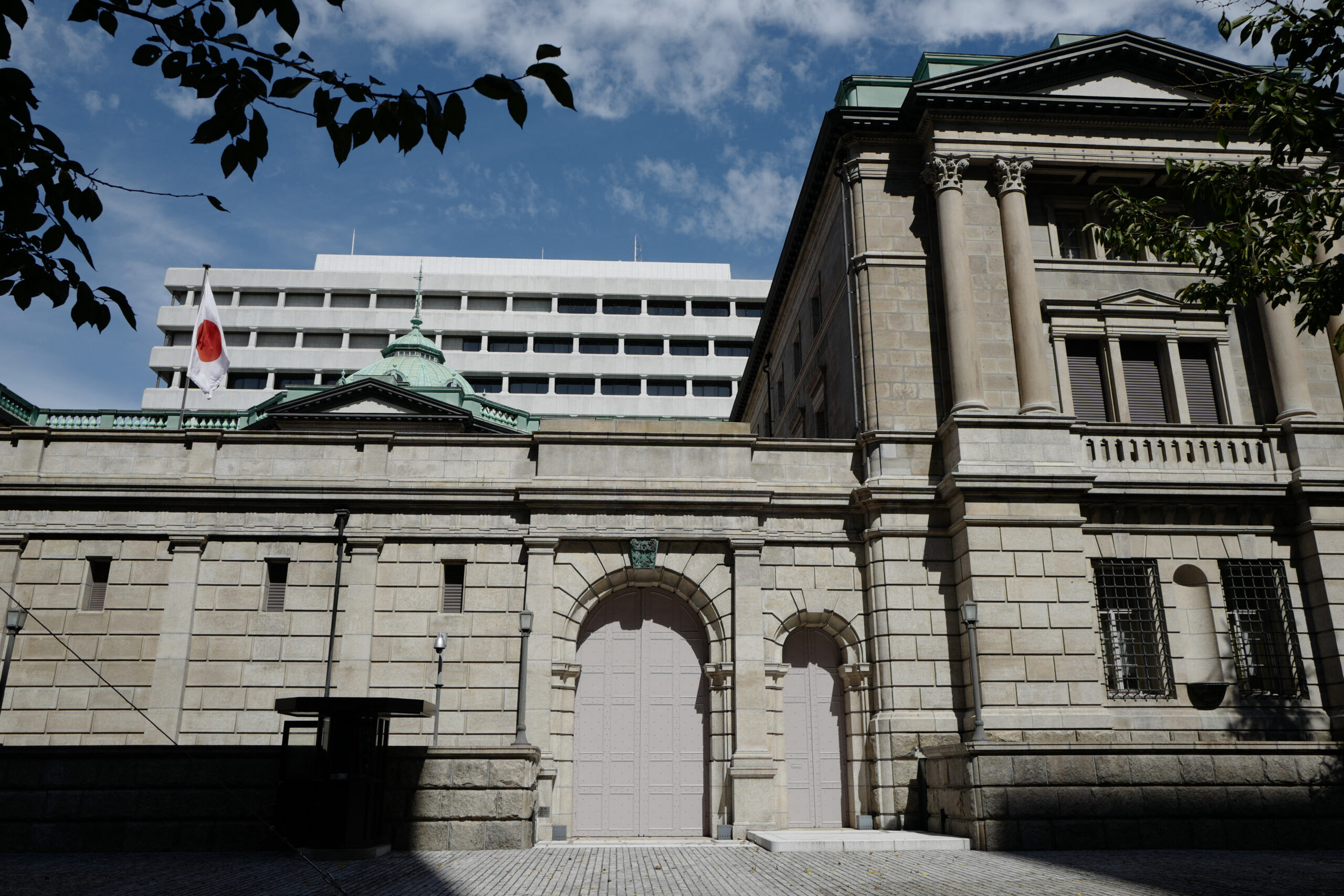
【Epoch Times News, September 8, 2026】As the Bank of Japan is moving closer to raising interest rates in September, the Japanese yen briefly rose to around 152 yen against the US dollar while the 10-year government bond yield also exceeded 3%. With the upward revision of the second-quarter GDP growth rate, consecutive 7-month increase in real wages, and the Bank of Japan officials positioning 2026 as a “new phase of rate hikes,” the market focus is shifting from whether there will be a rate hike in September to how high Japanese interest rates could rise.
Overnight interest rate swaps (OIS) market indicators show that the market pricing probability of the Bank of Japan raising interest rates by 25 basis points to 1.25% at the policy meeting on September 18 has surged from 75% on the 7th to 97% on Tuesday (8th), reaching the highest level since the current tightening cycle began. Driven by expectations of rate hikes, the yen-dollar exchange rate touched the 152 yen per dollar range on Tuesday morning.
Japan’s real GDP in the second quarter grew by 1.4% annually, higher than the initial estimate of 1.1%, marking the third consecutive quarter of growth. The decline in corporate capital expenditure also narrowed from the initial estimate of 1.2% to 0.9%, indicating that the economy has not shown significant signs of slowing down due to tightening financial conditions.
This is in line with comments made by the Bank of Japan Governor, Kazuo Ueda, stating that “real interest rates are still at extremely low levels, and monetary conditions remain loose,” indicating that current economic data does not yet show any clear signs of interest rate hikes significantly dragging down the economy.
In terms of wage increases related to consumption, real wages in Japan grew by 2.4% year-on-year in July, marking the 7th consecutive month of increase and the largest increase since May 2021. The sustained rise in real wages indicates growing support for household purchasing power, providing new grounds for the Bank of Japan to assess whether price increases can be sustained.
Currently, the focus of the market is on whether wage increases can further support consumption and prices, forming a more sustainable “wage-price” cycle.
JPMorgan Securities’ chief Japan economist, Ayako Fujita, stated that the Bank of Japan’s early adjustment of interest rates is gradually becoming inevitable. Takahide Kinoe, chief economist at Nomura Research Institute, also believes that the likelihood of a rate hike to 1.25% in September has significantly increased.
With improving economic and wage data, market focus is gradually shifting from whether there will be a rate hike in September to the future pace of rate hikes.
At a financial and economic forum in Sapporo on September 2, 2026, Bank of Japan Policy Board Member Satoshi Takada stated that Japan’s monetary policy has entered a new phase of rate hikes for the year. In his speech, he designated 2026 as the “3rd phase of monetary policy normalization,” calling it a “policy system shift.” Takada did not provide a specific timetable for rate hikes but emphasized that the Bank of Japan should make decisions flexibly based on economic, price, and financial conditions.
As expectations for a rate hike in September become close to the market consensus, predictions for the terminal interest rate of this round of rate hikes by the Bank of Japan are beginning to diverge.
Kyohei Morita, chief economist at Nomura Securities, expects that the terminal interest rate could reach 1.75% to 2% under the main scenario; Hirokazu Fujishiro, chief economist at Dai-ichi Life Research Institute, has a higher prediction, suggesting that it could ultimately rise to 2.25% to 2.5%. Former Bank of Japan Policy Board Member Hideyuki Ashida expects that even after a rate hike in September, there may be another rate hike in January next year.
While these predictions vary, they are all higher than the current market expectation of 1.25%, indicating that 1.25% may not necessarily be the end point of this round of monetary policy normalization.
According to a Reuters survey in August, 35 economists surveyed expect the Bank of Japan to raise rates to at least 1.5% by the end of March next year, with around 60% expecting it to rise to at least 1.75% by the third quarter of 2027. Among the economists answering the terminal rate question, the proportion choosing 1.75% as the terminal rate has increased from 19% last month to 50%, and the proportion choosing 2% or higher has risen from 23% to 36%.
The normalization of monetary policy is beginning to reflect in the Japanese financial markets.
The yen has appreciated rapidly since September, briefly reaching 152.89 yen per US dollar, hitting a new high in around 7 months. In addition to expectations of a rate hike by the Bank of Japan, short-covering of the yen, Japanese capital inflows, and arbitrage trade closures have further fueled the yen’s appreciation.
The yen’s appreciation helps reduce import costs and inflationary pressures, but if the pace of appreciation is too rapid, it may also affect export companies and economic growth, becoming a factor that the Bank of Japan needs to consider.
According to Reuters, the scale of cross-border yen borrowing reached around 36 trillion yen in March this year. The significant size of yen financing means that if the yen continues to appreciate, arbitrage trade closures may further amplify exchange rate fluctuations.
Japanese Finance Minister Satsuki Katsuyama stated in a press conference on September 8 that there has been no change in the coordinated stance between Japan and the United States on exchange rate policies, and the two countries will continue to maintain exchange market stability through close communication.
The appreciation of the yen is accompanied by the repricing of long-term interest rates in Japan. The yield on the 10-year government bonds rose to 3.015% in early September, hitting a new high since 1996, and then retreated to around 2.9%, indicating that the bond market is readjusting to interest rate normalization.
This means that the impact of the Bank of Japan’s rate hike is no longer limited to short-term interest rates. Rising interest rates will increase government debt financing costs and prompt financial institutions such as banks and insurance companies to reassess long-term asset prices and investment allocations.
If the government continues to pursue expansionary fiscal policies, the contradiction between fiscal needs and the normalization of the Bank of Japan’s currency may further reflect on long bond yields. As long-term yields rise, the Japanese government needs to balance economic growth and fiscal financing, while the Bank of Japan needs to strike a balance between controlling inflation and avoiding too rapid tightening of financial conditions.
The issues that the market needs to pay attention to are now shifting from “whether there will be a rate hike in September” to “where is Japan’s neutral interest rate, and how high can the economy tolerate policy rates.”