
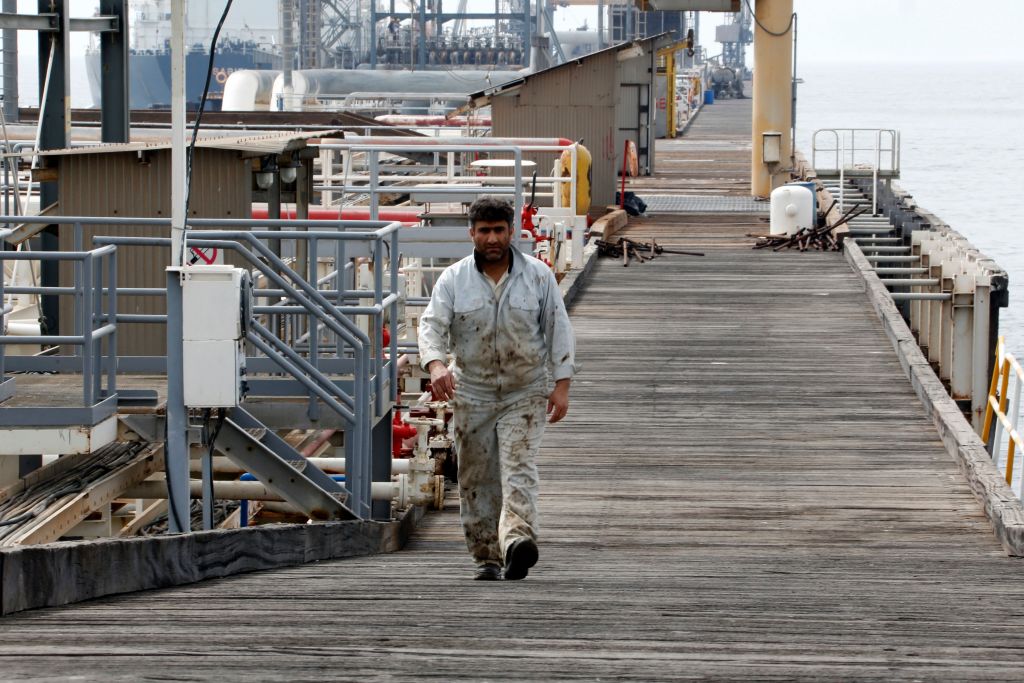
Iranian oil workers held protests on Monday (September 7) on offshore platforms operated by Pars Oil and Gas Company, as well as in the southern energy hub of Assaluyeh, demanding improvements in wages, taxes, and welfare benefits. Meanwhile, the economic pressure from the United States is dealing a heavy blow to Iran’s oil exports and the overall economy.
According to the UK-based “Iran International,” a Telegram channel called “Afkar-e Naft” specifically reports on issues affecting formal employees in the oil industry, stating that the protest activities are part of weekly demonstrations.
Photos released by the channel show workers at various offshore oil facilities holding banners demanding the removal of wage ceilings, full payment of wages and benefits, fair treatment, and reforms to the tax system for offshore personnel.
One banner reads “Full payment of wages and benefits,” while another states “Fair pay is our right, not an extra privilege.”
Other banners call for a complete overhaul of the wage system for oil workers and the elimination of unfair wage payment restrictions.
Some workers also emphasized that oil production continues during times of war, and they are required to work in such environments. One banner reads “Continuous production in war zones,” while another says “Continuous production in border areas.”
Protesters are also demanding the release of compensation funds that have not yet been disbursed.
As these protests erupt, Iran’s economy is facing increasing pressure, partly due to regional conflicts and the reimposition of sea blockades by the United States in mid-July. Satellite imagery reviewed by “Iran International” shows a significant decrease in visible ship activity at Iran’s two major commercial ports – Shahid Rajaee and Imam Khomeini – since the blockade was reinstated.
TankerTrackers.com estimated earlier last week that in the past 28 days, an average of around 5 million barrels of crude oil per day have been shipped out of the Persian Gulf through the Strait of Hormuz, with almost no Iranian crude.
In addition to the sea blockade, the United States has intensified financial pressure on Iran. On August 24, the US Treasury launched “Operation Economic Outcast,” aiming to sever Iran’s remaining financial and commercial connections and increase the risks faced by foreign banks and companies engaging in business with Iran.
Meanwhile, the Iranian currency is rapidly depreciating, and inflation continues to soar. This month, the exchange rate of the Iranian rial against the US dollar hit a historic low, at around 2.2 million rials per US dollar, compared to about 958,000 rials per US dollar a year ago.
Official data released by Iran in July shows an average annual inflation rate of around 62%, with a year-on-year inflation rate of 82%, and a food inflation rate as high as 134%, further intensifying the pressure on wages and the living standards of the public.