
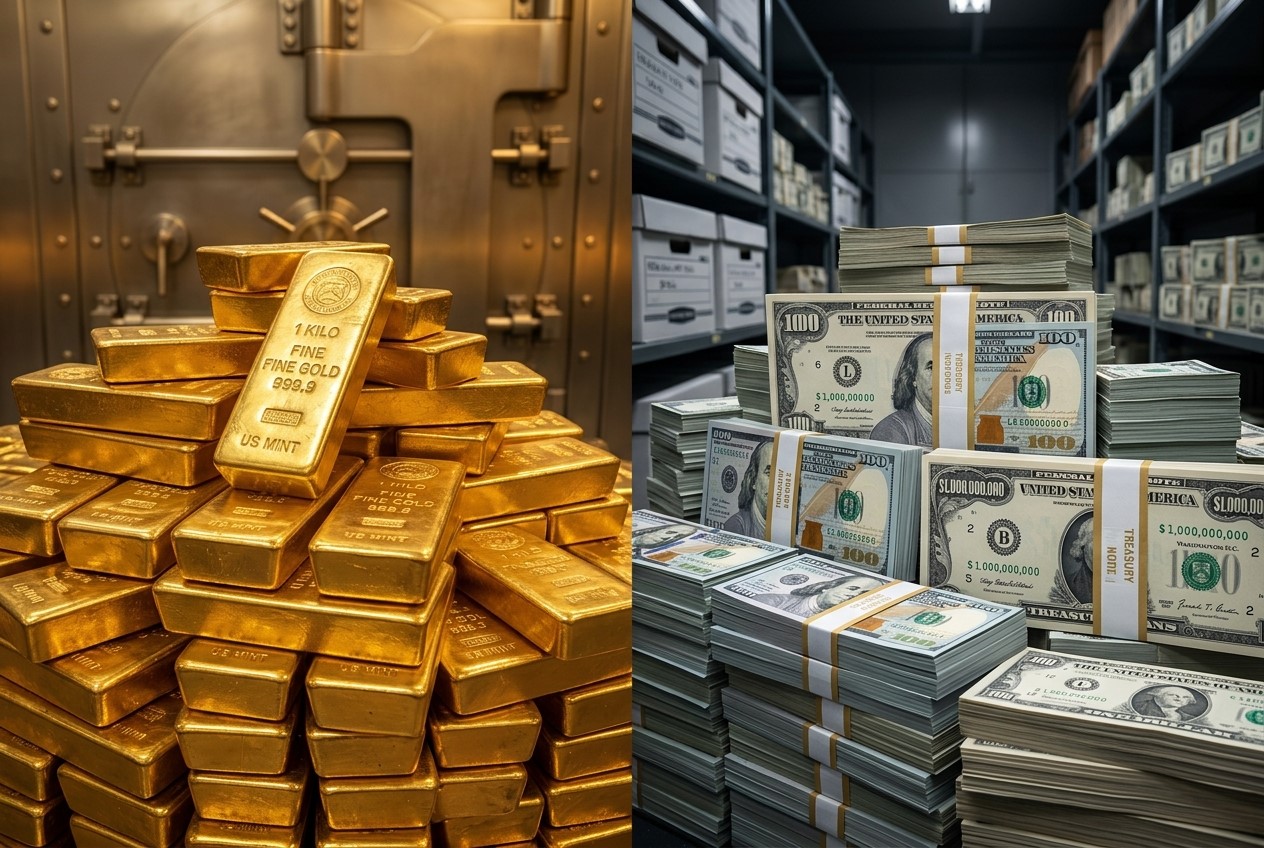
In a report published on Thursday, September 3, by Colin Weiss, the Chief Economist of Global Financial Flows at the Federal Reserve, it was highlighted that in 2025, the total international reserves held in the form of gold surpassed the value of various countries’ official holdings of U.S. Treasury securities. This fact has sparked attention from the media and policymakers. However, it does not necessarily mean that the attractiveness of gold as a reserve asset has surpassed U.S. Treasuries.
Weiss pointed out that the rise in gold prices is mainly being driven by private sector demand, while most official gold reserves are still held by countries that have not purchased gold in over fifty years.
The increase in the market value of gold reserves since 2024 was primarily due to a surge in demand from the private sector, leading to a spike in gold prices, rather than increased support from central banks. The rise in gold prices has also contributed to gold’s higher proportion in countries’ reserves compared to U.S. Treasury securities.
Weiss emphasized that the surge in gold prices does not reflect a simultaneous increase in central bank purchases. Despite a significant increase in central bank gold purchases in 2022, these central banks have only maintained a higher buying pace since then. The real boost to gold prices came from the sharp increase in demand from private sector investors by the end of 2024.
Although the astonishing rise in gold prices in 2025 likely required strong demand from both private and official investors, it is not solely fueled by official investments. The U.S., being the largest holder of gold reserves, significantly affects the global statistics on gold reserves compared to U.S. Treasuries.
As of the end of 2025, global gold reserves amounted to $51 trillion, with or without including the U.S., totaling $40 trillion. However, the surge is primarily attributed to valuation changes rather than a significant increase in central bank holdings over the past 18 months.
By June 2026, despite further increases in gold reserves, the scale of U.S. Treasury securities held by foreign central banks once again exceeded global gold reserves, excluding the U.S. This indicates that U.S. Treasuries have not been replaced by gold when considering the actual structure of official reserve allocation.
Weiss suggested that most central banks’ substantial holdings of gold are not a deliberate or strategic shift from dollar assets to gold but rather a legacy from the Bretton Woods System era.
The Bretton Woods System, established post-World War II (1944-1973), pegged the U.S. dollar to gold at $35 per ounce and other currencies to the dollar, creating a “double peg” system.
Weiss explained that despite the accumulation of gold reserves by many central banks in emerging markets since 2008, most of the global gold reserves were purchased pre-1971 (pre-Bretton Woods System), whereas significant holdings of U.S. Treasury securities by foreign central banks were accumulated post-2000.
He noted that there is a distinction between countries holding significant gold reserves and those holding substantial foreign exchange reserves. In 2026, countries actively choosing between gold and U.S. Treasuries still represent a limited portion of global gold reserves.
The top five countries in gold reserves – the U.S., Germany, Italy, France, and the IMF – account for approximately 52% of global gold reserves. However, since the 1970s, they have hardly increased their gold reserves on a large scale.
Weiss further analyzed that while some major reserve-holding countries like the U.S., Germany, France, and Italy have not significantly increased their forex reserves, gold accounts for over 80% of their international reserves at current market prices. This surge is due to recent increases in gold prices rather than structural shifts.
Apart from the top five holders of gold reserves, U.S. Treasury securities still have a higher proportion in the international reserve portfolios of other countries.
Though the gap between gold and U.S. Treasuries has narrowed due to valuation factors in the past year, as of June 2026, the scale of U.S. Treasury securities held by foreign central banks still exceeds global gold reserves by approximately $1 trillion.
Weiss cautioned that this comparison may overstate or understate the actual gap. Some central bank gold purchases post-2021 may not be reflected in official statistics, and the actual scale of U.S. Treasury securities held by foreign central banks may be higher than levels shown in TIC data due to custody arrangements with non-U.S. entities.
Considering geopolitical factors such as proximity to the U.S. ideologically or concerns about financial sanctions, central banks have been consistently increasing their gold holdings since 2008, with a significant acceleration since 2022. Yet, according to estimates by the World Gold Council, the additional gold purchases by central banks since 2022, excluding the top five gold reserve-holding countries, still lag behind U.S. Treasury securities held by foreign official entities by about $600 billion.
Despite some major forex reserve-holding countries selling billions of reserves to support their currencies post-2021, foreign official investors continued to net purchase nearly $200 billion of U.S. Treasury securities between 2022 and April 2026. Therefore, U.S. Treasuries remain a crucial component of international reserve portfolios.