
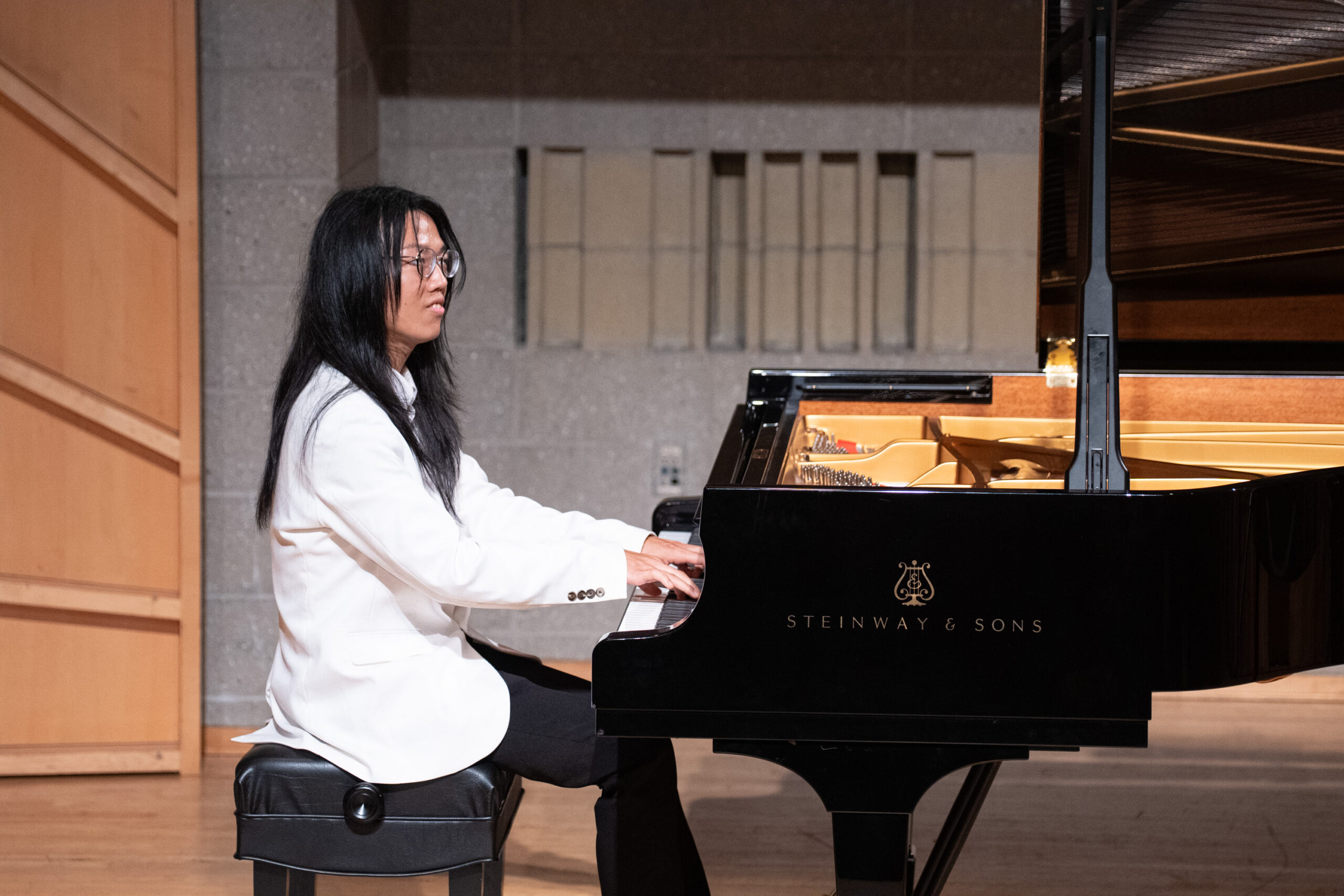
In the “8th NTD International Piano Competition” in New York, Taiwan contestant Francis Lien, who won the bronze award in the previous NTD competition, once again participated and won the bronze award. Competition judge Becky Yao commented that Lien’s piano skills were excellent, labeling him as a talented performer.
For his second competition, Lien revealed that he specifically came to participate for the designated piece “The Call of God.” He found that through learning, studying, and creating this musical piece, his music continuously improved.
Just like other contestants, Lien noticed that “The Call of God” didn’t have many specific instructions on the sheet music, requiring performers to interpret the speed and emotions themselves. He dedicated a substantial amount of time to understand the meaning of the piece and the composer’s intentions.
Lien explained, “For example, at the beginning, I didn’t directly enter like other contestants. You can tell from the quality, thickness, and breadth of the music that the speed here has a sense of ritual, seriousness.” He then delved into researching what kind of ritual it was, studying ancient Chinese rituals, gestures, and movements. “After a very stable first ritual, the subsequent parts gradually ascend. The first four measures are a calm yet intentional display, unveiling the call of God, thus starting the story…”
Continuing his explanation, Lien described how themes and dialogues began to emerge in the piece, visualizing “a woman dancing with ribbons,” counting and twisting, analyzing the movements of classical Chinese dance; meticulously contemplating why the author wrote a specific section in a particular way, resulting in an elegant and leaping interpretation. Some listeners commented on feeling “gentle bubbles” at this part.
“I would rack my brains to ponder over these things, learning the aesthetics of classical dance, their gestures, movements, sheer dedication in experiencing all of these,” Lien said. He recalled a past music teacher’s advice during this process, emphasizing the importance of “valuing the weak beats.”
He elaborated on the significance of weak beats and how focusing on them connects to the next phrase, enhancing the music’s appeal. Lien stressed that this conclusion wasn’t limited to music but extended to observing and experiencing the process, embracing various emotions and desires, ultimately encountering different hurdles. He highlighted the necessity of investing time in these experiences.
Throughout this enriching process, Lien felt a continuous sense of improvement, which naturally led to positive outcomes.
Furthermore, Lien noted that unlike familiar classical pieces with preconceived notions, the designated work was entirely new, offering performers the space to interpret freely. He emphasized guiding the audience and conveying the composer’s intentions, portraying a balanced mixture of imagery and blank spaces, allowing for diverse interpretations like a blank canvas, advocating for a natural and pure state of being.
In his award acceptance speech, Lien expressed gratitude towards the creator of the designated piece, stating, “Learning this piece has been inspirational, and together we succeeded, completing the competition.”
He also expressed deep appreciation towards the organizers of the NTD Piano Competition, acknowledging the event as a platform to share positive energy and the principles of “Truthfulness, Compassion, Tolerance.” He highlighted the importance of avoiding excessive self-criticism, striving for a spontaneous and selfless attitude while actively engaging in sharing experiences and exchanging ideas with fellow musicians instead of solely focusing on outperforming others.
Like many contestants, Lien formed friendships with numerous music colleagues during the competition, including a newfound friendship with the gold award winner, Vitalii Khairutdinov. From a previous encounter where Vitalii secured the first place and Lien took the second place, a mere acknowledgment turned into a friendship during the NTD competition, providing him with valuable learning experiences from his peers.
Lien shared, “After the semi-finals, I gained inspiration from them, determining how I would perform in the finals to improve on certain aspects.” He stressed the continuous room for growth and his eagerness to adopt elements from others’ performances to refine his own.
In conclusion, Lien emphasized the perpetual journey of improvement and the invaluable lessons learned through shared experiences, expressing a commitment to further enhance his musical interpretations through collaborative inspiration.