
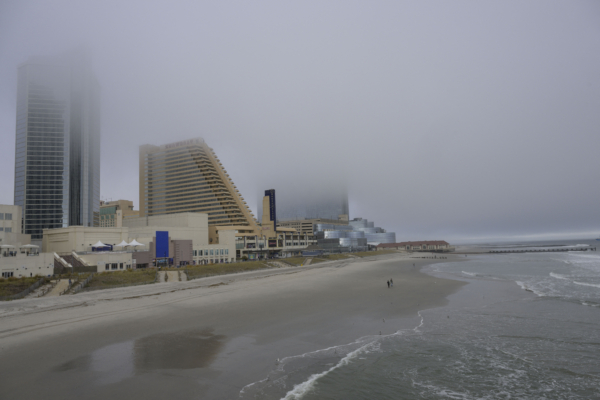
Amid global climate change and rising sea levels, the hundreds of miles of coastline in New Jersey are facing severe survival challenges. According to the latest research data compiled by the National Oceanic and Atmospheric Administration (NOAA) and Rutgers University, many coastal communities, roads, and bridges in New Jersey are projected to experience daily flooding during high tides, and some islands may even be completely submerged by the year 2100.
New Jersey is one of the regions with the fastest sea level rise along the Atlantic coast in the United States. The main reasons behind this phenomenon are sea level rise caused by climate change-induced thermal expansion of seawater and glacier melting, coupled with local land subsidence.
Jonathan DeLura, a senior researcher at the Rutgers University’s School of Planning and Public Policy, warned that even without the impact of superstorms or intense cyclones causing storm surges, within the next 25 years, many coastal roads and bridges will experience regular flooding during high tides, significantly affecting transportation and residents’ movements.
By 2050, if sea levels rise as expected by 2 feet, Ocean County alone will see about 70 miles of roads inundated by seawater during high tides, while Cape May County will have over 53 miles of affected roads.
NOAA data indicates that Atlantic City’s current rate of sea level rise is approximately 1.7 feet per century (0.17 inches per year), and this rate is accelerating.
Researchers have presented impact forecasts for different sea level rise scenarios by the year 2100:
1. 2.5 feet rise (moderate estimate): Most back bay areas in Cape May, Cape May Point, Wildwood, Stone Harbor, and Avalon will be inundated during daily high tides. Portions of Brigantine’s north end and Long Beach Island (LBI) are also in jeopardy, with potential impacts extending to Raritan Bay and the Hudson River coastline.
2. 7 to 7.5 feet rise (extreme estimate): Ocean County could see up to 404 miles of roads submerged, while Cape May County could face 216 miles of submerged roads. Cape May County may even experience over 19 miles of hurricane evacuation routes paralyzed due to flooding.
Faced with extreme climate threats, officials from New Jersey coastal towns have unequivocally stated that they will not choose to abandon their homes and retreat inland, but instead actively raise funds to establish defense systems.
Since Hurricane Sandy in 2012, Atlantic City has invested over $300 million in infrastructure improvements. The city government has rebuilt a $70 million northern seawall, replaced bulkheads in the back bays, and added three large pumping stations.
Meanwhile, New Jersey State has enacted regulations requiring new construction and major renovations to exceed current flood protection standards by 4 feet.
Mayor Zach Mullock of Cape May noted that due to disruption caused by the Cape May Canal and jetties to natural sand drift, the local coastline has faced prolonged erosion, necessitating substantial investments in regular sand replenishment. Cape May has received $24.3 million in funding from the Federal Emergency Management Agency (FEMA) for expanding seawalls and replacing outdated drainage pipelines.
Despite the concerted efforts of local governments in flood mitigation projects, the latest reports from the United Nations and NOAA highlight that global warming has surpassed critical tipping points, forcing policy responses to shift from “prevention” to “damage control”.
Brian Kempf, a planner in Atlantic City, emphasized that climate change will not only manifest in the form of singular devastating storms, but more commonly as “rainwater pipes unable to drain standing water,” “perpetually damp basements,” and “streets impassable due to high tides”.
“We must abandon the mechanical thinking of ‘spend to repair after the storm or simply move,'” Kempf stated, “To coexist with the new normal of rising sea levels, we need a candid and comprehensive reassessment of our daily lifestyles and urban development strategies.”