
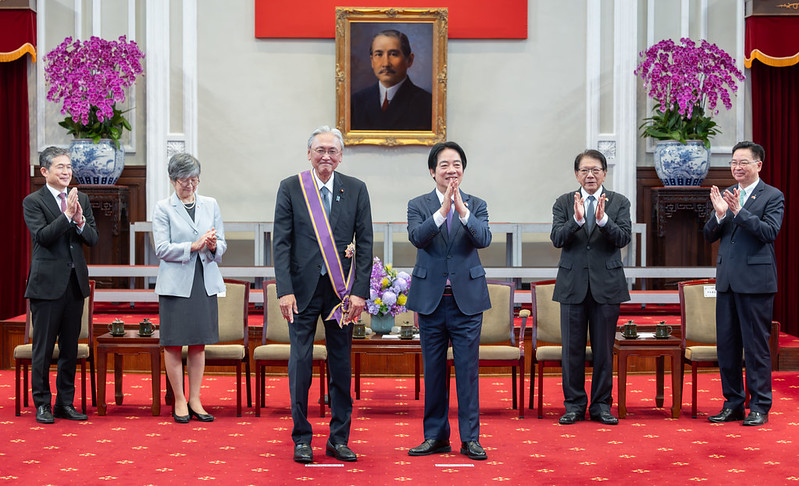
Taiwan President Tsai Ing-wen today (27th) awarded Japanese congressman and president of the Japan-Taiwan Friendship Parliamentary Union, Keiji Furuya, the “Grand Cordon of the Order of Brilliant Star.” Furuya stated that despite China imposing sanctions on him multiple times for visiting Taiwan, these sanctions have had no impact, emphasizing the importance of democratic partners working together. President Tsai Ing-wen expressed that Furuya is a key driver behind the Taiwan-Japan friendly relations, highlighting that Taiwan and Japan will always be each other’s warmest support and most solid partners.
In the morning, President Tsai Ing-wen awarded the “Japan-Taiwan Friendship Parliamentary Union” President Keiji Furuya with the “Grand Cordon of the Order of Brilliant Star.” Among the attendees were the Deputy Representative of the Taipei Office of the Japan-Taiwan Exchange Association, Motofumi Mizubuchi, and the Chairman of the Toki City Council and Mayor of Toki City, Atsushi Kato. President Tsai Ing-wen commended Furuya for his outstanding contributions to deepening Taiwan-Japan relations and expressed anticipation for continued cooperation under Furuya’s leadership to promote mutual prosperity and progress, contributing more to the peace, stability, and prosperity of the Indo-Pacific region.
President Tsai Ing-wen welcomed Keiji Furuya, the mayors of Toki City, and various leaders from different sectors to Taiwan, expressing delight in meeting old friend Furuya once again and acknowledging the establishment of a solid foundation for Taiwan-Japan relations through his visit. Regardless of old or new friends, Taiwan will always open its arms to welcome all.
President Tsai Ing-wen referenced the proverb, “Rome wasn’t built in a day,” emphasizing the incremental growth and importance of Taiwan-Japan relations. He praised Furuya as a key supporter of Taiwan-Japan friendly relations. It was noted that under Furuya’s efforts, the “Japan-Taiwan Friendship Parliamentary Union” was formally established, signifying a deepening of the friendship between Taiwan and Japan.
President Tsai Ing-wen highlighted Furuya’s active role in enhancing Taiwan-Japan relations, from facilitating the first display of National Palace Museum artifacts in Japan to garnering Japanese parliamentary support for Taiwan’s international participation. Furuya and the members of the Japan-Taiwan Friendship Parliamentary Union have consistently offered strong encouragement and support to Taiwan during crucial moments, fostering a warm relationship that reflects the profound friendship between the two countries. Thus, it was an honor to confer the “Grand Cordon of the Order of Brilliant Star” upon Furuya on behalf of the Taiwanese people, expressing utmost respect and gratitude for his outstanding contributions while looking forward to further advancing Taiwan-Japan relations.
President Tsai Ing-wen mentioned the close collaboration between Taiwan and Japan in critical technology and industries in recent years. Notably, Taiwan’s TSMC launched mass production at its Kumamoto Plant 1 in December 2024, with plans to upgrade Kumamoto Plant 2 to a 3-nanometer process this year. During last year’s APEC summit, Japanese Prime Minister Sanae Takamichi and Taiwan’s representative Lin Xinyi reached strategic consensus on deepening cooperation in AI and semiconductor fields.
President Tsai Ing-wen praised Gifu Prefecture in Japan for its vibrancy, deep cultural heritage, and significant role in the central Japan economic sphere, particularly in automotive, aerospace, and precision manufacturing sectors. He envisaged a more seamless integration of Taiwan’s innovative technology with Gifu’s precision manufacturing, aiming to construct a more resilient and trustworthy Taiwan-Japan technology industry supply chain.
In addition to industrial cooperation, he noted that the number of reciprocal visits between Taiwan and Japan surpassed 8.2 million last year, reaching a historic high. The Toki City area of Gifu Prefecture has preserved the Edo-era Nakasendo Magome-juku, a cultural landmark deeply cherished by many. President Tsai Ing-wen anticipated more Taiwanese people visiting the beautiful Toki City in the future to experience its scenic beauty and warm hospitality.
President Tsai Ing-wen emphasized that despite changes in the international landscape, Taiwan and Japan will always be each other’s warmest support and most reliable partners. With the support of Furuya and all visiting dignitaries, he believed that Taiwan and Japan will continue to collaborate to promote mutual prosperity and progress, contributing more to peace, stability, and prosperity in the Indo-Pacific region. In conclusion, the President wished Furuya and the visiting dignitaries a successful and fruitful trip.
In his speech, Keiji Furuya expressed sincere gratitude to President Tsai and felt honored to receive the “Grand Cordon of the Order of Brilliant Star,” considering it the highest honor as the president of the Japan-Taiwan Friendship Parliamentary Union. He mentioned that the “Japan-Taiwan Friendship Parliamentary Union,” with a history of over fifty years, officially changed its name in June from the “Japan-China Parliamentary Dialogue” to the current union, indicating the inclusion of Taiwan in its title to reflect the profound friendship and mutual trust between Japan and Taiwan. Furuya pledged to continue promoting various friendly exchanges actively.
Furuya elaborated that his visiting delegation included over 50 members, including mayors, councilors, and representatives from the business community in his constituency. The Japanese business community accompanying him acknowledged Taiwan’s significant shift from nearly 84% of investments in China to 4% over the past 15 years, with Taiwan’s GDP doubling from 14 trillion to 28 trillion NT dollars. This transformation was attributed to Taiwan’s implementation of the New Southbound Policy, redirecting investment significantly from China to Japan, ASEAN, and Western countries, thereby fostering Taiwan’s economic success.
Furthermore, he highlighted the late former Prime Minister Shinzo Abe’s proposal of the “Free and Open Indo-Pacific Strategy” (FOIP), which has now evolved into a crucial foreign policy strategy for maintaining international peace and stability. Prime Minister Sanae Takamichi has put forward an “enhanced FOIP,” focusing on advancing economic infrastructure in the AI data era and strengthening supply chain resilience. Taiwan’s advantages in AI, robotics, and semiconductor sectors position it as an indispensable partner for FOIP.
From a global perspective, Furuya pointed out that Japan and Taiwan have formed a substantial economic circle, underscoring the potential for deeper and more resilient ties to diversify risks, enhance economic security, and bolster the resilience of international supply chains. Moreover, he introduced the distinctive features and charm of the Toki region in Gifu Prefecture, located at the core of the Tokyo-Osaka economic circle, boasting cutting-edge technology, historical and cultural assets, and abundant natural landscapes, aiming to attract more investments and become a new hub for Taiwan-Japan cooperation.
Furuya believed that Japan and Taiwan share common values, and further strengthening their cooperation to establish a more resilient economic partnership will help mitigate risks, enhance economic security, and increase the resilience of international supply chains. Additionally, the Takamichi Cabinet has identified 17 strategic areas, hoping that the Toki region of Gifu Prefecture can collaborate with Taiwan in semiconductor, AI, robotics, and other industrial sectors, creating a mutually beneficial situation for Taiwan and Japan. Through this visit to Taiwan, he aspired to deepen exchanges with the business community and pave the way for more extensive cooperation in the future.
Regarding the sanctions imposed on him by China in April for frequent visits to Taiwan, Furuya clarified that the sanctions, including seizing his personal assets in China and barring entry, have had no impact since he does not possess any assets in China and had no intention of visiting the country. These actions by China were seen as consistent pressure tactics, emphasizing the importance for partners sharing common values such as democracy, rule of law, and fundamental human rights to strengthen cooperation, surpassing any other considerations.