
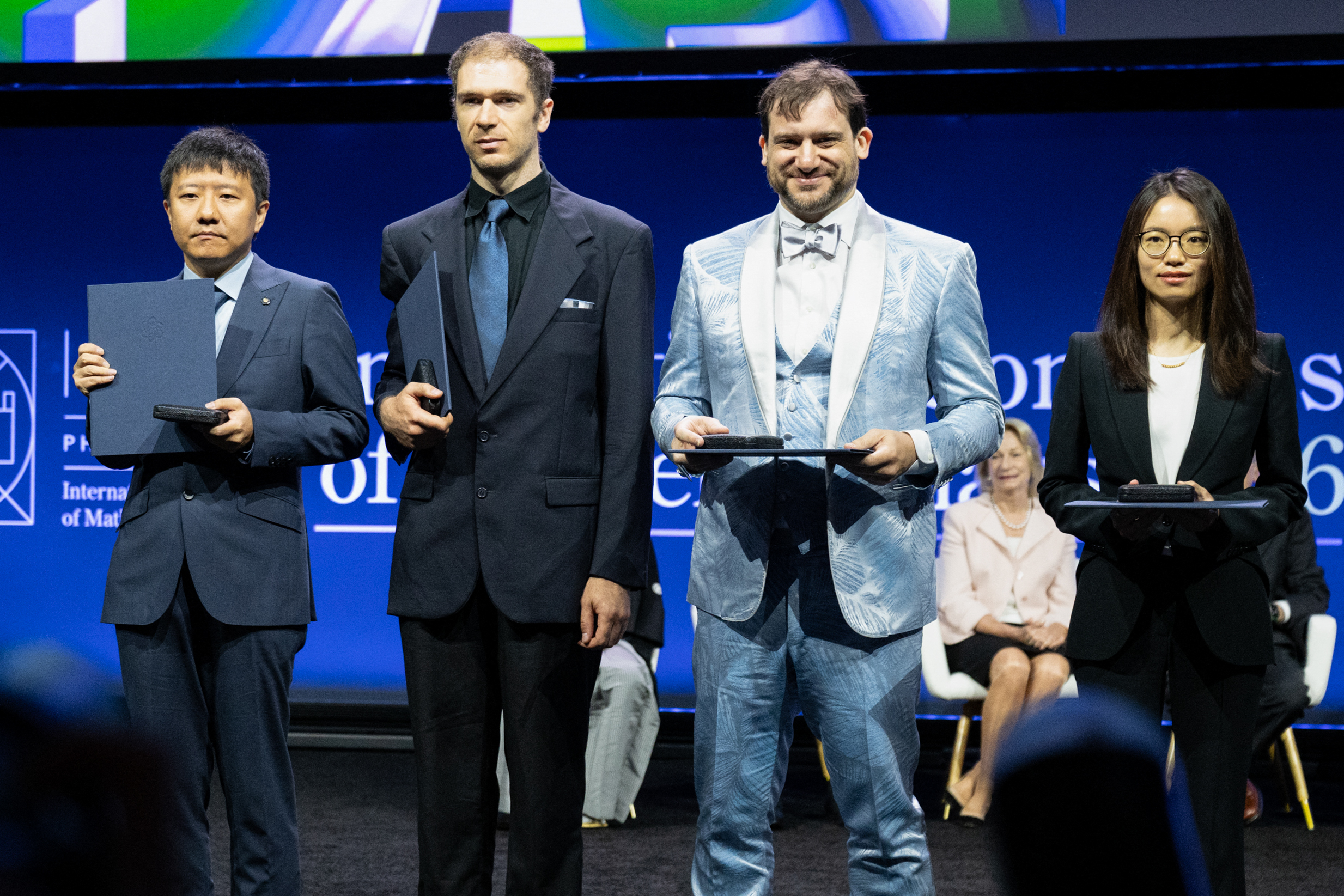
In a recent development, Chinese scholars Wang Hong and Deng Yu, who teach in Europe and America, were awarded the Fields Medal, the highest honor in the field of mathematics, on July 23 in Philadelphia, Pennsylvania, USA. This prestigious award, also known as the “Nobel Prize of Mathematics,” marked a historic moment as it was the first time two Chinese nationals, young mathematicians Wang Hong and Deng Yu, received this accolade.
Upon the news reaching China, the domestic media quickly embraced Wang Hong and Deng Yu’s achievements as a victory for the system and the nation. Headlines across major media outlets were adorned with bold red characters proclaiming phrases like “milestone in Chinese mathematics history” and “top talent cultivated domestically.” Beijing University even issued a congratulatory statement after their win, seeking to bask in the glory their success brought.
Public records indicate that Wang Hong and Deng Yu were classmates in the Mathematics Science School at Peking University, graduating in the year 2007. Wang Hong, born in Guilin, Guangxi in 1991, displayed a talent for mathematics from a young age. Despite graduating from Peking University, she furthered her studies abroad, obtaining a master’s degree from Paris-Saclay University and a Ph.D. from the Massachusetts Institute of Technology (MIT).
Deng Yu, born in China in 1989, also graduated from Peking University’s Mathematics Science School, winning a gold medal in the International Mathematical Olympiad in 2006. After earning his Ph.D., he pursued a career in the United States, currently serving as a professor at the University of Chicago.
During the award ceremony in Philadelphia, Wang Hong’s affiliation with Peking University was noticeably absent from the introduction, emphasizing her current positions at prestigious institutions like the Institute des Hautes Études Scientifiques in France and Deng Yu’s affiliation with the University of Chicago. This omission underscored the pivotal role played by the Western academic environment in nurturing their remarkable achievements, rather than their education in Chinese universities.
Following the announcement of their awards, French President Macron personally called Wang Hong to express gratitude for her outstanding contributions to science. The U.S. Embassy in China also issued a statement acknowledging the global appeal and collaboration opportunities provided by American universities and research institutions for top-tier talents.
Despite the public adulation in mainland China for the Chinese scholars’ achievements, Wang Hong’s remarks regarding her time at Peking University have cast a shadow over the renowned institution. She expressed mixed feelings about her alma mater, implying struggles and emphasizing that merely surviving there was an accomplishment.
In analyzing Wang Hong’s and Deng Yu’s trajectories, it becomes apparent that their exceptional accomplishments were fostered by the academic freedom and support offered in Western countries, rather than the restrictive academic environment in China. This revelation has led to introspection within the Chinese academic community and raised questions about the efficacy of talent cultivation within the Chinese education system.
In conclusion, the disparity between the selection and development of talents highlighted by these scholars’ experiences underscores the challenges faced in nurturing intellectual potential within China. While China excels in identifying high IQ individuals, the ability to provide a conducive environment for their flourishing remains a considerable challenge. True respect for talent lies in creating an environment where individuals can thrive based on their abilities, rather than the institutions they represent. Failure to heed this lesson may lead to inevitable setbacks in the future.