
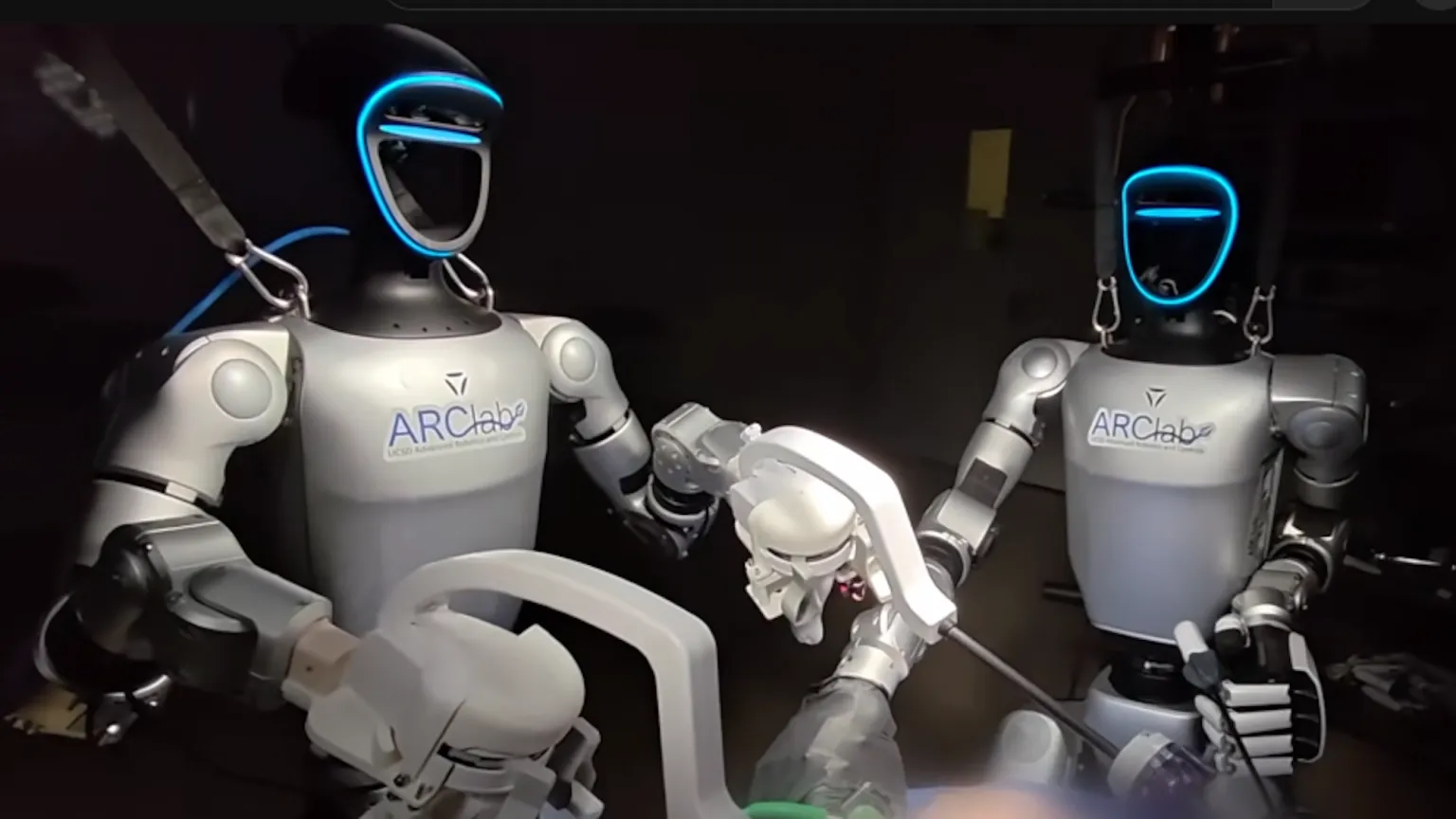
In a groundbreaking medical achievement, doctors have successfully utilized remotely operated humanoid robots to perform two different surgeries simultaneously. This proof-of-concept preclinical trial was conducted on large non-primate mammals for gallbladder removal surgeries. One surgery was carried out by a humanoid robot in collaboration with a human assistant, while the other surgery was entirely performed by two robots working together.
The use of robot-assisted surgeries has become common in many medical facilities, saving countless lives. However, existing systems have limitations. Many multi-armed robotic surgery systems are large, weighing over 1,800 pounds (approximately 816 kilograms), requiring a specialized team for installation, and often necessitating dedicated operating room modifications for use. Additionally, these devices are typically designed for specific types of surgeries.
In contrast, humanoid surgical robots, as their name suggests, have a human-like appearance. The surgical robot, nicknamed “Surgie,” stands approximately 5 feet tall (about 1.52 meters), weighs only 60 pounds (around 27 kilograms), is smaller in size, more flexible, easily customizable, and cost-effective. With advancements in related technologies and adequate training, a team of multiple “Surgie” robots in the future could be deployed to regions with scarce medical resources to assist in providing critical surgical services.
Engineering professor Michael Yip from the University of California, San Diego, stated in a release, “Remote-controlled and autonomously operating humanoid robots indeed have the potential to significantly increase patients’ access to crucial surgeries, enabling those who may not have otherwise received treatment to undergo surgery. This not only aids in alleviating the medical crisis in the United States but also improves the issue of inadequate global medical resources.”
Yip and the research team recently published the study’s results in the international journal Nature, detailing this groundbreaking preclinical trial. While the operators needed to design dedicated adapters for each robot to grasp surgical instruments, they found that remotely controlling the robots’ operations felt unexpectedly natural and smooth.
Dr. Nikita Thareja, a surgeon at the University of California, San Diego, expressed surprise at how well Surgie coordinated with their surgical workspace and operational processes. Another surgeon and co-author of the study, Shanglei Liu, added, “Its cost is much lower than traditional surgical robots, occupies significantly less space in the operating room, making it easy to deploy in various environments, whether remote areas, battlefields, or even space, with great potential applications.”
However, the process of using remote-controlled humanoid robots for surgery did encounter some initial challenges. For example, Surgie required multiple recalibrations, leading to longer overall surgery times compared to existing robotic surgery systems. Additionally, improvements are needed to address signal latency between the operator control end and the robots.
Nevertheless, researchers are confident in the development prospects of this technology and draw parallels with the evolution of robotic laparoscopic surgery. The first robotic laparoscopic surgery took a lengthy 6 hours, while similar surgeries performed with robots today typically require only about 30 minutes.
Moreover, Surgie’s applications are not limited to performing surgeries directly. The research team envisions future humanoid robots serving as surgical assistants in the operating room, assisting in delivering surgical instruments or conducting cleanup tasks post-operation.
Yip stated, “One of our goals is to develop autonomous surgical assistants. Surgical teams in many areas have long faced shortages of personnel, resulting in many patients not receiving timely treatment. We hope to build operating rooms of the future where humanoid robots can work alongside healthcare personnel as a highly integrated medical team.”