
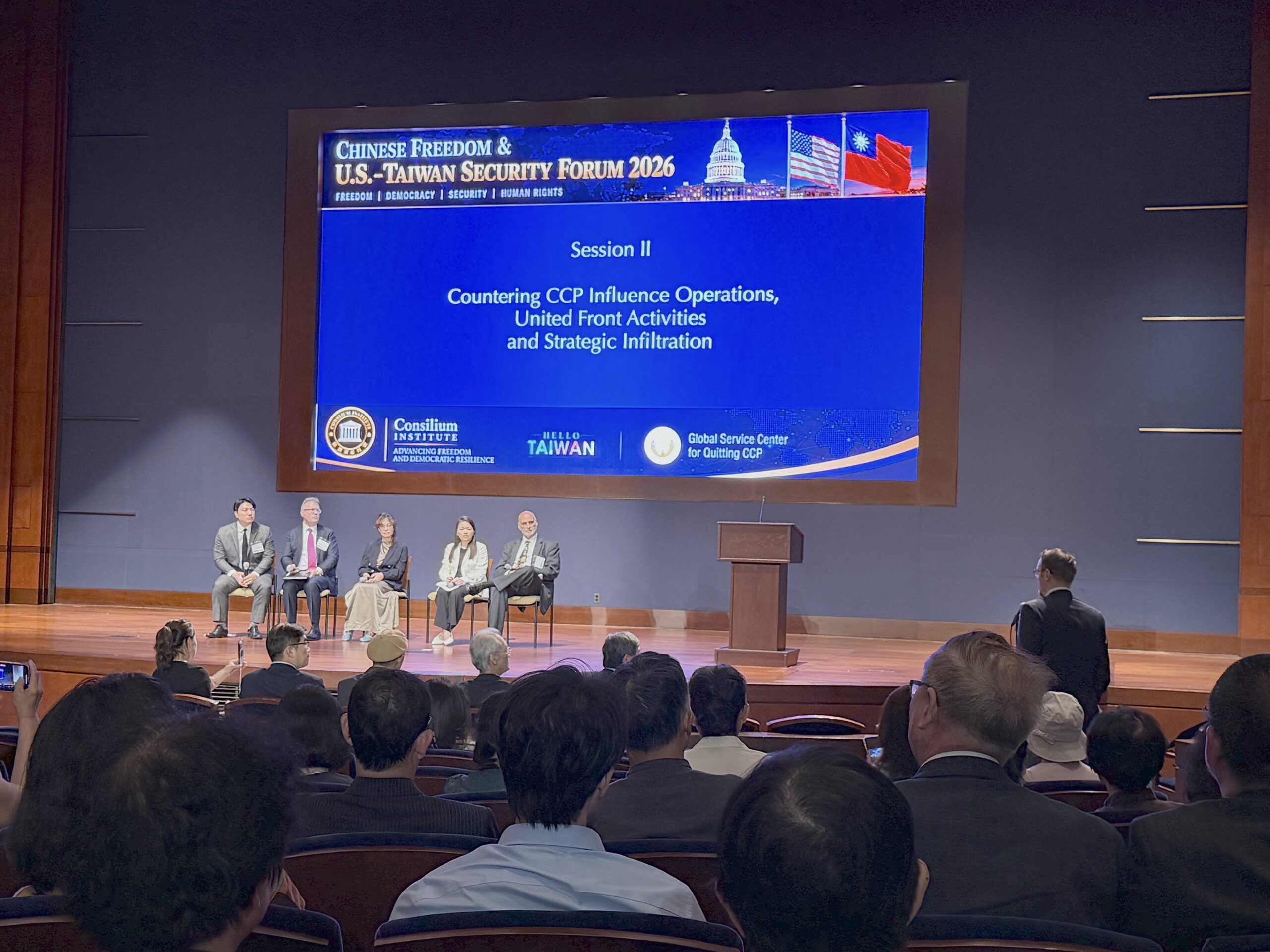
On July 21, 2026, the “Chinese Freedom US-Taiwan Security Forum” organized by the Consilium Institute and Hello Taiwan was held at the U.S. Congress. The focus of the second forum was on countering authoritarian influence operations, CCP united front tactics, and strategic infiltration.
The forum featured guests such as former intelligence official Nicholas Eftimiades, American political scientist and national security expert Dr. Bradley A. Thayer, Dr. Yu-Hsi Liu, a scholar in Taiwan media economics and international political economics, and Cheryl Yu, a researcher at the Jamestown Foundation.
During the forum discussions, Dr. Yu-Hsi Liu and Cheryl Yu introduced their research topics, highlighting how the CCP infiltrates Taiwanese and American communities to exert its influence.
Dr. Yu-Hsi Liu, an associate professor at Shih Hsin University in Taiwan, explained how the CCP uses religious sentiments in Taiwan, like with the “Mazu Temple,” to sway Taiwanese voters and manipulate Taiwan’s elections. She also emphasized the negative impact of TikTok’s short videos on Taiwanese society, especially on the youth.
Cheryl Yu from the Jamestown Foundation shed light on CCP’s infiltration in the United States. She mentioned how the CCP establishes various community organizations, conducts activities to influence the public, and manipulates these groups to work for CCP’s interests.
She pointed out that the CCP targets different groups in different eras. For example, during Deng Xiaoping’s era, the focus was on the elite Chinese community, while during Jiang Zemin’s era, the emphasis shifted to Chinese tech students and scholars to build networks and influence.
Cheryl Yu highlighted the importance of recognizing Taiwan on multiple fronts: its role in global industries like semiconductor chips, its strategic position in the first island chain, and its successful transition from authoritarianism to democracy.
Dr. Bradley A. Thayer emphasized that CCP’s political warfare tactics stem from Bolshevik ideology, aiming to weaken societal power centers through united front strategies, infiltration, and front organizations to achieve political goals.
He stressed the need for countries to understand communism and CCP regime’s nature fully and adopt proactive strategies to expose its origins, illegitimacy, corruption, including publicizing CCP leaders’ hidden wealth.
Thayer also underscored the importance of international recognition of Taiwan’s significance, given CCP’s escalating military and political pressure on the island. He called for deeper U.S.-Taiwan relations to counter CCP’s political strategies collectively.
Nicholas Eftimiades, another forum participant, described CCP’s political warfare as a long-term strategy centered around intelligence, mobilizing societal forces through espionage, business influence, technology acquisition, information manipulation, and psychological operations to maintain power, expand national strength, and weaken opponents.
Eftimiades highlighted the need for the U.S. to counter CCP’s political warfare more assertively by leveraging military, economic, and diplomatic advantages and adopting more deterrent measures while advocating for establishing long-term cross-government strategies to maintain policy continuity.
Participants in the Q&A session suggested improving education and awareness to expose CCP’s united front organizations and operations effectively. They emphasized the importance of legal awareness among U.S. nonprofit organizations and student groups to mitigate CCP’s influence, citing potential violations of U.S. laws.
Tom McDevitt, the chairman of The Washington Times, advocated for learning from Cold War experiences to strengthen ideological resistance against CCP by mobilizing media, businesses, civil society, and religious groups for comprehensive societal engagement. He highlighted The Washington Times’ special issue focusing on Taiwan’s importance to continue in-depth coverage.
Dr. Thayer emphasized the need for the U.S. to leverage its core values of individual freedom and rule of law against CCP’s communist ideology. Another question raised was how to identify CCP’s infiltration in the U.S., including its media and influence operations in various sectors, calling for enhanced investigation and research.
Eftimiades suggested that the U.S. should treat actions like tire slashing, intimidation, bomb threats targeting dissidents or specific groups as terrorism under related laws, urging swift law enforcement and judicial actions to create a deterrent effect. He emphasized the importance of government-victim cooperation to collect evidence, push cases through the judicial system to establish a more robust response mechanism.