
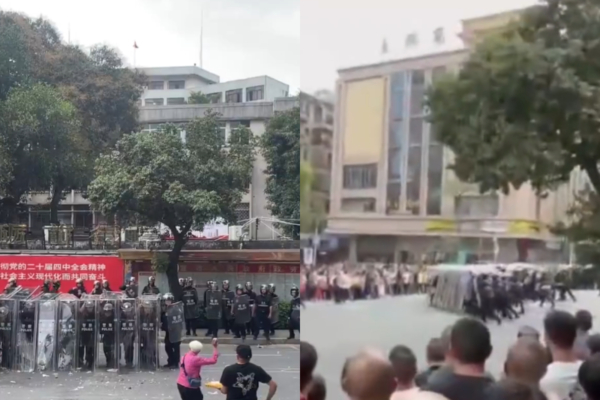
In a recent incident in Wangyong Village, Shuikou Town, Xinyi, Guangdong, villagers protested against the authorities’ construction of a crematorium near the village and school, leading to a fierce clash with the police. One elderly man, with white hair, fearlessly confronted the riot police by throwing rocks and eggs at them. The scene was shared widely on social media, shaking the entire online community.
The on-site video footage showed a large group of riot police with shields and batons lining up in front of the municipal government building, facing off against the villagers. An elderly man with white hair stepped forward in the crowd, repeatedly picking up eggs and rocks to throw at the riot police.
Subsequently, the riot police violently dispersed the villagers, leading to a heated confrontation. Several people were detained on the spot, while others were beaten by the riot police, resulting in multiple injuries and bleeding.
Following the incident, roads leading to the Xinyi municipal government and nearby villages were completely blocked. According to reports from several local businesses to Hong Kong’s Ming Pao, on March 20, there were no crowds near the government building, and roads were still blocked several hundred meters across the intersection opposite the government gate.
A villager from Wusheng Village working in Shenzhen, known as Xiao Li, revealed that starting from the 18th, authorities dispatched 10 police cars to patrol the village entrance every day, prohibiting non-locals from entering and conducting checks on vehicles passing by for tools. There has been a significant presence of special police forces in the urban area in recent days. After his family posted on TikTok with videos from the scene, Li’s parents immediately received warning calls to delete the posts.
On March 21, a blogger who has long been focusing on mainland China’s human rights issues, under the alias “YesterdayBigcat,” posted a video on platform X, claiming that on March 20, authorities came to settle the score by sending special police to search for protesters in a village near Shuangshi Elementary School in Shuikou Town, Xinyi. The video showed a large number of special police officers getting off police cars and entering the village through a small bridge. However, there is currently no confirmed information verifying these claims.
According to previous reports by Dajiyuan, this dispute stems from the Xinyi municipal government’s planned “Xinyi Yifuyuan” funeral parlor project. According to the announcement, the authorities planned to invest 145 million yuan to build a crematorium in Malutang on the outskirts of the city. The announcement immediately sparked strong dissatisfaction among nearby villagers.
Villager Li Jun revealed that when the land was initially requisitioned by the authorities, it was under the pretext of building the “Liru Avenue”. It was not until the announcement on March 16 that everyone learned it was for a funeral parlor, and the foundation for the funeral parlor had already been laid.
The authorities’ secretive actions sparked protests from the villagers. Starting from March 17, hundreds of villagers gathered at the Wangyong Village committee to protest, only to be suppressed by the authorities. Undeterred, the villagers then demonstrated in front of the Xinyi municipal government building over the next two days. According to online rumors, the protests are ongoing, and the villagers’ demands have yet to receive a response.
In response to the incident, Sheng Xue, vice-chairman of the Civil Human Rights Front and spokesperson for the Independent Chinese Pen Society, expressed in an interview with Dajiyuan that the conflict in Xinyi, Guangdong, demonstrated a bolder resistance from the public, possibly due to many feeling cornered. When a person feels that even their basic dignity or the peace of their home cannot be maintained, and sees no hope for change, this sense of despair can overcome the fear of severe punishment. The elderly man throwing rocks should be seen as a spontaneous outburst of instincts under extreme oppression.
She pointed out that constructing a crematorium just 700 meters away from the village fundamentally violates the property value, physical health, and psychological bottom line of the villagers by the exercise of administrative power. “When a regime needs to advance municipal projects through deception, it signifies that it already presupposes the people as enemies. This is the inevitable logic of knife-edge stability. By creating established facts through deceit and then suppressing resistance through riot police, this process indicates that grassroots governance has abandoned any negotiation mechanisms, and the government is no longer attempting to persuade the people but directly using state violence to subdue them.”