
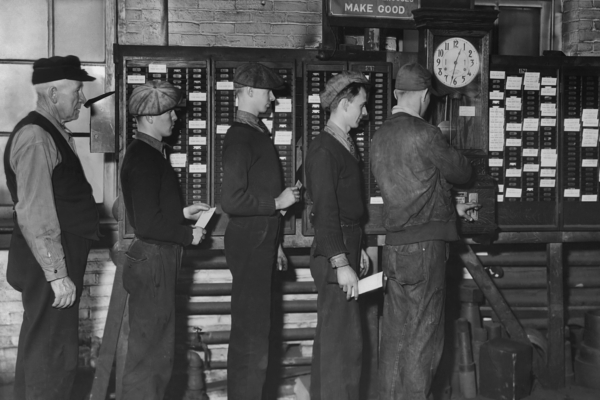
In 1938, the United States established the 40-hour workweek under the Fair Labor Standards Act (FLSA), clearly defining the boundaries between labor and life – entering the factory meant work, stepping out of the factory meant the workday was over. However, with the popularization of communication software, the rise of the gig economy, and the integration of Artificial Intelligence (AI) in the workplace, this longstanding labor divide is being reshaped.
Modern workers are facing challenges that have shifted from “fighting for shorter work hours” to “defining work hours”.
Remote work has become the norm in the post-pandemic era, offering greater flexibility but blurring the lines between work and leisure. According to a 2025 Pew Research Center survey, 73% of employees who work remotely at least part of the time and whose job allows for remote work feel that it has improved their work-life balance. However, a 2026 survey showed that 44% of remote workers admitted that their actual work hours had increased. The time saved on commuting often flows back into work.
Even employees working in offices find it hard to fully disconnect. Communication software and email notifications extend work into family dinner time. The U.S. Department of Labor notes that for non-exempt employees entitled to overtime pay under the law, whether at the office or at home, time spent working at the employer’s request or permission should typically be counted as work hours. However, the establishment of overtime pay still depends on the nature of the position, total weekly work hours, and whether the employer is aware. As of now, including in most areas like New York, there is still a lack of universal “Right to Disconnect” for all private sector employees.
While knowledge workers may be puzzled as to “when is it considered the end of the workday”, for gig workers such as delivery drivers, their first challenge is defining “when does the workday begin”.
Platform delivery drivers may choose when to log in, but they can’t control when orders come in. To address this new form of labor relationship, New York City has implemented minimum wage rules that differentiate between “travel time” (from accepting an order to completing the delivery) and “waiting time” (logged in, ready to accept orders but not yet matched).
Since April 2026, the minimum wage standard for restaurant and grocery delivery platforms in New York City has increased to $22.13 per hour (excluding tips). However, as platforms can choose different calculation methods (such as only counting travel time or a composite calculation including waiting time), the actual hourly wage for each delivery driver still varies. The core controversy behind this system reform is: when workers must constantly watch their phones waiting for the system to assign orders, does that “waiting time” fall under employer-controlled working time?
Mobile phones have extended the dimension of working hours, while the prevalence of AI has changed the workload within a set period of time.
Data released by the Federal Reserve Bank of St. Louis in August 2026 shows that the percentage of employees using AI at work on a weekly basis has rapidly increased from 28.2% in the third quarter of 2024 to 39.2% in the second quarter of 2026.
While AI has improved productivity, it does not necessarily lead to more rest time. A study by the UC Berkeley Haas School of Business at the University of California, Berkeley, in a tech company of about 200 employees, revealed that after eight months of observation, AI did not simply reduce total workload but expanded employees’ capacity and willingness to take on tasks.
The research shows that employees now utilize downtime during meetings, lunch breaks, or even evenings to command AI or have AI perform other tasks in the background. The tiny moments once used for respite are now filled with new responsibilities. When this efficiency enhancement becomes the norm for a team, the previously “surprising output” quickly transforms into “standard performance expectations”.
From the 19th-century labor movement slogan of “eight hours for work, eight hours for rest, eight hours for what you will” to today, the framework of labor laws still exists, but technological advancements have altered the essence of work.
The legal 40-hour workweek remains, but how to calculate work hours, what time is considered work, and how workload changes after technological efficiency improvements have become new challenges for workers in the digital economy.