
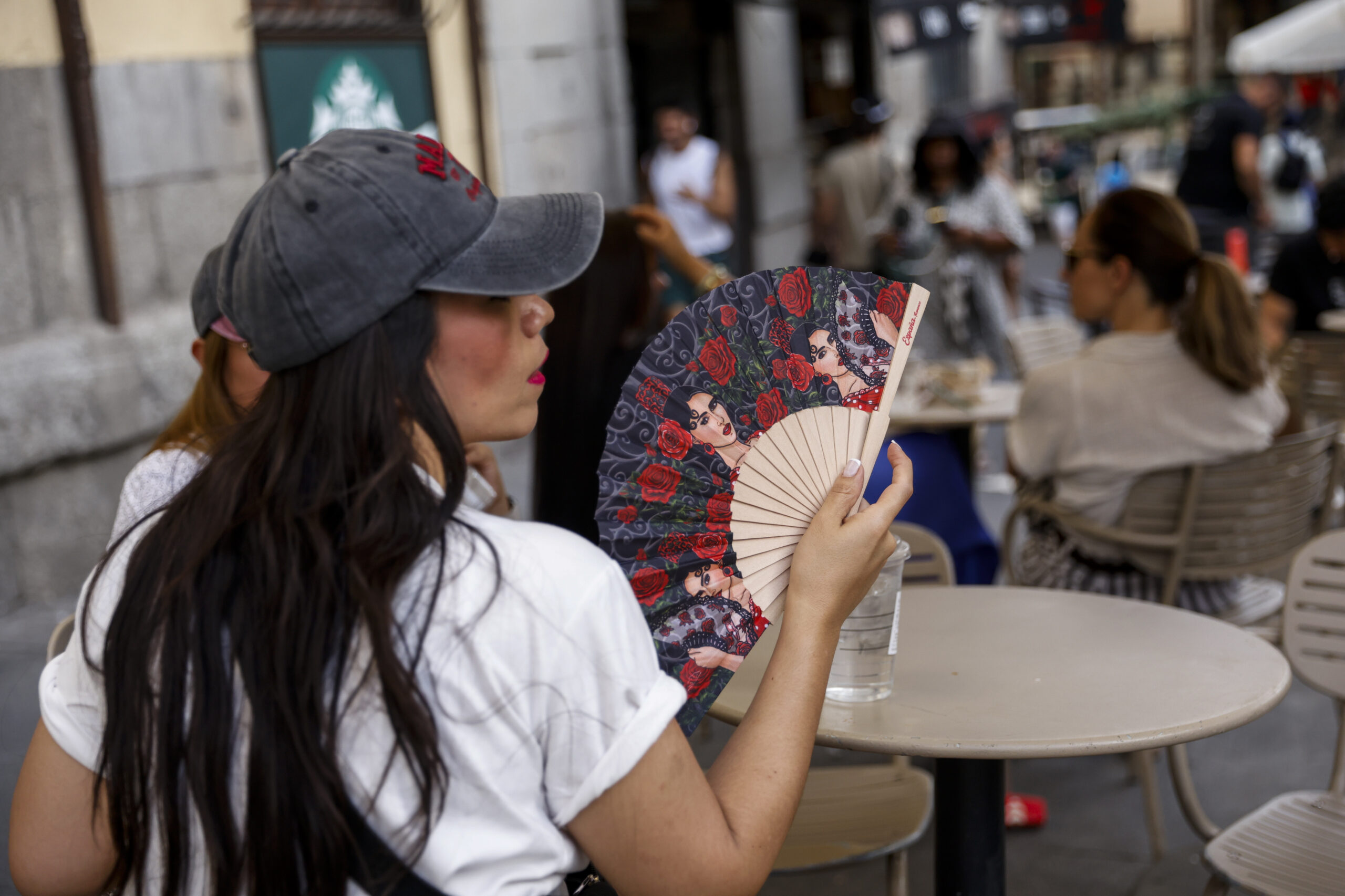
In ancient China, the folding fan that could be carried around was an important accessory for scholars and literati to showcase their status and refinement. In Europe, folding fans were also once fashionable accessories for noble women. Now, in scorching-hot Spain, this traditional accessory has become a popular cooling tool, once again gaining favor among the people.
According to a report by the Associated Press, the traditional Spanish folding fan (abanico) is petite and delicate, easily fitting into a handbag. With a gentle flick of the wrist, users can instantly unfold it into a half-circle, fanning out a surprisingly strong and refreshing breeze.
As Western European countries have been hit by heatwaves this summer, with temperatures soaring to unbearable levels, the folding fan has become a must-have item for people of all ages in various regions of Spain. Whether on public transportation or at events like concerts, you can see women – and an increasing number of men – using them to cool off.
On a day in August, 20-year-old Ana Feliu shielded herself from the sun in the Spanish capital Madrid with a folding fan. In an interview with the Associated Press, she said she had been carrying this fan with her all summer. It’s her favorite one, the largest in size, but she owns many other fans as well.
For over a century and a half, Javier Llerandi’s family has been selling folding fans in a shop in Madrid. He told the Associated Press, “We make a living from the hot weather.”
The fans sold in his shop are all made in Spain, with a variety of styles available, from simple dual-colored wooden fans to intricately crafted hand-painted mother-of-pearl folding fans adorned with elaborate floral patterns.
The prices of these fans start at around 30 euros (about 35 dollars), with some styles ranging between 200 and 500 euros (up to approximately 580 dollars), and some high-end pieces priced as high as 6,000 euros (nearly 7,000 dollars). The pricing depends not only on the materials used but also on the craftsmanship involved.
Llerandi mentioned that as Madrid has increasingly become a popular tourist destination, foreign visitors have been clamoring to purchase his fans. These fans are considered more reliable than portable electric fans because they never run out of power.
For less discerning customers, souvenir stalls sell plastic folding fans with printed patterns for just a few euros. There’s a stall located just a few hundred meters from Llerandi’s shop, where the salesperson also mentioned that sales of folding fans this summer have been remarkable.
Historians believe that folding fans were introduced to Europe through maritime trade with Asia in the 15th to 16th centuries. As early as the mid-17th century, Spanish painter Diego Velázquez created the mysterious painting “The Lady with a Fan.”
As folding fans became a craze in European courts, Spain developed its own unique taste and related industry. Madrid became an important production center for this industry. By the 18th century, Valencia rose to prominence as the capital of folding fan production in the country.
Mary Kitson, a curatorial consultant at The Fan Museum in London, mentioned, “The printing industry rapidly developed in the 18th century. The application of printing technology significantly reduced the production cost of folding fan faces.”
By the 19th century, folding fans had deeply integrated into Spanish noble society. Women used them to subtly express flirtation, interests, or displeasure, a method known as the “language of the fan.”
Folding fans later spread from Spain to Latin America. As Cuban music and dance styles like guajira influenced flamenco, performers began utilizing folding fans as expressive props. Over time, the connection established between folding fans and flamenco dance made it an iconic symbol of Spain.