
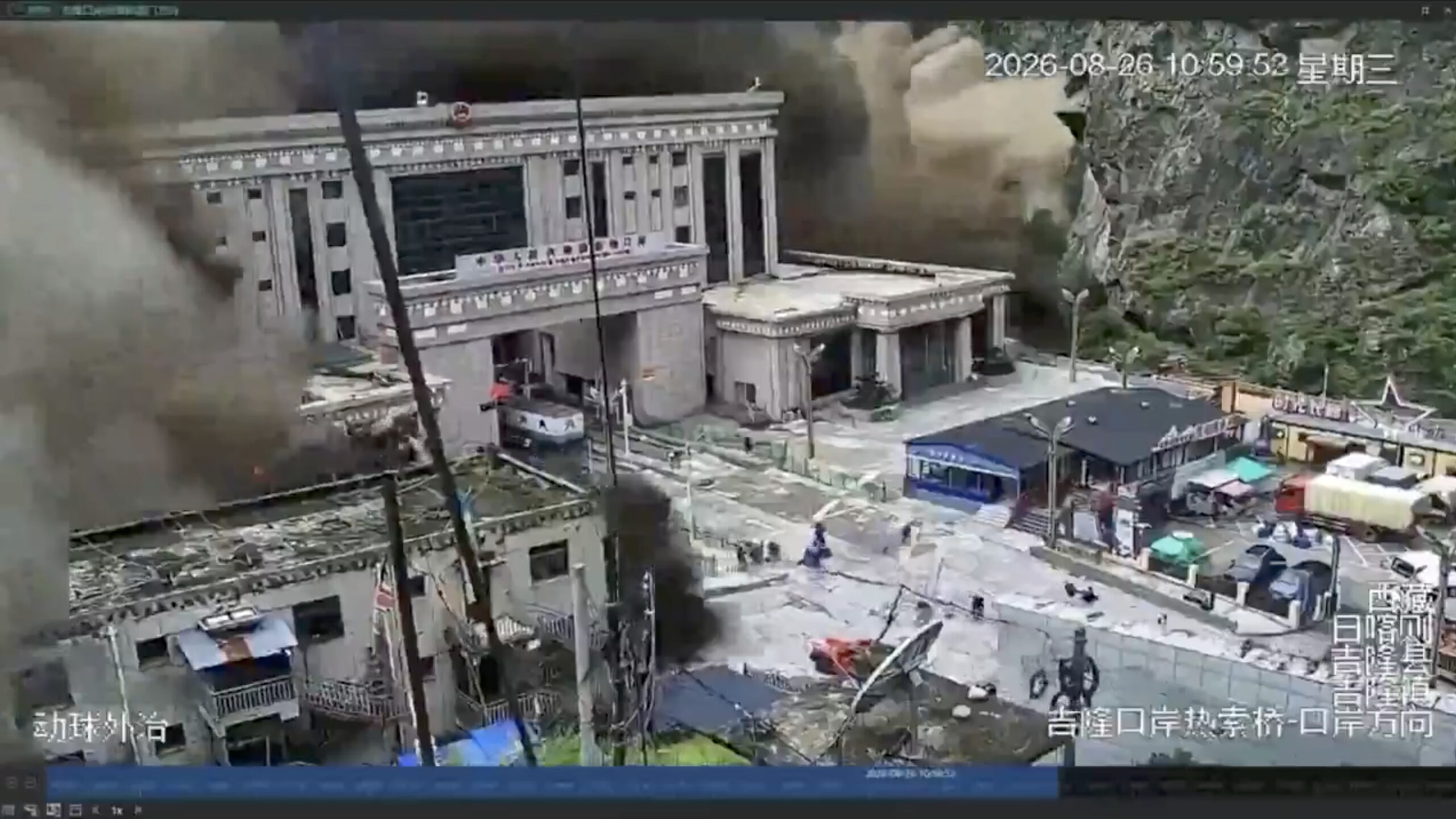
Eleven days have passed since the mudslide disaster at the China-Nepal border. On one side of the border, there have been frequent reports of survivors being rescued in Nepal, with a farmer from Henan province saved on September 5th. However, on the Tibetan side at the Gyirong Port, there have been no survivors found yet, leaving numerous families anxiously waiting in despair. Meanwhile, Chinese state media have been criticized for publicizing military personnel “cooking meals” at the disaster site, which has sparked public outcry.
The sudden ice and rock collapse at the China-Nepal border on August 26 triggered a massive flash flood and mudslide, affecting the Gyirong Port in Tibet and the Rasuwa district in northern Nepal.
As of September 5th, Nepalese authorities reported that 1,344 bodies have been found in the disaster area, with 4,898 people still missing. By August 30th, five days after the incident, nearly 20,000 safety personnel had been mobilized for rescue efforts in Nepal, leading to the rescue of 8,730 individuals.
In contrast, Chinese state media reported that as of 6 p.m. on September 4th, the mudslide at the Gyirong Port has claimed 31 lives, with 531 people missing. However, eleven days after the disaster, no survivors have been located on the Chinese side.
The severe mudslide at the Gyirong Port in Tibet may have resulted in over a hundred casualties! On August 26th around 10:30 a.m., a severe mudslide occurred in Nepal, flowing into the Gyirong County at the Gyirong Port in Tibet, causing significant casualties and missing individuals. Many buildings at the port were buried, and road, communication, and power access to the port were completely cut off. The disaster on the Nepalese side may be linked to melting snow and the sudden rise of the Bhote Koshi River.
A Chinese citizen was successfully rescued inside a 225-meter tunnel at the Upper Trishuli Hydropower Project in Nepal on September 5th, marking the third survivor in the tunnel rescue operation.
According to Nepalese military sources, the rescued individual, Lu Haitao, a 49-year-old man from Anyang, Henan, showed no significant external injuries, stable vital signs with mild hypothermia, and was airlifted to a military hospital for treatment.
On September 5th, a volunteer group in a Chinese-Nepal border mudslide missing persons group shared a screenshot of a Nepalese news report stating that a Chinese individual had been rescued from a construction project.
This news immediately garnered attention. Due to the blurry news photo, Lu Haitao’s sister was still uncertain if the rescued person was her brother and inquired about his name. Subsequently, clearer photos were sent by the volunteers, and Lu Haitao’s son confirmed, “That’s my dad, wonderful!”
Lu Haitao’s sister revealed that her brother, a farmer for generations growing wheat and corn, supplemented the family income with carpentry work during agricultural downtime. His wife’s poor health prevented her from heavy work, making the family’s livelihood challenging. Lu Haitao had traveled to Nepal earlier this year for work with a villager from the same village but had limited communication with his family due to poor local signals.
After enduring eleven days trapped without food or water, Lu Haitao was visibly weakened upon rescue, looking older than his actual age. His family has yet to directly speak with him, and he may be transferred to Kathmandu for further examination.
Congratulations to the Chinese individual miraculously rescued from the mudslide in Nepal on September 5th.
As the news of survivors emerging on the Nepalese side continued, there has been no discovery of any survivors on the Tibetan side at the Gyirong Port even after eleven days since the disaster.
Chinese state media referenced experts involved in the rescue efforts who described the disaster as not your usual mudslide but a chain reaction involving ice avalanches, debris flows, and mudslides with potential flow speeds reaching 50 meters per second. They highlighted the challenges of search and rescue in such extreme conditions.
However, this explanation faced external scrutiny. If the authorities acknowledged the high destructive force and lethal speed of the disaster, why was there no timely downstream warning before the incident? Meanwhile, Nepal faced a similar ice avalanche mudslide impact and managed to rescue multiple survivors.
Moreover, numerous Chinese missing persons’ family members shared that they had traveled to the disaster area from Lhasa, Sichuan, and other regions but were denied entry to Gyirong County. Some relatives expressed waiting near the inspection point without receiving definitive news on their loved ones’ fates.
Rescue miracles continue in Nepal. On September 5th, the tenth day since the mudslide, the Nepalese military successfully saved a woman from the top floor of a building buried by the mudslide.
As the rescue progress in China and Nepal gains attention, Chinese state media reported on September 3rd that after the road rescue channel was cleared in Gyirong Port, a squad from the military and armed police forces set up a field kitchen on-site to prepare hot noodle soup, rice, large dishes, and ginger soup for frontline rescue personnel.
While the official media highlighted the scenes of cooks preparing meals for rescue workers in the muddy environment as a symbol of solid logistics support and heartfelt care, this coverage received mixed reviews and criticism.
Amidst the ongoing rescue efforts, the central question pertains to why this level of food preparation detail was prioritized over emergency convenience foods in a time-sensitive rescue operation.
At the same time, the controversy over the propaganda around the field kitchen accentuates the general public’s lack of trust in the official disaster information dissemination methods. Moreover, doubts about the authenticity and filming methods of certain on-site videos only added to the skepticism surrounding the transparency of the rescue operation.
Following the disaster, a supposed official “propaganda instruction” mandating media outlets to only disseminate the centralized news stories and prioritize mentioning “mudslide in Nepal” in the first sentence circulated on the internet, reflecting concerns about information control and minimizing external scrutiny regarding the unfolding events.
With Nepal investing significant resources in high-tech search and rescue operations and demonstrating comparatively fast disclosure of casualty and rescue information, outsider interference allowed, while China restricts access to the disaster area, prominent individuals have expressed concerns over the differential responses from both nations.
In an interview with a Canadian Chinese writer and “China Spring” magazine editor-in-chief Sheng Xue, she remarked that post-disaster, authorities appear more concerned with information control and decreasing external attention before comprehensive rescue efforts for Chinese citizens.
Senior American media figure Fang Wei noted that while China possesses warning capabilities, political decisions possibly hinder the timely translation of warning information into actionable measures. He underscored the regime’s prioritization of political stability over citizen lives.
Incredible rescue stories of two workers surviving 170 meters underground after being buried by the Nepal mudslide for nine days have circulated online. Two engineers from a hydropower station were safely rescued ten days after the disaster.
Amidst the contrasting responses from China and Nepal in this disaster, the divergent actions have sparked debates regarding transparency, responsiveness, and administrative priorities in crisis management.