
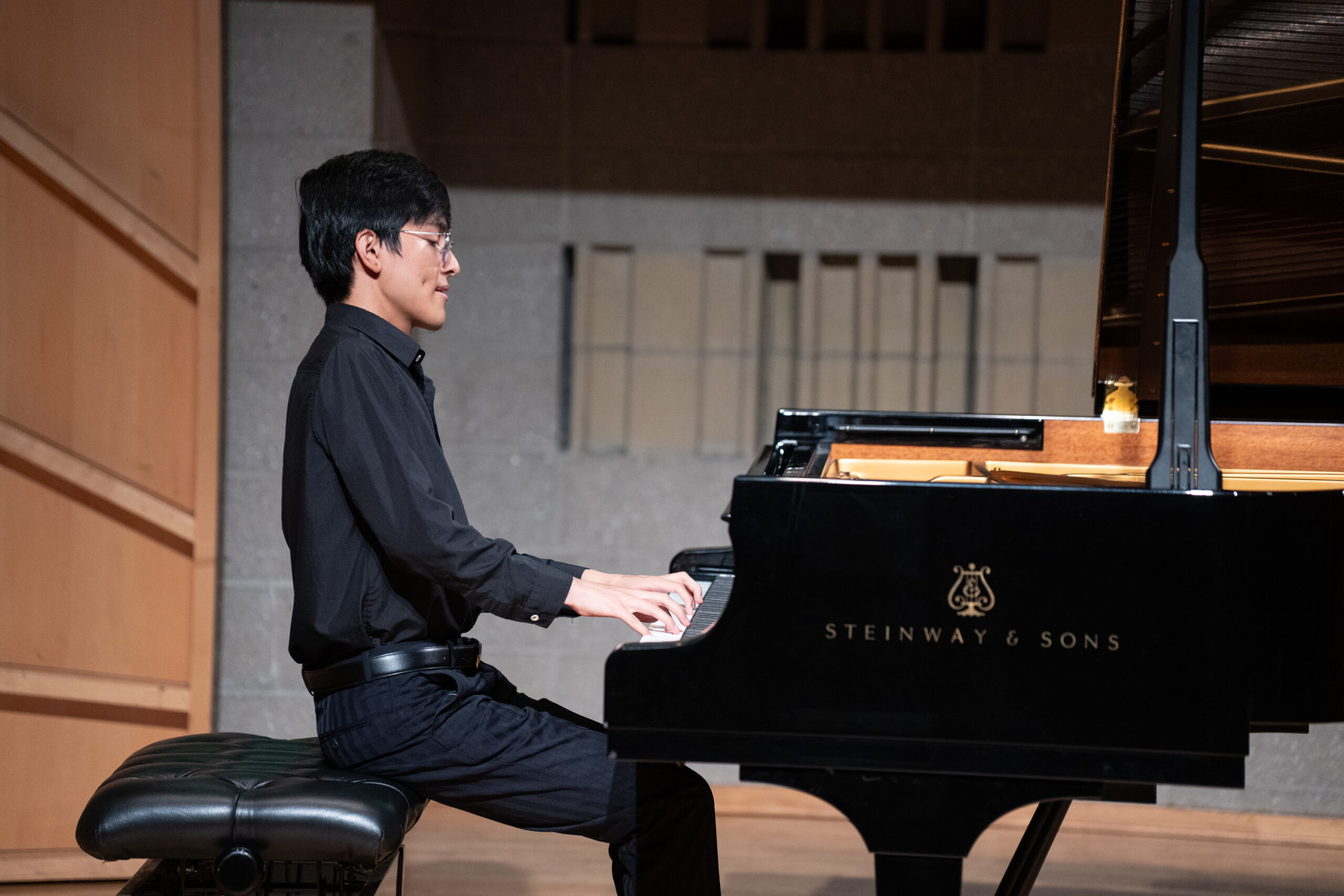
On September 4, at the semi-finals of the 8th NTD International Piano Competition, young pianist Khoi Luu from Vietnam took the stage to perform the designated piece “The Call of God.” He shared his insights on the meaning behind the piece with the reporters.
Currently pursuing a master’s degree in music at the Boston Conservatory at Berklee, Khoi Luu has been active in various piano competitions and performances since 2016. He has previously won the ICA International Piano Competition, placed second in the Chopin International Piano Competition Bangkok division, and claimed the championship in the Piano Concerto Competition and the Alfred Lee Scholarship Competition in 2023. In 2025, he also collaborated with the Hanoi Philharmonic Orchestra in performing Chopin’s “Piano Concerto No. 2.”
During the semi-finals, Khoi Luu performed the designated piece “The Call of God.” Reflecting on his understanding of the composition, he likened the opening eight bars to the beginning of a story, setting the stage for a narrative to unfold.
As the music progressed, he felt a communication between the earthly realm and the divine within the piece. The lower register of the piano represented the voices of mortals seeking help from the divine or transcendent forces, while the higher register responded in turn.
In Khoi Luu’s interpretation, it was like a dialogue between two worlds, with the theme appearing alternately in the mid and high registers, creating a sense of two characters conversing, one from the earthly realm and the other from heaven.
As the music transitioned to another section, Khoi Luu sensed a starkly different atmosphere, describing it as a scene of a battle between good and evil. The section featured strong rhythmic accents on the second beat, vibrant energy, and grandeur reminiscent of a war scene, akin to those in historical epics like “Romance of the Three Kingdoms.”
However, the battle of good and evil was not the end of the story. The piece concluded with soaring high notes, symbolizing the world after the conflict, according to Khoi Luu’s interpretation.
Regarding the depiction of God in the composition, he felt that the divine presence seemed to fade away and disappear into the heavens, but it did not mean that God was absent, as “He is always there.”
This led him to contemplate the deeper meaning behind the designated piece “The Call of God.” Ultimately, he believed it conveyed a message of the necessity of peace, especially created during times of ongoing conflict.
This summer, Khoi Luu attended an arts festival where he met a fellow musician who had participated in the NTD Piano Competition before. Upon seeing advertisements for the competition and feeling that the repertoire suited him, he decided to give it a try.
To prepare for the competition, Khoi Luu dedicated a significant amount of time to practicing. However, practicing in Boston presented practical challenges due to limited access to piano rooms at his school, which was a major hurdle during his competition preparation.
As Khoi Luu became more familiar with his competition pieces and took to the stage, he expressed feeling both nervous and a sense of enjoyment.
“Every time I sit in front of the piano to play, I feel blessed,” Khoi Luu said. “The world of classical music is vast and has a wide range. It’s not as limited as some people may perceive. So, I believe there’s always something to explore… always something truly moving to discover.”