
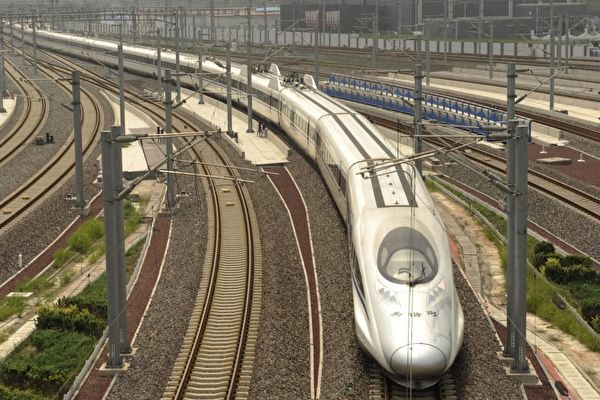
Recent reports indicate that the Shaanxi XiXian New District Intelligent Rail Demonstration Line 1, formerly promoted by the Chinese Communist Party as the “Northwest’s First Intelligent Rail” with an investment of 700 million yuan (RMB), has ceased operations after years of continuous losses.
At the scene, journalists observed that the trains on the XiXian New District Intelligent Rail Demonstration Line 1 had come to a halt. The specialized track fencing had been dismantled, several stations were without electricity, the entrance and exit gates were removed, and the official WeChat public account could no longer provide information. The once-promising intelligent rail project now shows little to no signs of operation.
A local resident named Mrs. Liu informed reporters that the XiXian Intelligent Rail stopped operating around mid-January of this year. She recalled that prior to the suspension, the passenger volume on this line had always been low, with trains often appearing empty and long intervals between train schedules.
Even during peak commuting hours, she noted that there were few passengers inside the carriages and a scarce number of people waiting on the platforms. Following the suspension of the intelligent rail service, the previously installed fencing along the route was gradually removed, allowing for improved traffic flow in the surrounding areas. Mrs. Liu remarked, “It’s a waste of money, investing 700 million yuan only to see it all go down the drain. It’s truly a travesty.”
Subsequent attempts by journalists to contact the Shaanxi XiXian New District Urban Management and Transportation Office for clarification on the situation were met with a response indicating that due to prolonged low passenger numbers, the operation faced challenges leading to the temporary suspension of the intelligent rail line. However, when pressed on the reasons for the line shutting down after just three years of operation and whether it had effectively become a failed project, the officials declined to provide further comments and subsequently hung up.
Public records reveal that the XiXian Intelligent Rail project was approved and funded by the State Council of the Chinese Communist Party, with a total investment of approximately 700 million yuan and a construction period of nearly 10 years. The Intelligent Rail Demonstration Line 1 officially commenced operations in March 2023, connecting the cities of Xi’an and Xianyang, encompassing 7 counties (districts) and 23 townships and street offices within the two cities. It was touted as a regional transportation and tourism integration demonstration project by the authorities.
During the project’s initiation and construction stages, the Chinese state media extensively promoted the initiative, highlighting its role in “filling the technological gap in intelligent rail in the Northwest” while emphasizing its “balance of transport capacity and cost-effectiveness” and the project’s “short construction period and low investment costs.” However, once the line was functioning, there was a noticeable disparity between the projected passenger traffic and the actual numbers, and the operational conditions failed to improve as initially anticipated.
A media commentator from Shaanxi named Liu Yu expressed during an interview that he was not surprised by the suspension of the XiXian Intelligent Rail. He stated, “These kinds of projects were politically driven from the beginning, with the emphasis on being the ‘first’ and ‘filling a gap,’ rather than actual demand.”
Liu Yu pointed out that in situations where local finances were constrained, investing hundreds of millions in constructing an intelligent rail line with inadequate passenger flow and unclear functional positioning carried significant risks. He added, “Many problems could have been foreseen during the approval phase, but under the logic of political achievements, such concerns were often not seriously addressed.” According to him, if the project cannot generate stable revenue post-completion, it would ultimately rely on financial subsidies for maintenance.
A private enterprise representative from Shaanxi named Mr. Dong mentioned that as early as the project’s approval in 2014, scholars and industry insiders had raised objections to building the XiXian Intelligent Rail, citing reasons such as the dispersed local population and the presence of alternative public transportation modes like buses and subways. However, these opposing views did not make it to the decision-making level.
Mr. Dong believed that such projects focused more on the superficial “innovation” and “demonstration effect” during the implementation phase, neglecting considerations of sustainability for continued operations. He noted, “There was a lot of fanfare at the project’s launch, but very few explanations were given when it stopped. In the end, it is the local finances and ordinary citizens who bear the costs.”
Multiple sources suggested that due to land compensation disputes along the route, key stations such as the Joy Valley remained closed, preventing the line from covering the main tourist areas as previously advertised by the authorities. With insufficient passenger traffic, ticket revenues could not support operational costs, leading the project into increasing difficulties.
Mr. Dong emphasized that such projects lacked consistent passenger flows and struggled to effectively integrate with existing transportation systems, relying heavily on financial subsidies for long-term sustainability. When such subsidies became unsustainable, the option to suspend operations became a harsh reality.