
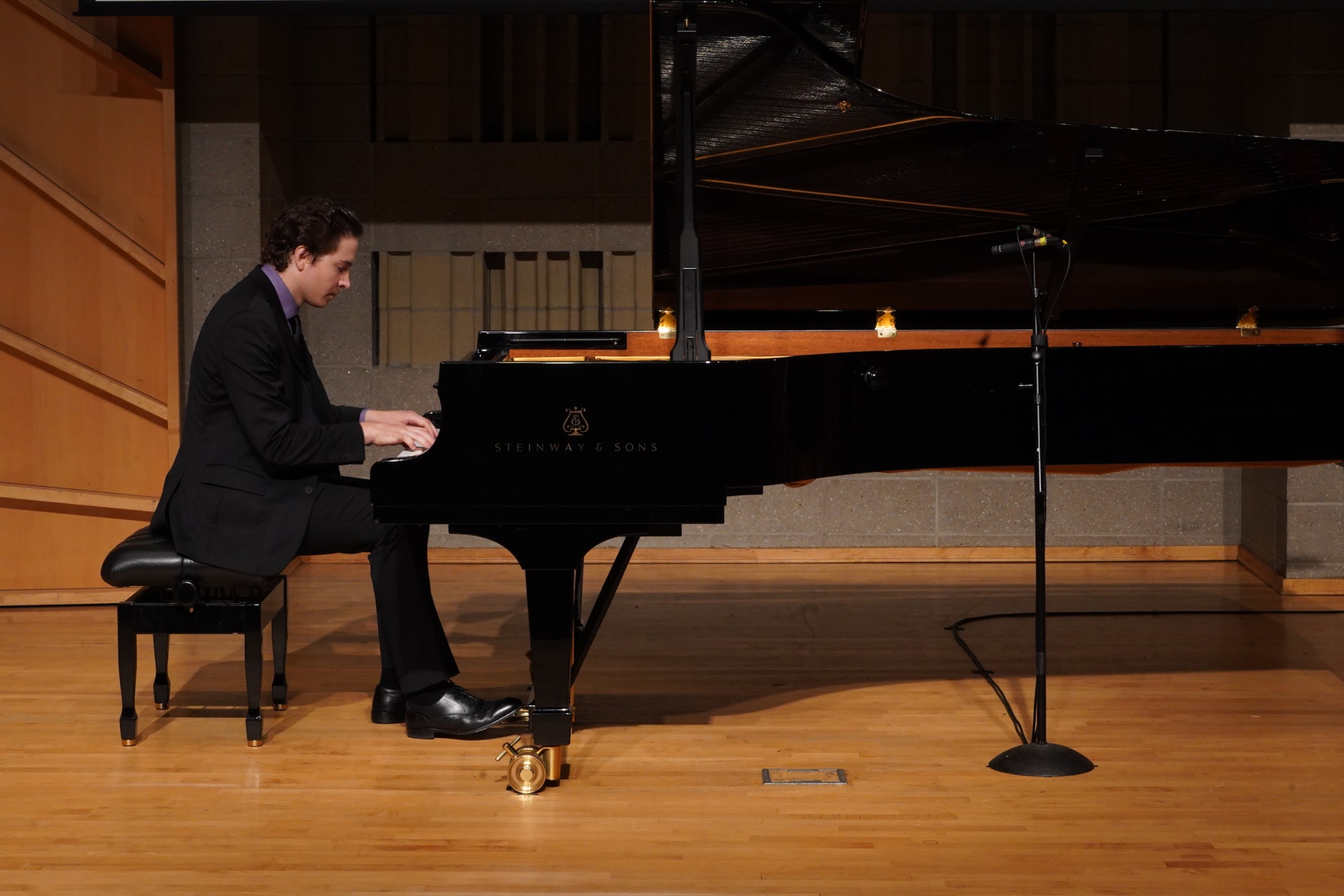
American pianist Gabriel Landstedt from Connecticut, a music arts Ph.D., who has won awards in numerous piano competitions in the United States and Europe, participated in the 8th NTD International Piano Competition. Several months ago, he stumbled upon news of the competition online and found that the repertoire completely matched his expertise. Moreover, the competition venue was conveniently located near his residence, making it a perfect choice for him to sign up.
In the preliminary round on September 2nd, Landstedt performed Bach’s Suite No. 4 in D Major and Chopin’s Etude in C Minor, Op. 10 No. 12.
“I chose these two pieces to showcase different styles and techniques. Bach’s piece is very lively, joyful, sweet, and passionate, while Chopin’s piece is more intense. I enjoy expressing these pieces. I hope the judges can feel the richness of emotions in my performance,” Landstedt said after the competition. “Yes, performing these two pieces was also fun because they provided me with various emotional experiences.”
Starting to play the piano at the age of 5, Landstedt is now a father of two but still maintains a practice schedule of 3 to 6 hours daily, participates in competitions, concerts, and also composes music. He mentioned that his favorite composers are Bach and Beethoven.
“I appreciate Beethoven’s strong emotions in his works and the sacred sense in Bach’s compositions,” he said. “If I could only choose one composer to perform, I would choose Bach. I also love composing because it is very soul-stirring.”
While learning the designated piece for this competition, “The Calling of the Gods,” Landstedt embarked on a journey. Despite the challenge of memorizing the scores within six weeks, he had his own approach.
“I enjoy analyzing the music I play, identifying similar themes. It helps me see the overall structure, making memorization easier due to the recurring themes,” he said. During this, he experienced many sounds of Chinese instruments. “So, I tried to imbue it with a truly pure sound. I used more pedal to display various brilliance but still create an atmosphere, surrounded by all the bells, imagining being enveloped in a beautiful environment.”
Landstedt described “The Calling of the Gods” as a piece with a “hopeful and optimistic” feeling.
“I feel this piece starts grandly, with a sacred calling sense from the beginning. This sense of mission exists from the outset but as the story progresses, one goes through a journey of doubt and self-exploration, finally establishing true confidence,” he said. “Towards the end, I feel the piece speaks of reconciling with oneself and God, reconciling with one’s own mission, then it fades into the horizon, the ending is truly wonderful.”
In today’s society, Landstedt believes that NTD Television hosting a competition that values early music is a “noble” mission.
“I think it’s a noble mission. You know, especially in the 20th century, many new music styles emerged, I believe remembering and revisiting their origins is crucial. Classical music has a sense of purity because modern society brings a lot of industrialized roughness, whereas early music retains a sense of pure idealism.”
Landstedt expressed that his goal is to perform his music worldwide and share his art with students at universities. “I have already achieved some level of this, but I want to do more.”