
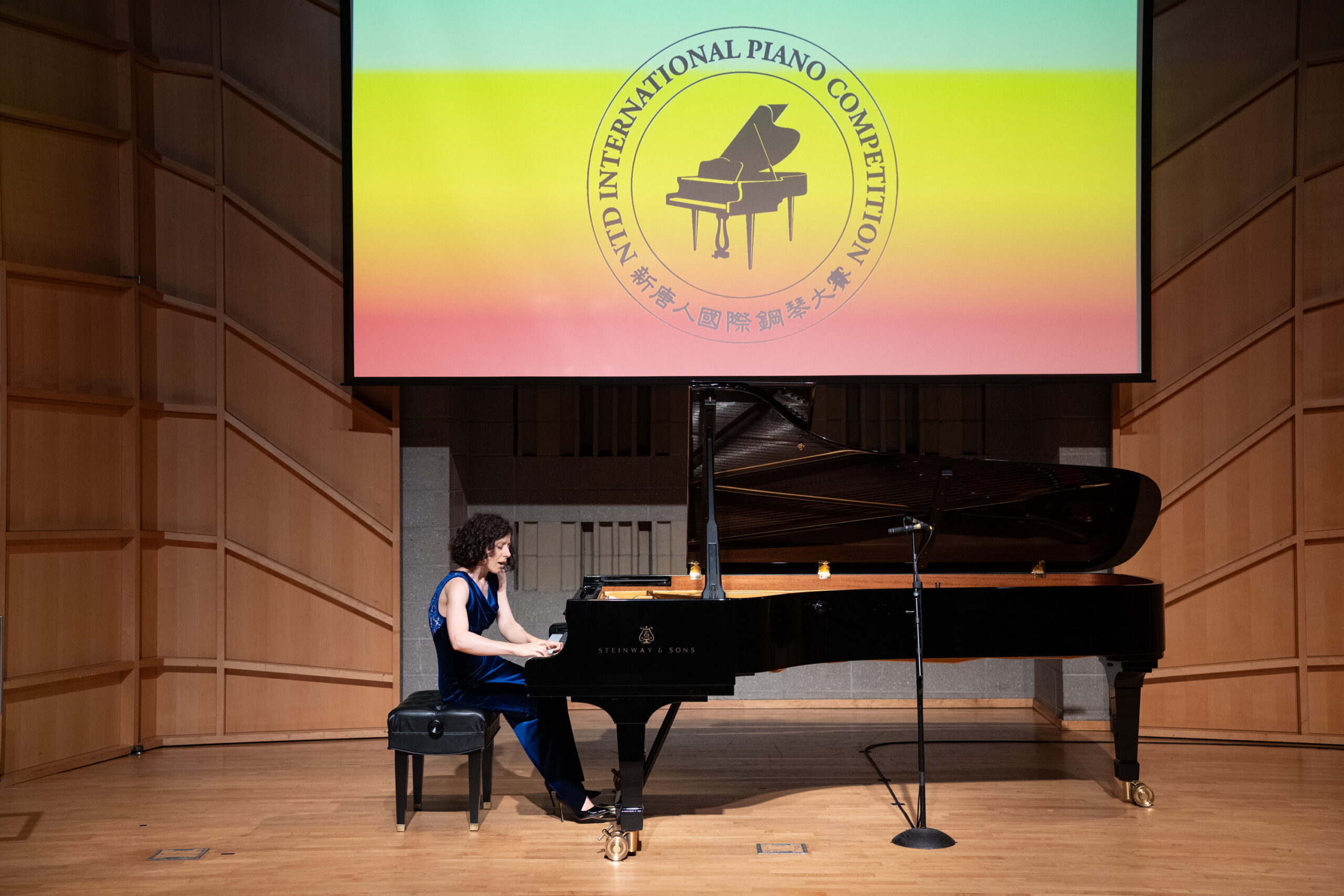
On September 4th, the eighth NTD International Piano Competition entered the semi-finals. According to the rules of the competition, each contestant in the semi-finals had to perform the designated piece “The Calling of God” and a piano sonata by Beethoven.
For Polish contestant Elzbieta Bilicka, the most satisfying part of this competition’s semi-finals was her performance of the designated piece “The Calling of God”.
“I am very happy with today’s performance,” she said, especially referring to the designated piece, which was like a journey for her that continued up until the last moment before stepping onto the stage, when she was still making last-minute adjustments and adding new ideas.
“I really feel like it all came together in the end on stage, becoming meaningful, colorful, and captivating. There were many magical moments in it,” she said, expressing her joy at seeing the piece presented in this way.
However, preparing for this piece was not easy for her. During the competition, she found out that the piece was based on a traditional Chinese folk song. For Chinese audiences, this song might be very familiar, and they could naturally imagine the orchestration of the entire piece in their minds: which instrument plays which part of the melody.
“But for me, everything was completely new,” she said.
She tried to find recordings of this folk song online but couldn’t find any. “I really searched for it, but for some reason, I just couldn’t find it. Maybe if I knew Chinese or understood Chinese characters, I might have been able to find it.”
Therefore, she had to listen to similar styles of music to try to figure out what kind of sound would be suitable for this piece. She would imagine whether a certain segment should be played by a specific instrument and then try it out on the piano.
However, the imagined sounds didn’t always work on the piano. “Not everything that we try to imitate on our instruments sounds good,” she explained. Therefore, she kept trying and overturning her original ideas.
She described this process as “very, very complex”.
Usually, she would come up with a musical idea, play it immediately, and then record it, only recording a short section. She would repeatedly listen to it, sometimes waiting until the next day to listen again, allowing herself to judge with a fresher perspective. “If I like what I hear, I trust my instincts. Honestly, at this stage, there’s no other way.”
Until the end, she kept practicing, listening, modifying, thinking about the overall length of the piece, the speed, and what kind of character each section should portray.
She deliberately avoided listening to how other contestants performed the piece.
“Because once you listen, it’s easy to start imitating or doubting yourself,” she said. If she was already moving in a certain direction, the best way was to stick to her own ideas.
The piece was only handed to the contestants 60 days before the competition. She said that initially, reading, learning, and memorizing the sheet music were relatively smooth, but the real challenge was in the musical interpretation.
The first step was to get familiar with the trickier parts of the piece, then she started searching for the main melody and themes of the piece.
“It keeps coming back, but each time it’s like wearing different clothes,” for example, underneath the main melody, there were a lot of arpeggios, so she had to find a way to play them in a manner that didn’t overshadow the melody. This is known in music as “voicing” – highlighting certain notes while concealing others.
The final stage was dealing with the dynamics of the music: which parts needed to push forward, where to relax, slow down a bit, and how to find different tones to emulate the effects of different instruments.
“I think that’s the final stage.”
The name of this piece is “The Calling of God”. When asked what this title evoked for her, she said that while playing, she kept imagining going “upwards, in the air”.
At first, it was a very practical sound concept – she wanted the sound to ascend. But for her, there were also extremely gentle passages in the piece that required creating a special sense of time.
“Everything stops. Time doesn’t flow, it doesn’t pass. There’s only this beautiful sound ascending upwards, going somewhere.”
It was with this feeling that she connected her performance with the title “The Calling of God”.
During her performance, her facial expressions appeared very joyful. She said that it wasn’t just a performance effect but a genuine emotion. “I can’t express it in words. It’s not something concrete, it’s just a feeling, an emotion.”
She also believed that the enjoyment of music by the performer could be felt by the audience.
“When the audience sees the performer enjoying the music, they usually enjoy it more too. But if they see someone on stage struggling, looking very unhappy, they can’t possibly like the music.”