
When the landslide struck the mountain above the Nepal power plant where Sanjay Sah works, the mechanical supervisor faced a choice: run or stay behind. He chose to stay and help others. As a result, he, along with hundreds of other workers, found themselves trapped in darkness in a tunnel by the ruthless mudslides and floods.
However, after 9 days following the disaster that occurred near the China-Nepal border, a miracle happened. On Friday, September 4th, he and another worker were rescued, bringing a glimmer of rare hope to the search and rescue operation, although there are still thousands of people missing.
At the end of August, a catastrophic glacial collapse triggered massive flash floods and mudslides in the northern regions of Tibet, China, and Nepal, devastating several hydropower projects along the Trishuli River. This major disaster has resulted in over 1,300 deaths and more than 5,600 people missing.
In the Rasuwa region near the China-Nepal border, the Upper Trishuli 3A Hydropower Station was engulfed by massive ice blocks, rocks, and debris in an instant. During the disaster, 30-year-old mechanical supervisor Sah was inside the control room deep within the underground tunnel.
Facing a life-or-death decision, Sah did not choose to escape alone. Upon hearing the disaster alert from upstream, he immediately warned and urged dozens of colleagues inside the control room and in the vicinity to evacuate. However, as he turned to escape, the mudslides and collapse had blocked the exit, leaving Sah and the 45-year-old mechanical manager Kabir Maharjan trapped deep inside the dark underground tunnel.
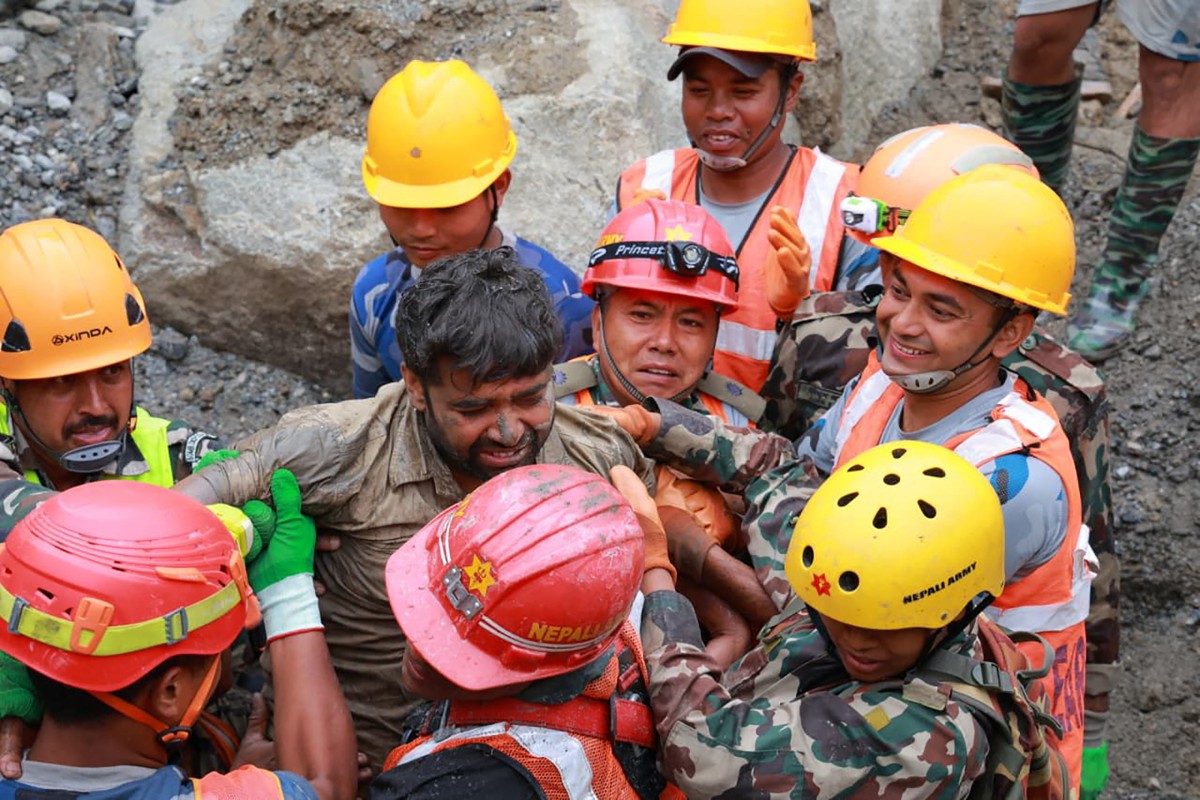
According to Reuters, during the 9-day ordeal, Sah sustained his will by reciting prayers and tried to maintain contact with other surviving colleagues through a hidden passage within the tunnel. On Friday, the 9th day of being trapped, Nepalese military search and rescue personnel finally cleared a rescue path to save the mud-covered Sah and Maharjan.
The rescue team also discovered a third worker at the same tunnel site, but unfortunately, the worker had already succumbed, swept away by floodwaters while attempting to flee the tunnel. Sah and Maharjan were immediately airlifted to a military hospital in Kathmandu for urgent treatment.
Sah’s family in Saptari County learned about his miraculous rescue through circulating on-site photos on the internet. Sah’s father, Ramphal, expressed his excitement to CNN, saying, “When I saw the photos, I was overwhelmed with happiness.”
Upon being rescued, Sah was conscious, with minor injuries and able to speak. His first question to the rescuers on-site was, “What day is it today?” In contrast, manager Maharjan was immobile with severe injuries and is currently under observation in the ICU.
Currently, the military is fully engaged in rescuing approximately 900 workers believed to be trapped inside tunnels at six hydropower projects along the banks of the Trishuli River. Sah and Maharjan are among the first group of trapped workers rescued from the depths of these hydropower project tunnels. Within hours of the disaster, a small number of individuals successfully escaped from another tunnel. As of now, over 270 workers have been rescued across various hydropower projects.
According to the Nepal National Disaster Risk Reduction and Management Authority (NDRRMA) and the latest official statistics from the Chinese authorities as of September 4th, after the transboundary mega-disaster caused by the Himalayan glacier collapse, in Nepal, rescuers have recovered 1,287 bodies, with 5,083 people registered as missing (including hundreds of foreign tourists and trekkers); in Tibet, China claims 21 deaths and 541 missing.
However, due to communication disruptions and limited external access to some areas in the Tibetan disaster zone, analysts suggest that the actual casualties and missing persons in China may be significantly higher than the officially reported figures.
Currently, both Chinese and Nepalese border rescue teams along with geological experts are conducting extensive search and rescue operations in the severely affected Trishuli River basin.