
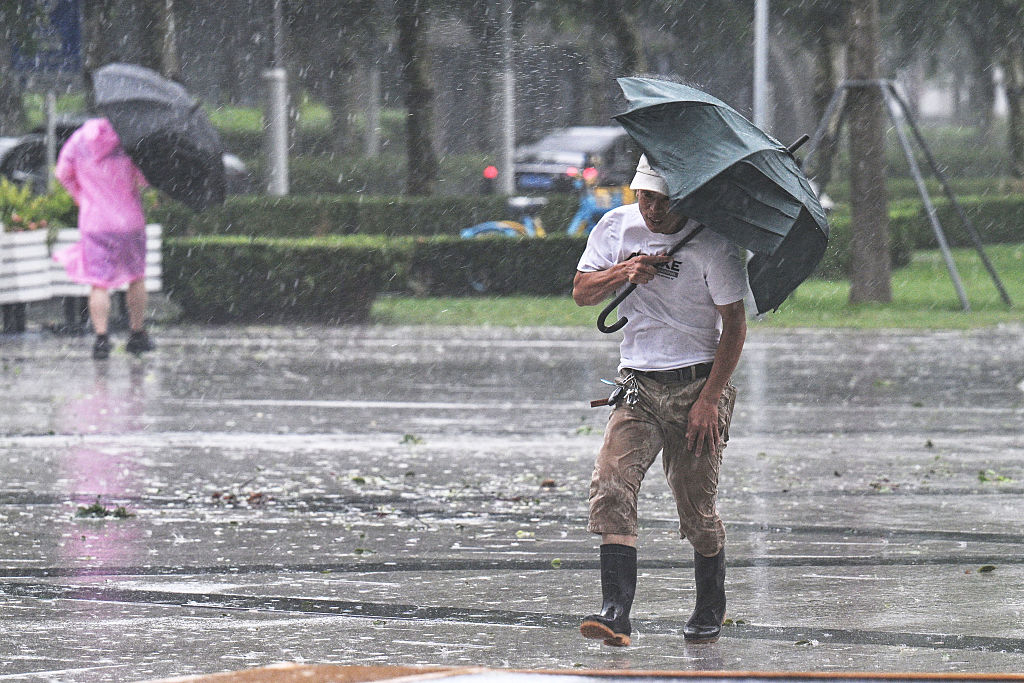
In the summer of 2026, China mainland was hit by a series of seven typhoons. Typhoon “Shadel” made a rare triple landing in Zhejiang and Fujian provinces, while the super typhoon “Baihaitun” made landfall twice within an hour in Zhejiang. Unprecedentedly, the centers of three consecutive typhoons landed in Yuhuan City, Zhejiang, where the Chinese naval base is located.
So far in 2026, the number of typhoon formations and landings in China far exceeds previous years, showcasing many miraculous occurrences that prompt deep contemplation.
According to China Weather Network, on September 3, 2026, the center of Typhoon No. 18, called “Shadel” (tropical storm level), landed for the third time in Guilei, Zhangpu County, Zhangzhou City, Fujian Province in the morning around 6:30 AM, with the maximum wind force near the center reaching level 9 (23 meters per second) and a minimum central pressure of 985 hPa.
Prior to this, “Shadel” had landed in Yuhuan City, Zhejiang, and Longwan District, Wenzhou on August 28. In the following days, Zhejiang, Fujian, and other provinces experienced heavy rainfall, leading to widespread flooding as multiple reservoirs were simultaneously releasing water.
According to data from the Japan Meteorological Agency, the remnants of “Shadel” reorganized into a tropical depression, designated TD20, on August 31. By September 1, it had reintensified into a tropical storm. Interacting with Typhoon No. 24, “Kelorwang,” in the northwest of the South China Sea, they exhibited a complex interaction, forming a path resembling the number “6” at sea before heading southwest and then veering towards the west-northwest, once again approaching the border between Fujian and Guangdong. The center of Shadel landed in Guilei, Zhangpu, Fujian on September 3, around 6:30 AM.
Before its final landing, “Shadel” had notably shifted southwards and was initially predicted to be the first typhoon to hit Taiwan in 2026. However, it suddenly turned west, bypassing Taiwan and striking Zhejiang.
On the evening of August 31, former Director of the Hong Kong Observatory, Lin Chaoying, posted on social media that after entering Zhejiang from the East China Sea, “Shadel” gradually weakened but retained a vortex-like appearance, moving southwest and re-strengthening into a tropical depression.
Reflecting on the dramatic resurgence of “Shadel,” Lin Chaoying curiously asked, “What is Heaven trying to tell us?” With 40 years of experience in meteorology, he expressed disbelief at the unique nature of this typhoon, emphasizing the unpredictable complexity of weather phenomena over human-made technology.
Three weeks prior, on August 9, 2026, Typhoon “Baihaitun” made landfall in Yuhuan City, Zhejiang, then re-landed in Leqing City, Wenzhou. Typically, a regular typhoon’s lifecycle lasts only 5 to 7 days, but “Baihaitun” defied expectations by surviving for over 15 days (ceasing numbering on August 11 at 5 PM) and maintaining super typhoon intensity for about 5.5 days. Meeting the dual criteria of “surviving over two weeks” and “sustaining super typhoon strength for an extended period” made it a highly unusual and rare event in the realm of typhoons.
Born near 13.2 degrees north latitude and 176.9 degrees east longitude, close to the International Date Line, “Baihaitun” broke a historical record by becoming the easternmost typhoon to hit China since 1951, surpassing Typhoon “Mangkhut” in 2018. It embarked on an oceanic journey, setting a record for its prolonged life and becoming the first typhoon to generate near the date line and make landfall in China at tropical storm level or higher.
“Baihaitun” brought record-breaking rainfall to Jiangsu, Zhejiang, and Shanghai, with multiple regions issuing red alerts for heavy rain. Additionally, from August 11 to 15, its remnants caused torrential rain in Anhui, Hubei, Henan, Shandong, Shanxi, Hebei, Beijing, and northeastern regions, with some areas experiencing severe or extremely heavy rainfall.
Within about 50 days, three consecutive typhoon centers landed near Kanmen Street, Yuhuan, Taizhou, Zhejiang, including Typhoon No. 9 on July 11, Typhoon No. 13 on August 9, and Typhoon No. 18 on August 28, setting an unprecedented historical record.
Ma Xinyu, Chief Expert at the Zhejiang Meteorological Service Center, noted that in the same year, three typhoons landing in the same location had never occurred before in history.
Notably, the Yuhuan Dama Island Naval Base is only about 160-180 kilometers away from Taiwan’s main island (Keelung) in a straight line, serving as one of the closest naval bases of the Eastern Theater Command of the People’s Liberation Army to Taiwan. According to media reports, the base is equipped with a large number of landing ships (LST, LPD) and rapid harbor facilities, considered by the US-Taiwan military intelligence community as an important site for possible PLA amphibious landing operations or as a potential “first wave port of departure” in a military operation.
The consecutive strikes of three typhoons on the Chinese naval base in Yuhuan sparked heated discussions online. After Typhoon “Baihaitun” hit Yuhuan, writer Yang Weilong commented that it seemed like the typhoons were targeting Yuhuan one after another, suggesting a divine intervention that would not cease until the message was received. He implied that the Yuhuan Naval Base would take a long time to recover its combat capability and highlighted the significant damage caused by “Baihaitun” to Beijing, Shanghai, and other crucial cities as if striking at the heart of the entire Chinese Communist Party, surpassing the impact of a thousand missiles.
On the evening of July 11, 2026, before Typhoon “Bavi” made landfall, several netizens in Shanghai and Hangzhou captured the sky turning a pink-purple hue. According to the Daily Economic News on July 11, this phenomenon, known as a typhoon glow, often signals the approach of a typhoon with potentially strong winds and rain.
On the evening of August 8, 2026, before the landfall of Typhoon No. 13, “Baihaitun,” the sky in Shanghai turned a deep red color, blanketing the entire city.
At 10:30 AM on August 9, the Shanghai Central Meteorological Observatory upgraded the downtown area’s rainstorm warning from orange to red, predicting accumulated rainfall of over 220 millimeters within the next six hours. This marked the first time the newly implemented red alert criteria was triggered, with the last red rainstorm alert occurring during Typhoon “FITH” in 2013.
From 8 AM on August 9 to 8 AM on August 10, Shanghai experienced widespread heavy rain, local downpours, severe downpours, and even record-breaking rainfall exceeding observations dating back 154 years.
Around noon on August 9, due to the impact of Typhoon “Baihaitun,” the 1,000-ton dampers of China’s tallest skyscraper, the Shanghai Tower, noticeably swayed.
Throughout the summer of 2026, various epidemics including COVID-19, frequent earthquakes, extreme heatwaves, consecutive typhoons, widespread floods, landslides, and other geological disasters plagued mainland China. According to ancient beliefs, natural disasters stem from human misdeeds, and the severe typhoons, earthquakes, and extreme weather anomalies are interpreted as warnings from Heaven against imperial decadence or court incompetence.
Amid escalating internal power struggles within the Chinese Communist Party, Xi Jinping faces a crisis of authority, clashes within the Xi family faction, and widespread cleansing of the military and officialdom. Coincidentally, seven typhoons densely struck Xi’s political stronghold and the Xi family’s main base in Fujian, Zhejiang, and Shanghai. These typhoons, breaking norms and records, bypassing Taiwan and consecutively targeting the Chinese naval base, present numerous miraculous occurrences. The celestial signs bear a meaningful message for reflection.
【Epoch Times, first released on September 3, 2026】