
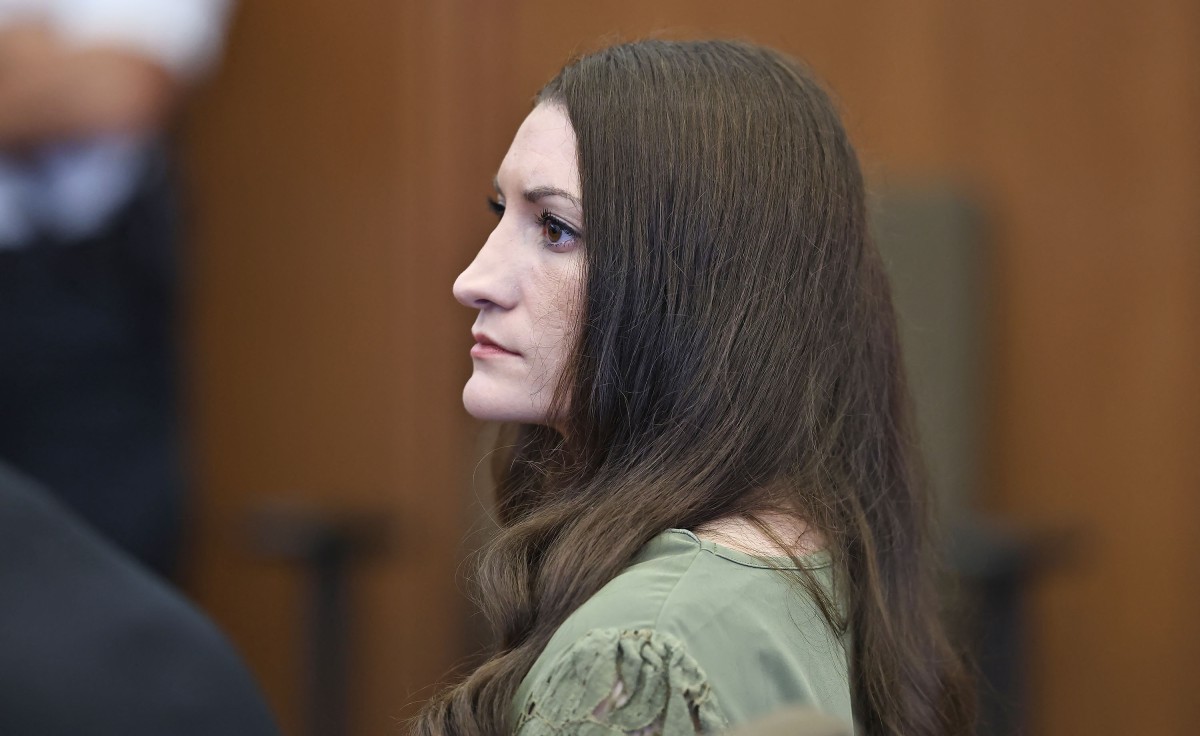
On Friday (September 4), the trial of Lindsay Clancy, a mother from Massachusetts in the United States who killed her three biological children, was declared a mistrial. A jury of 12 previously stated that they could not reach a unanimous decision on whether Clancy should be held criminally responsible for her actions.
In January 24, 2023, Lindsay Clancy, a former labor and delivery nurse from Duxbury, Massachusetts, strangled her three young children at home using a resistance band: 5-year-old Cora, 3-year-old Dawson, and 8-month-old Callan (who died a few days later).
At the time, she had sent her husband Patrick out to get takeout food and medication, then proceeded to cut her wrists, cut her neck, and attempted suicide by jumping out of a second-floor window, which left her paralyzed from the waist down. She is currently detained at a state mental health hospital for treatment.
Friday marked the seventh day of deliberation for the Clancy case jury, and the outcome was reached after weeks of emotional testimony and days of tense waiting, during which the jury debated vigorously in closed-door sessions and repeatedly reported being deadlocked. A note from the jury foreperson indicated that only one member held a divergent opinion. Judge William Sullivan had urged them multiple times to continue efforts to reach a verdict.
Ultimately, when the jury indicated on Friday that they were still unable to break the impasse, Judge Sullivan announced the mistrial. Defense lawyers attempted an emergency appeal to continue deliberations or replace the “obstreperous” juror, but the request was rejected by the Massachusetts Supreme Court.
The American public has been closely following this trial, and the next possible scenarios are as follows:
According to a report from CBS News Boston, a mistrial means that the defendant’s status reverts back to pre-trial, and Clancy will remain in custody and receive psychiatric care at Tewksbury State Hospital. She has been detained there since 2023.
If Clancy is found not guilty by reason of insanity, she will be held indefinitely in a mental health facility; if she is found criminally responsible for the murders, she would be sent to prison.
Prosecutor Timothy Cruz, from Plymouth County, will decide whether to retry Clancy for first-degree murder or lesser charges with a new jury, or consider reaching a plea deal. Cruz may also opt not to retry the case.
Following the announcement of the mistrial, Cruz stated in a press conference outside the courtroom that he would not immediately disclose any related plans. He said, “I will meet with our team and proceed at the appropriate time in conjunction with the formal court process to further address this case.”
Clancy’s defense attorney, Kevin Reddington, had earlier stated this week that he was prepared for a retrial if necessary, but believed Clancy was not emotionally ready for a second trial. Questioned about this comment at the Friday press conference, Reddington said, she would be prepared if a retrial occurred in the fall.
Reddington had previously criticized Cruz for charging Clancy with first-degree murder, as that charge mandated a jury trial. A lesser charge could have allowed for a bench trial conducted by a judge or a plea deal.
CBS News legal analyst Caroline Polisi expressed that a mistrial due to a hung jury is a “heartbreaking result,” but she believes the prosecution will consider a retrial.
Polisi pointed out that in Karen Read’s case, after a mistrial due to a hung jury in 2024, the prosecution “immediately rolled up its sleeves” and conducted a second trial; ultimately, Read was acquitted in the retrial.
“I think they are likely to try again,” Polisi said.
Jessica Levinson, a professor at Loyola Law School and legal commentator for CBS News, shared a similar view.
“I think they are entirely likely to move forward with a retrial for several reasons,” Levinson said. “First, sometimes you see a significant shift in attitudes by jurors between two trials. Second, the prosecution can present a radically different theory of the case.”
She noted that the prosecution wouldn’t have to present a choice of first-degree murder, second-degree murder, manslaughter, or insanity defense to the jury, but “might offer a much more streamlined narrative. Additionally, a plea agreement could be reached.”
Polisi suggested that if a retrial occurs, the prosecution would have the opportunity to adjust or improve its strategies. For example, she recommended reconsidering the argument about Clancy “faking a suicide.”
“I believe they will significantly streamline the case, no longer trying to downplay her mental health but recognizing her severe depression at the time,” Polisi stated in a previous interview. She noted the focus could shift to “whether she could distinguish right from wrong” instead of proving it was a fake suicide attempt.
She mentioned that both sides would want to understand the viewpoints of those non-unanimous jurors as it would impact future decisions and litigation strategies.
“If this case goes to a retrial, we may see a completely different set of argument strategies,” Polisi added.
Legal analyst Jennifer Roman from CBS Boston station WBZ-TV suggested that both parties would likely reflect on what steps they could improve upon.
Polisi further indicated that a retrial would potentially favor the prosecution in several aspects.
“They can streamline the trial, review the gains and losses of the first hearing, and make improvements,” she explained. “And the defense won’t bring any surprises this time.”
“I do think that’s the case here because, from what I’ve seen, the prosecution made some quite serious mistakes in this trial. They will have a second chance to rectify those missteps. I think the case will be stronger during the retrial.”
The specific reasons that led the jury to deadlock are currently unclear due to the confidential nature of deliberations. The jury faced five options at the time: not guilty by reason of insanity, first-degree murder, second-degree murder, or manslaughter, with any decision requiring a unanimous agreement.
A key point of dispute in this case was whether Clancy should be held criminally accountable for killing her children or if she was unable to grasp her actions due to mental illness.
Both the prosecution and defense attorney Reddington acknowledged Clancy’s mental health issues, but there was a disagreement on the extent of her responsibility. The prosecution argued Clancy premeditated the murders and had the capacity to distinguish right from wrong, while the defense contended she had taken an overdose of drugs at the time and suffered from postpartum psychosis.
During the trial, the jury heard testimony from 85 witnesses and reviewed over 200 pieces of evidence.
This case has sparked widespread attention across the United States, with supporters, protesters, and counter-protesters appearing at the courthouse and intense online discussions taking place. Polisi stated that the failure of the jury to reach a unanimous decision was not surprising.
“It’s a microcosm, isn’t it? We are in a complete deadlock, and it’s no surprise, because look at everyone outside,” Polisi said. “If everyone outside can’t reach a consensus, how could the jury possibly come to one?”
Psychologist and jury consultant Laura Niemi told CBS News Boston on Monday that jurors faced “a very challenging task.”
“It’s not just about understanding medical evidence, nor is it just about reconciling those conflicting diagnoses,” Niemi said. “The jurors must integrate all this information into a coherent narrative.”