
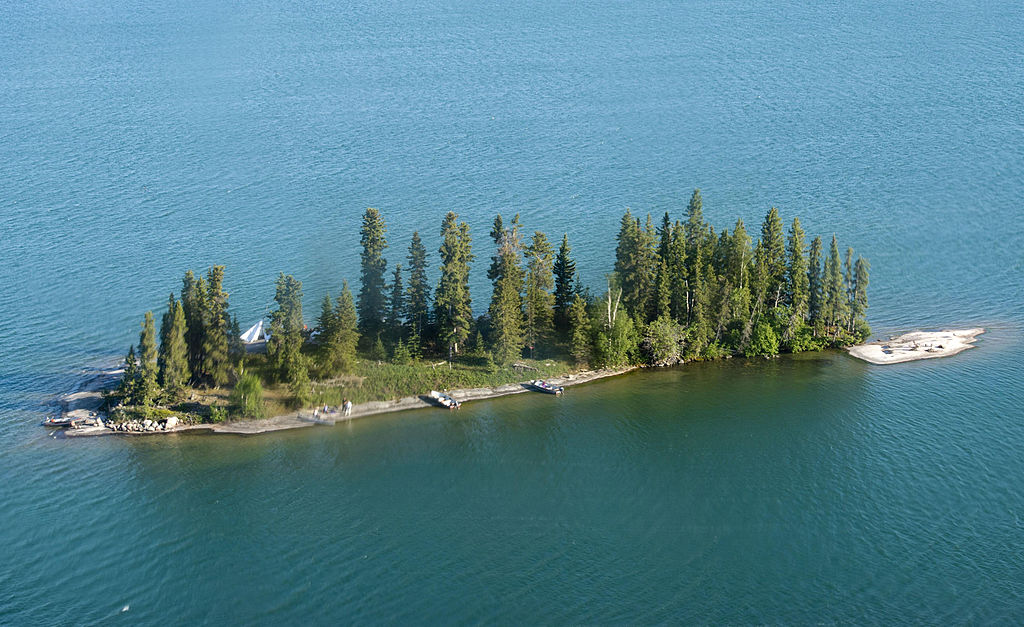
In a rare and fascinating sight, a massive “floating island” covered in trees that resembled a complete forest suddenly appeared in the Williston Reservoir in British Columbia, Canada. This island, measuring approximately 140 meters long, 70 meters wide, and occupying an area of about 9800 square meters, equivalent to two football fields, captured the attention of local residents, media, and scientists as it floated silently on the water’s surface. However, in August of this year, the mysterious island vanished without a trace for 15 days, only to reappear 30 kilometers away, leaving everyone astonished.
This extraordinary island, with dense vegetation and fully grown trees, looked like a small forest uprooted and drifting on the water when viewed from a distance. The event quickly garnered global media attention, prompting scientists to question how this floating island was formed and how it managed to drift on the water’s surface.
The mysterious floating island was initially discovered by local residents, with Rocky Avery’s friend capturing footage of the tree-covered island at the Williston Reservoir and sharing it with him. Avery, who has lived in the area for over 48 years, expressed shock at the unusual sight, stating that the movement of the island with the water’s waves from the boat he was on confirmed its existence, describing it as truly incredible.
He later shared the footage with BC Hydro and the Tsay Keh Dene First Nation. Bob Gammer, the manager of BC Hydro, initially doubted the authenticity of the photos and videos received on August 13, suspecting it to be AI-generated or a prank, until satellite imagery confirmed the existence of the “floating island.” The mystery was finally unraveled on August 31, revealing that the floating island had drifted 30 kilometers away rather than vanished into thin air.
Using satellite imagery, low-altitude observations, and information provided by boaters, BC Hydro gradually reconstructed the floating island’s movement route. It was speculated that the floating island first appeared near Finlay Bay in the reservoir around July 21, and by August 15, satellite images showed it had moved to the Ospika Arm area, approximately 30 kilometers from its original position. The company assured that the floating island’s movement would not impact the reservoir’s operations.
Though the cause of this floating island remains partially unknown, BC Hydro proposed a reasonable theory. The Williston Reservoir, created by the construction of the W.A.C. Bennett Dam, accumulated a significant amount of fallen wood, woody debris, and other plant materials along the wind-sheltered shores over the years. As the wood decomposed and plant roots intertwined the materials, a buoyant “wooden platform” might have formed.
With rising water levels and wind forces, these wooden platforms that were originally stuck on the shores or shallow waters could detach from the land, turning into a “forest island” floating on the water’s surface.
While large floating vegetation islands are not unprecedented, the rarity of such a massive floating island covered in mature trees has piqued the interest of geologists, ecologists, and other researchers. Scientists are currently working to determine the timeline of the island’s formation, the stability of its wooden structure, whether it harbors birds, small animals, or fish, and if it might drift away from the shore again in the future.
BC Hydro mentioned that geologists and ecologists are actively monitoring the situation. Due to the unstable nature of the floating island, the company cautioned the public against attempting to land on or climb the island, suggesting boat rides or the use of drones for observation to avoid potential hazards.