
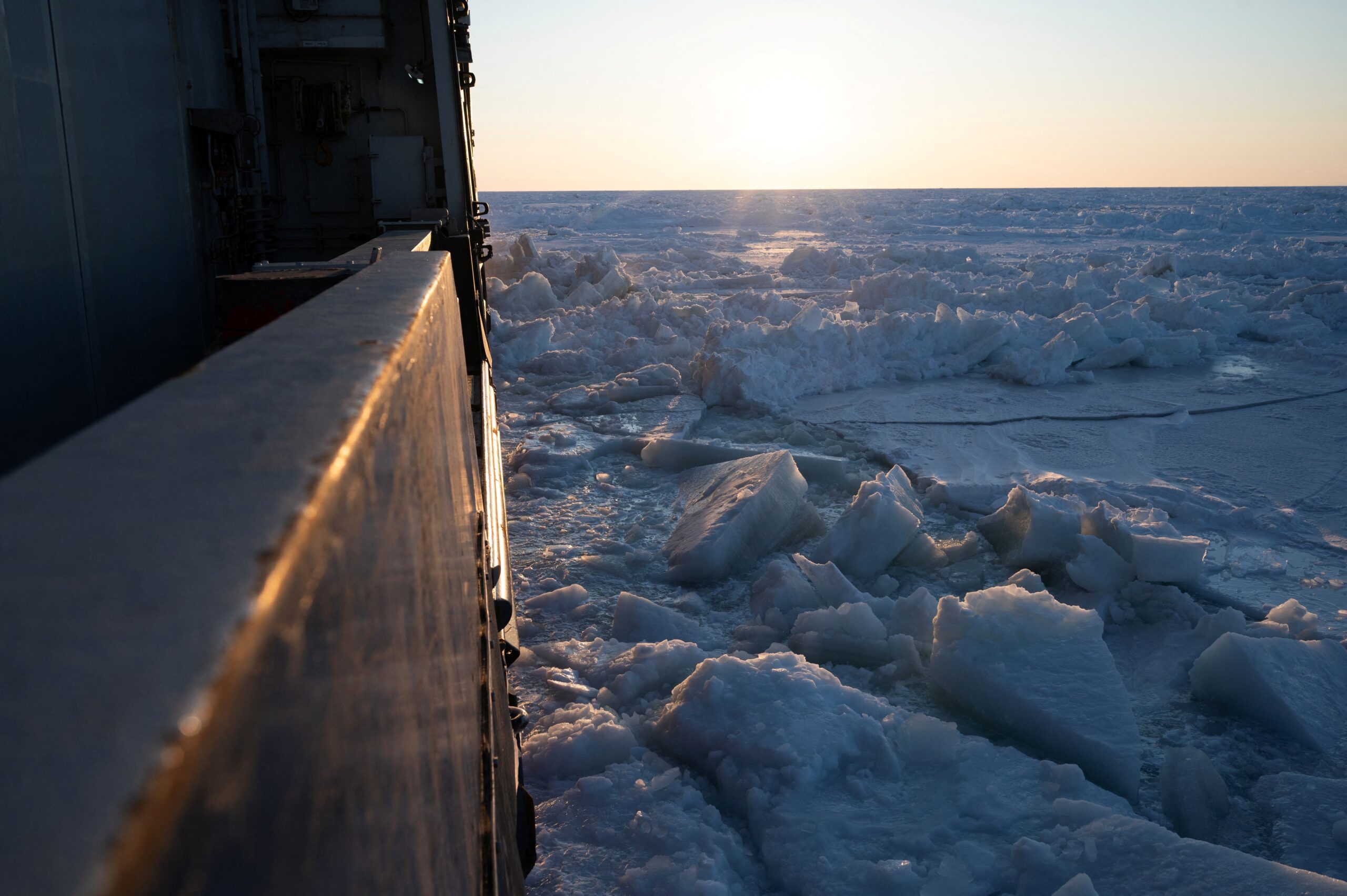
For the past few weeks, both Canada and the United States have been closely monitoring the movements of two Chinese icebreaker research vessels in the Arctic Ocean near Alaska.
According to the United States Coast Guard, the two Chinese vessels are respectively named as “Xuelong” and “Xuelong 2”. These two ships sailed into the U.S. exclusive economic zone in the Bering Sea in July and headed north towards the Arctic region.
The U.S. authorities have stated that foreign vessels sailing in the U.S. exclusive economic zone do not violate international law per se, but for activities related to oceanic research, the U.S. mandates obtaining prior permission.
The Canadian Department of National Defence confirmed that the Canadian military is currently cooperating with the United States to closely monitor the movements of these two ships. Cheryl Forrest, a spokesperson for the Department of National Defence, stated in a written statement, “Canadian Joint Operations Command is actively monitoring maritime traffic in the Arctic, including the ‘Xuelong’ and ‘Xuelong 2’.”
Data compiled by independent research consultant and vessel tracking expert Steffan Watkins shows that a CP-140 reconnaissance aircraft from the Royal Canadian Air Force has been on mission in Alaska since early July.
Forrest also mentioned that the two Chinese vessels are currently operating outside of Canada’s exclusive economic zone. Canada holds sovereignty rights in its exclusive economic zone and has jurisdiction over activities such as marine environmental research and protection.
In recent years, Chinese research vessels have entered the Arctic region almost every summer, gradually raising concerns among Western security and defense officials.
According to CBC, Canada began enhancing surveillance in northern sea areas last year through “Operation Latitude” and coordinating with allies, including the United States, and paying particular attention to the North Pacific region, including the Bering Sea off Alaska.
The Royal Canadian Navy has deployed the HMCS Ottawa frigate as well as the Arctic offshore patrol vessels HMCS Max Bernays and HMCS Harry DeWolf, and coordinating with the Royal Canadian Air Force surveillance aircraft on missions.
The Canadian Department of National Defence stated that personnel from Canadian Special Operations Forces Command and the icebreaker CCGS Des Groseilliers are also involved in related operations.
On August 6, when asked about the Chinese vessels, Defence Minister David McGuinty stated that the Canadian military is actively monitoring Canadian waters.
China has consistently claimed that its icebreaker research vessels entering the Arctic are mainly for peaceful scientific research, environmental monitoring, and global climate change research.
However, Western defense officials have noticed that both the “Xuelong” and “Xuelong 2” are equipped with advanced sonar and remote sensing buoys. Apart from collecting scientific data on marine environments and seabed topography, these equipment could also be used to detect and track submarine activities underwater.
Richard Shimooka, a defense researcher at the Ottawa-based Macdonald-Laurier Institute in Canada, mentioned his concerns about underwater infrastructure near the Bering Sea. While there are no major transoceanic underwater cables in the area, there is an important regional submarine communication network in the Alaska region.
Shimooka expressed his concern that Chinese research vessels are spending a considerable amount of time mapping the submarine communication network, similar to the activities Russia has conducted in the Baltic Sea and North Atlantic.
He noted that while the U.S. Navy is preoccupied with tensions in the Middle East, Canada is playing an increasingly vital role in the western Pacific. However, given the aging of Canadian navy patrol ships and coast guard vessels, Canada’s capabilities are limited.
“We are nearing the limit of what can be easily sustained, particularly considering the aging of the Halifax-class patrol ships,” he said.
The Halifax-class patrol ships are dubbed as the “spine of the Royal Canadian Navy,” with some ships now being 30 to 40 years old.
Canadian defense researchers have pointed out that with increased activities by China and Russia in the Arctic, Canada needs to allocate more resources to focus on the region.
Members of the House of Commons Standing Committee on National Defence from Canada visited the Arctic in mid to late July this year. Conservative defense affairs critic James Bezan stated that China (PRC) continues to increase its interest in the Canadian Arctic region, with China (PRC) and Russia also enhancing cooperation in aerial activities in the Arctic.
Bezan warned that these activities are challenging and testing Canada’s response capabilities.
In response to the changing Arctic security situation, the Canadian government has started increasing related investments, including constructing new destroyers, initiating the procurement of submarines with Arctic operational capabilities, and planning to deploy an underwater sensor network.
Bezan emphasized that time is of the essence as this is not just a military issue but also concerns Canadian sovereignty in the Arctic region.
He highlighted that neither China (PRC) nor Russia recognizes Canada’s rights in the far northern maritime areas, including the Northwest Passage, so Canada must increase investments and defense efforts in the Arctic.
“The Arctic holds abundant resources, a significant portion being energy resources, including those in the Beaufort Sea. We must take more measures to protect these resources and withstand these adversaries,” he said.