
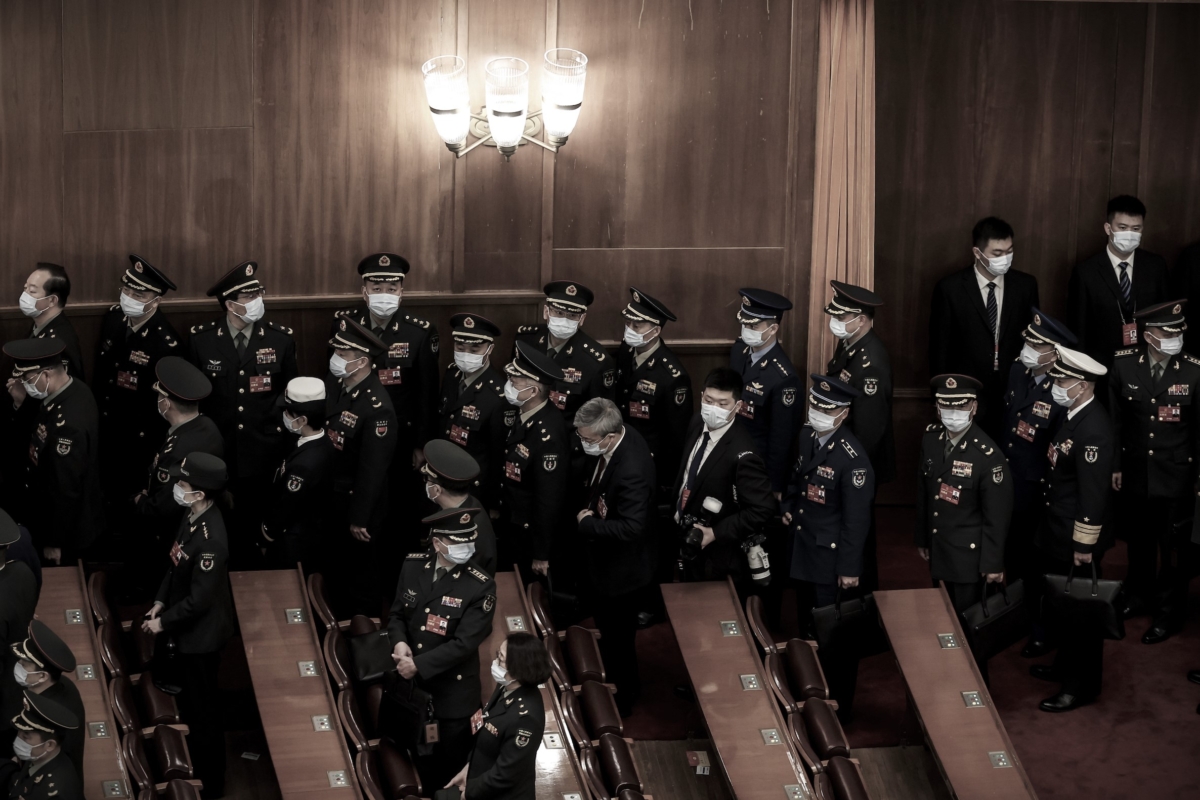
Rumors of infighting within the Chinese Communist Party’s military continue to escalate. Recently, Vice Chairman Zhang Youxia and Member of the Central Military Commission Liu Zhenli were relieved of their positions; at the same time, there are overseas reports that former Beijing Military Region Commander Zhang Shib and former Beijing Military Region Political Commissar Song Puxuan have had their homes searched by the authorities, though these related reports have not been officially confirmed. Xi Jinping’s sweeping purge has also affected a large number of retired generals, many of whom have mentored and worked alongside each other in the military. If the authorities push too hard, could this trigger a backlash?
Independent commentator Cai Shenkun posted on social media on September 3, stating that former Beijing Military Region Commander Zhang Shib’s home was suddenly searched. Zhang Shib, a native of Zhuji, Zhejiang, shares the same hometown as Zhong Shaojun. In order to cozy up to Xi at the 18th National Congress, Zhang Shib arranged for Xi’s inspection before the August 1st military parade to be held at the Beijing Military Region through Zhong Shaojun. However, Xi did not trust Zhang Shib, and in 2014, Zhang Shib and Song Puxuan were reassigned to serve as presidents of the National Defense University. Dramatically, Zhong Shaojun’s final destination was also the National Defense University, where he was demoted to political commissar in 2024, until this recent official announcement of the incident.
The post screenshots show that Zhang Shib’s villa in Zhuji, Zhejiang was raided, and the military discipline inspection commission dispatched two vehicles to Song Puxuan’s home. It is said that the Chinese authorities have not made this matter public and seem to be handling it discreetly.
This news points to both Zhang Shib and Song Puxuan having their homes raided, but the information is currently unverifiable.
Zhang Shib, born in February 1952, served long term in the Jinan Military Region, and at the end of 2007, he was appointed as the commander of the Hong Kong garrison. In July 2009, Zhang Shib was promoted to major general; in October 2012, he was transferred to be the Beijing Military Region Commander. In December 2014, he switched roles with Major General Song Puxuan and served as the president of the National Defense University. On July 31, 2015, he was promoted to the rank of General.
Song Puxuan, born in March 1954 in Boxing, Shandong, became the commander of the 54th Group Army in 2006, the deputy commander of the Nanjing Military Region in 2009, and was promoted to major general in 2010. In July 2013, he served as the president of the National Defense University. In December 2014, Song Puxuan switched roles with Zhang Shib and became the Beijing Military Region Commander. On July 31, 2015, he was promoted to the rank of General. On September 3, 2015, Song Puxuan served as the overall commander in the military parade in Beijing, accompanying Xi Jinping in reviewing the troops.
In January 2016, Song Puxuan was appointed as the first commander of the Northern Theater Command. In August 2017, he was reassigned as the Minister of Logistics Support of the Central Military Commission. However, at the subsequent 19th National Congress of the Chinese Communist Party, Song Puxuan unexpectedly failed to be elected as a Central Committee member. He retired in April 2019 and was appointed as the Vice Chairman of the National People’s Congress Education, Science, Culture, and Health Committee in August 2020.
Cai Shenkun’s post implied that Zhang Shib’s previous promotion was related to Major General Zhong Shaojun, who was just removed from his position as a representative of the National People’s Congress.
Zhong Shaojun, a native of Kaihua, Quzhou, Zhejiang, had been Xi Jinping’s personal secretary for 22 years before taking over the important position of the General Office of the Central Military Commission. In recent years, there have been multiple rumors about his downfall. It was not until August 28 that the Standing Committee of the National People’s Congress of the Chinese Communist Party issued an announcement, revealing that Zhang Youxia, Liu Zhenli, Ju Qiansheng, and Zhong Shaojun had been removed from their positions as the representatives of the 14th National People’s Congress. The news of Zhong Shaojun’s downfall was only officially confirmed by the Chinese Communist Party at that time.
However, the relationships within the Chinese Communist Party are complex. Song Puxuan and Zhang Shib had previously worked together with Liu Yazhou, a member of the “Crown Prince Party” who had been secretly sentenced, at the National Defense University (Liu was the political commissar of the National Defense University). It is said that Liu Yazhou had a good relationship with them. Song Puxuan, Zhang Shib, and Zhang Youxia, Liu Zhenli, who have held important positions in the military for many years, may also have had close interactions.
On January 24 this year, Zhang Youxia, Vice Chairman of the Central Military Commission, and Liu Zhenli, member of the Military Commission and Chief of Staff of the Joint Staff Department, were both announced to be under investigation.
On the afternoon of February 6, the Chinese Military Commission held a cultural performance to welcome the Lunar New Year for retired cadres stationed in Beijing. Xi Jinping, also the Chairman of the Military Commission, watched the performance and extended greetings to the retired cadres.
In the scene, several young tall men in military uniforms with solemn expressions were visible, especially when a young soldier appeared nervous while shaking hands with Xi Jinping and the retired cadres.
This so-called comforting event appeared warm and peaceful, but the scene exposed the potential for internal turmoil within the Chinese military.
An article published in the Chinese Communist Party’s military newspaper on February 9 claimed that “the residue of corruption has not been thoroughly eliminated,” which was interpreted by the public as the ongoing cleansing within the military possibly extending to more retired senior generals.
It’s worth noting that in recent years, many retired senior generals have run into trouble, such as former Navy Commander Shen Jinlong, former Navy Political Commissar Qin Shengxiang, former Air Force Political Commissar Yu Zhongfu, and former Air Force Political Commissar Guo Puxiao, who were relieved of their positions as National People’s Congress representatives in the first half of this year, some of whom had previously been rumored to be in trouble. However, more retired generals implicated in rumors of downfall are not current members of the National People’s Congress or the Political Consultative Conference, and thus have not been publicly confirmed by the authorities, like former member of the Central Military Commission and first Minister of Logistics Support Department Zhao Keshi, former Army Commander Han Weiguo, etc.
In addition, on August 17, an official event celebrating the centenary of former Party leader Jiang Zemin’s birthday was held by the Chinese Communist Party. However, former member of the Military Commission and former Chief of the Joint Staff Department of the Central Military Commission, General Li Zuocheng, was absent, sparking speculation.
On August 28, the Standing Committee of the National People’s Congress decided to dismiss Zhang Youxia from his position as Vice Chairman of the National Central Military Commission and to remove Liu Zhenli from his position as a member of the National Central Military Commission. Both were also relieved of their positions as National People’s Congress representatives. According to insiders familiar with the system, the official dismissal of Zhang and Liu has once again shaken the military, leaving active-duty officers feeling angry and helpless, while retired generals have shown strong reactions.
The author believes that when Xi Jinping began investigating the Rocket Force and Equipment Department earlier, it had already stirred up the retired old generals. For instance, former Vice Chairman of the Military Commission Xu Qiliang was suddenly announced to have died from illness in June 2025, leading to various rumors online claiming that his death was “unnatural” or that he was “scared to death.”
A widely recognized context of power struggles is that Xi Jinping’s initial military purge had Fujian faction insider and Vice Chairman of the Military Commission Ho Weidong orchestrating the operation, targeting Zhang Youxia and bringing down a large number of Zhang Youxia’s associates. However, Zhang Youxia counterattacked, resulting in Ho Weidong’s downfall. Additionally, military personnel allied with Ho, such as personnel chief Miao Hua, also fell from grace one after another. Seizing the opportunity, Zhang Youxia seized power on his own, marginalizing Xi Jinping and ultimately Xi Jinping, with the help of outside forces like Cai Qi and Wang Xiaohong, along with the defection of the Military Discipline Commission Secretary Zhang Shengmin, brought down Zhang Youxia and his ally Liu Zhenli. This internal feud within the military created a chaotic situation: the original military personnel configurations overseen by Xi were shattered.
The fifth plenary session of the Chinese Communist Party will be held in October, with the theme announced as “Party consolidation.” It would not be surprising if the authorities announce the expulsion of Zhang Youxia from the Party and the military, and even raise the issue of an “anti-Party group.” Before the fifth plenary session, Xi Jinping will continue to investigate the old generals, mainly targeting the supporters of Zhang Youxia and Liu Zhenli. It is possible that some of their grievances have been monitored and reported by the spies dispatched by Xi. While these retired senior officers may not have the ability to overthrow, many of them have current subordinates in the military. If Xi pushes too hard, it may also provoke a backlash.