
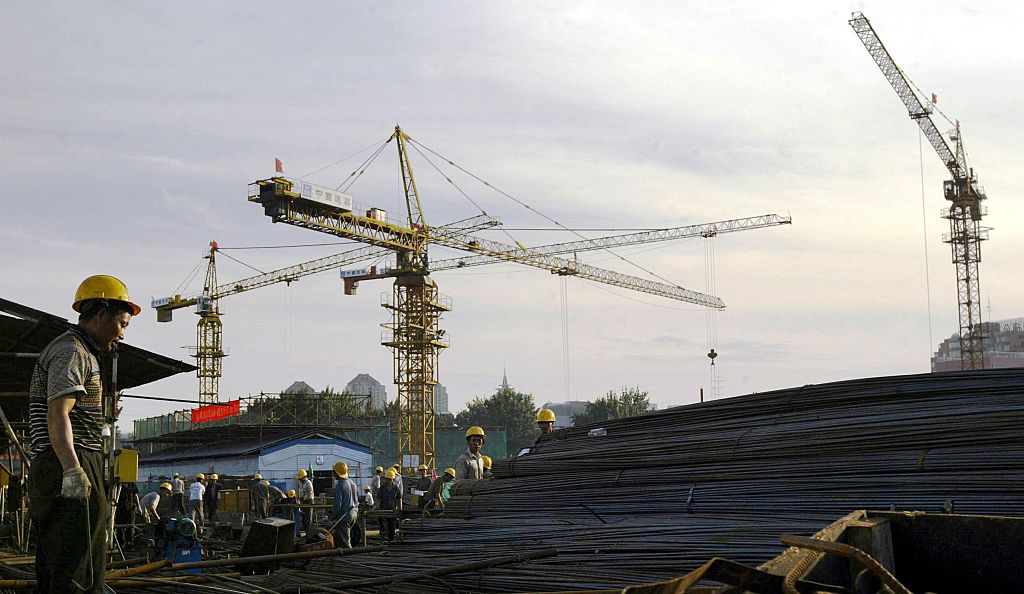
Beijing held its first high-priced land auction after the introduction of new regulations for existing property sales on Thursday (September 3). Out of the two residential land parcels originally intended for sale, one was suddenly suspended before the on-site bidding, while the other, despite going through 174 rounds of bidding, only had two groups of bidders. Analysts believe that the recent new real estate policies by the Chinese Communist Party have extended the period for funds to return from existing property sales, prompting real estate developers to be more cautious in land acquisition.
According to the “Daily Economic News,” the total starting price of the two land parcels amounted to 14.592 billion yuan.
Among them, the starting price of the Chaoyang District Jiu Tai Village Camel Fang Campsite land parcel was 7.521 billion yuan. Consortiums such as China Overseas Land & Investment, China Construction Intelligence Land real estate, Swire Properties, and China Resources Land had registered, but only China Overseas Land & Investment collected a bidding number plate at the scene. Just before the auction began, the staff suddenly announced a halt to the sale.
The Beijing Municipal Planning and Natural Resources Commission did not explain the reason for the suspension, nor did they disclose when the land parcel would be reintroduced.
The project includes a residential land parcel and three sports venue land parcels. The winning bidder must not only pay for the land but also invest around 980 million yuan in constructing the sports venue, underground commercial space, and parking spaces, which will be transferred to the relevant authorities free of charge upon completion.
Chinese economic expert Mike Li told Dajiyuan that although three groups of real estate companies had registered, only one collected a bidding number plate at the scene, indicating that developers are becoming more cautious in land acquisition. He believes that a lack of actual participants may be a crucial reason for the suspended sale.
The transaction completed that day was for the Wenyuhe land parcel in Shunyi District, with a starting price of 7.071 billion yuan. The only participants in the auction were the state-owned enterprise China Resources Land and a consortium composed of Beijing state-owned enterprises China National Chemical Engineering Group Corporation and Maoyuan.
According to “The Paper,” after 174 rounds of bidding, China Resources Land won the bid with 8.299 billion yuan, with a premium rate of 17.37%, meaning the final price was approximately 1.228 billion yuan higher than the starting price.
Mike Li stated that since the 1990s, the Wenyuhe area has been developing villa projects, with early residents and tenants mainly comprising foreign embassy personnel and multinational corporate executives, hence being called the “Central Villa Area.” After over 20 years of development, the local commercial and educational facilities have gradually improved, but the number of foreign residents has decreased.
He expressed that the housing supply in the Shayu block after 2025 is about 2.31 times the demand, with an increase expected in 2026. He estimated that the future selling price of China Resources Land’s project could exceed 80,000 yuan per square meter; to maintain a relatively normal profit margin, the selling price may reach 85,000 to 100,000 yuan.
Mike Li believes that even with China Resources Land’s stronger financial strength, in a situation where the supply continues to increase, there is still a significant risk in successfully selling these high-priced residential properties.
On August 7, Beijing relaxed housing purchase restrictions, allowing non-Beijing residents who have paid social security or personal income tax continuously for at least one year to purchase housing outside the Fifth Ring Road without a restriction on the number of units. Mike Li believes that one of the goals of China Resources Land’s high-priced land acquisition may be to attract non-Beijing residents with stronger purchasing power, indicating that this transaction also supports Beijing’s land prices.
Zhang Kai, head of land market research at the China Real Estate Information Corporation, told the “Daily Economic News” that this land parcel has a plot ratio of only 1.01, mainly for low-rise residential buildings with relatively shorter construction periods, meaning its impact from the new regulations on existing property sales is less than that of high-rise residential projects. However, the housing supply in the Shayu block is still increasing, leading to accumulating pressure on inventory digestion.
On August 28, the Chinese Communist Party’s Ministry of Housing and Urban-Rural Development and other departments issued new regulations on the sale of commercial housing. Although the regulations did not entirely abolish pre-sale housing, they stipulated that residential projects on newly released land must prioritize existing property sales; even projects still using pre-sale methods must wait until the main structure is completed before selling units.
In the past, developers could sell pre-sale housing after reaching a certain stage of construction, using the home purchase funds to continue building. With the implementation of existing property sales, developers typically have to wait until the houses are substantially completed before receiving the bulk of the sales funds, potentially tying up funds for two to three years. The home purchase funds must also be deposited into a regulatory account and cannot be easily transferred to other projects.
Mike Li stated that the new regulations delay the time when developers receive most of the sales funds, prolonging the period their own funds are tied up, slowing down turnover, squeezing profit margins, and increasing the development risks of projects.
An analysis report by Caitong Securities mentioned that existing property sales would extend the development cycle, reducing the number of projects that can be simultaneously developed with the same scale of funds. Zhang Kai believes that influenced by the new regulations, the Beijing land market cooled significantly compared to July and August, with the intensity of bidding on September 3 far below previous auctions.
Data from China Real Estate Information Corporation shows that as of the end of June this year, Beijing’s new housing inventory was close to 90,000 units, requiring about 31 months to digest the existing inventory based on the sales pace of the past 12 months, with some suburban areas requiring an even longer time.