
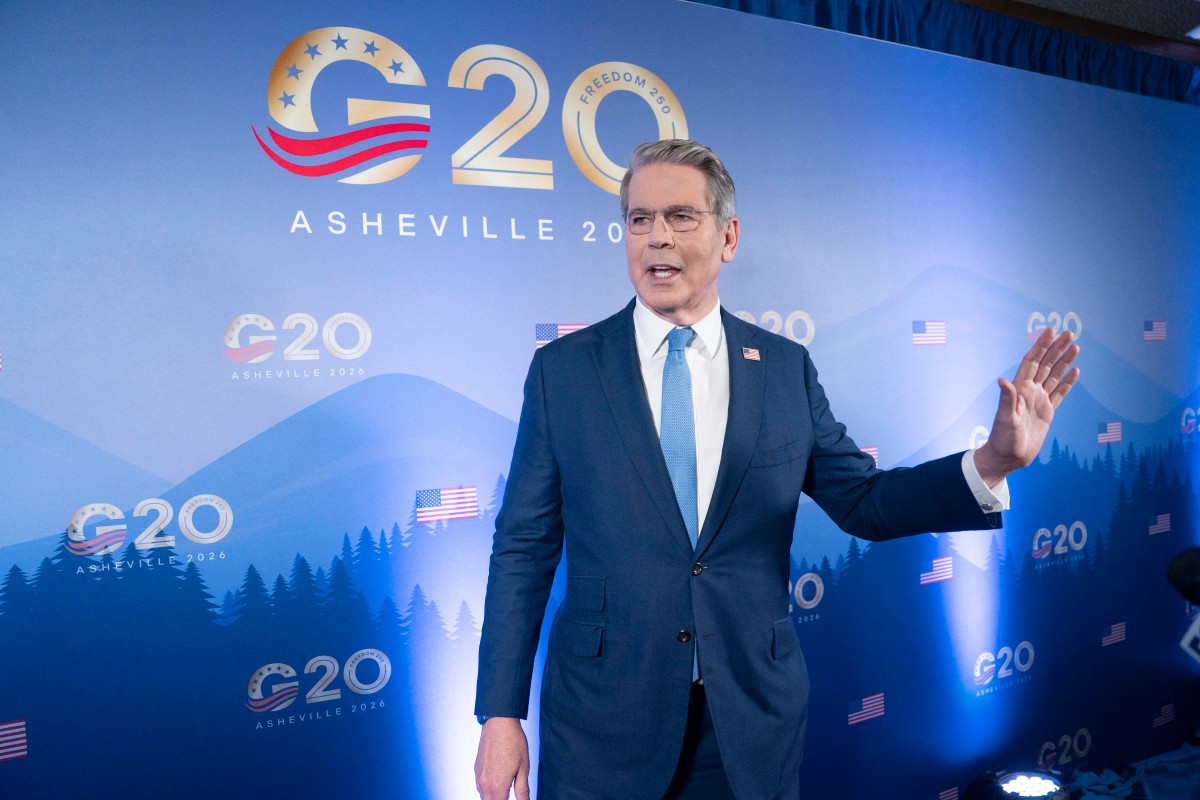
The G20 finance ministers and central bank governors have concluded their meeting with 19 member countries agreeing to address the global economic imbalances caused by “non-market” policies and massive cheap exports. Scott Bessent, the US Treasury Secretary, stated that due to China’s obstruction, a joint communique could not be issued at this meeting.
The G20 meeting, composed of developed countries from Europe and America as well as emerging market countries such as China and Russia, ended its second day of discussions in Asheville, North Carolina on September 1st. The meeting focused on various issues including global macroeconomic conditions, global growth, global imbalances, international debt, and financial risks.
Russian Finance Minister Anton Siluanov attended the meeting in the United States, marking his first participation in a G20 meeting in four years since the outbreak of the Russia-Ukraine conflict in 2022. Bessent and Siluanov held a rare one-on-one meeting during the conference, representing a rare face-to-face interaction between the economic leadership of the US and Russia.
Chinese central bank governor Pan Gongsheng and Deputy Finance Minister Liao Min led the Chinese delegation at the meeting and delivered speeches.
As the rotating chair country of the G20, the US government secured agreement from 19 member countries (including Russia) at this G20 meeting to take action against the global economic imbalances caused by “non-market policies and massive cheap exports,” although the Chinese delegation expressed objections.
According to convention, the issuance of a joint communique depends on whether all member countries can reach 100% consensus on the text. If one country strongly opposes a core clause, the joint communique cannot be issued.
Following the meeting, the US Treasury Secretary Scott Bessent stated during the closing press conference that due to disagreements over China’s massive trade surplus issue, the G20 finance ministers and central bank governors could not release a joint communique after this meeting, only issuing a G20 chairman’s statement. “We believe that continuously exporting cheap goods from non-market economies is not a sustainable practice. It is clear that the country with the largest and unsustainable current account surplus globally – China, is the country holding dissenting views.”
The G20 chairman’s statement released by the US Treasury after the meeting revealed that the Chinese delegation also raised objections on multiple issues, including free navigation of ships in the Hormuz Strait, establishing a working group to further study and alleviate trade imbalances, granting the International Monetary Fund (IMF) oversight authority over trade imbalances, and terms related to debt restructuring.
Bessent emphasized at the closing press conference that countries with excessive and long-standing external surpluses should abolish distorting policies that restrict domestic consumption and lead to overreliance on exports, as these measures “have harmful spillover effects on the global, regional, and domestic markets, exacerbating economic dependencies.”
He stated, “I believe that endlessly dumping cheap exports from non-market economies is unsustainable. When all 19 member countries want to address this issue, it speaks to the severity of the problem.”
On September 2nd, the Chinese Ministry of Finance released a statement that did not directly respond to Bessent’s remarks and did not agree with the content of the chairman’s statement.
China’s trade surplus reached a historic high of $1.2 trillion in 2025, with the trade deficit between China and the EU continuously expanding, reaching €360 billion in 2025, also setting a historic high.
Valdis Dombrovskis, the European Commission’s Vice-President for Economic Affairs, stated at the G20 meeting that China is a significant source of global economic imbalances.
Scott Kennedy, Senior Advisor at the Center for Strategic and International Studies in Washington and Director of the China Business and Economics Program, told Voice of America that many countries around the world are concerned about China’s growing trade surplus.
“I believe that whether as members of the G20 or not, countries from the global North and global South are concerned about their trade and investment relations with China, partly due to China’s ever-expanding trade surplus with many countries. This surplus is partially due to industrial policies that encourage exports amid weak domestic demand in China. Therefore, this has raised concerns among many countries, particularly China’s trading partners. So I think these concerns do exist.”
In addition to trade imbalances, China’s restriction on rare earth exports in the critical mineral processing sector is also a key issue of concern for some G20 member countries.
Japanese Finance Minister Aya Shionzaki stated during a press conference that she has informed other G20 member countries that unilaterally restricting exports of critical minerals is harming the global economy and these restrictions should be lifted.