
The United States national debt has surpassed $40 trillion, hitting a historic high and reaching nearly 100% of the Gross Domestic Product (GDP) for the first time since World War II.
The majority of funds for the U.S. Treasury come from the global bond market, including individual investors, retirement funds, banks, and foreign governments.
According to data released by The Brookings Institution based in Washington, D.C., as of mid-2025, foreign officials and private investors collectively held about 40% of outstanding U.S. Treasury debt.
The Brookings Institution points out that the willingness of foreign investors to purchase and hold U.S. Treasuries directly impacts America’s borrowing costs, the dollar exchange rate, and financial stability.
Some believe that the $40 trillion debt is not only a warning for the future but also a contributing factor to the current cost of living crisis.
Readers of the Epoch Times have evaluated the economic risks, ultimate responsibility, and potential solutions regarding the U.S. national debt.
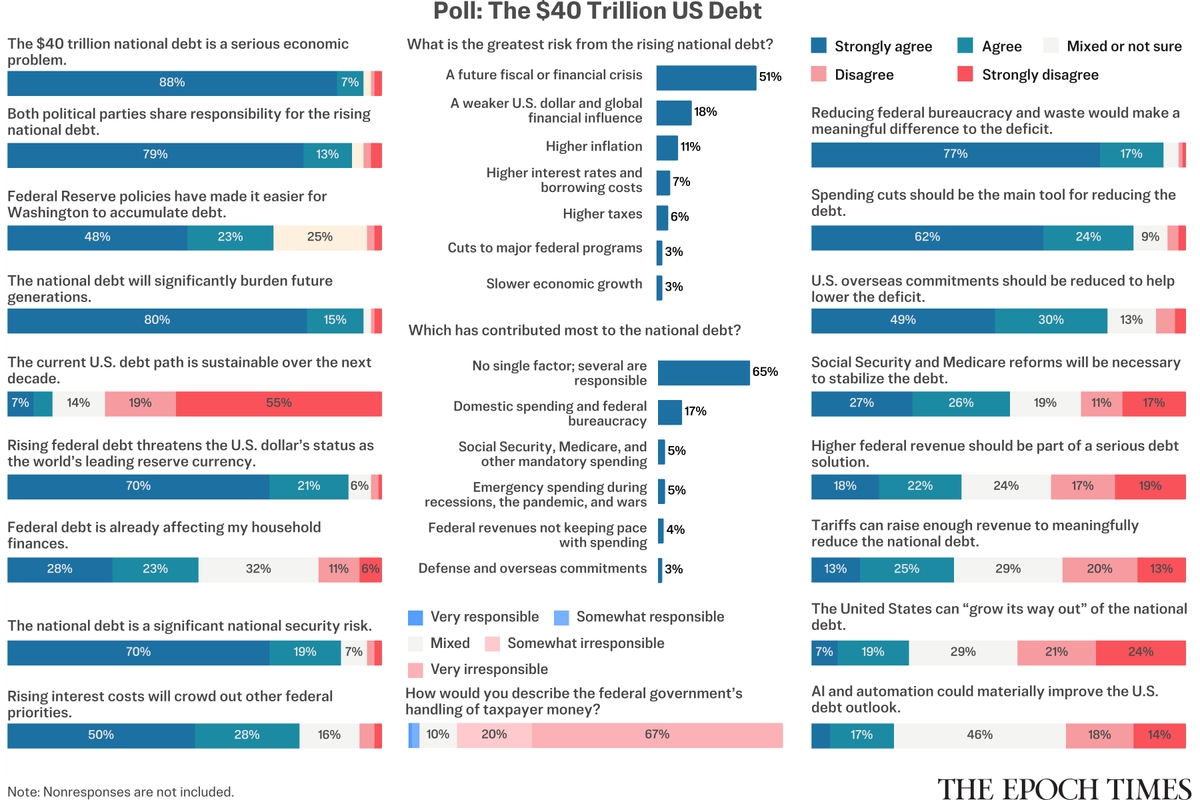
A staggering 95% of respondents consider the national debt a significant economic issue.
Over 50% of respondents believe that the continuous growth of U.S. debt poses a major risk of potential fiscal or financial crises in the future. Furthermore, 95% feel that the national debt will burden future generations.
Regarding the view that the current debt growth trajectory in the U.S. is sustainable over the next decade, about 3/4 of respondents disagree.
Survey results indicate that the second-largest risk, with nearly 20% of reader votes, is a weakening dollar and declining global financial influence.
Additionally, over 90% of respondents believe that the increasing federal debt threatens the U.S. dollar’s position as the world’s primary reserve currency.
Another 24% of respondents consider intensified inflation, rising interest rates and borrowing costs, and increased taxes as the biggest risks.
More than half of respondents state that the federal debt has already affected their family’s financial situation, 17% feel no impact, and nearly a third are uncertain.
Close to 90% of respondents view the national debt as a significant national security risk.
Further, 78% think that the escalating interest expenses will squeeze out funding for other federal government priorities.
92% of respondents believe that both major parties, the Democrats and Republicans, should bear responsibility for the growing national debt, with 79% strongly agreeing.
When asked if Federal Reserve policies make it easier for Washington to accumulate debt, 71% agreed, about a quarter were uncertain, and only 4% disagreed.
An overwhelming 87% of respondents find the federal government’s handling of taxpayer funds irresponsible, with 67% considering it very irresponsible. Meanwhile, 10% hold a neutral stance and 3% believe the government is responsible in its handling of taxpayer funds.
When questioned on the factors having the greatest impact on the national debt, 65% of respondents believe it is the result of various factors working together.
17% of respondents attribute the growth of national debt to domestic spending and bureaucratic inefficiencies within the federal government.
A total of 10% of respondents see mandatory expenditures such as Social Security, Medicare, as well as emergency spending during economic recessions, pandemics, and wars as causes of the debt growth.
Most readers suggest addressing the national debt issue through streamlining bureaucratic agencies and cutting expenses.
The vast majority of respondents (94%) believe that streamlining federal government bureaucracy and reducing waste will substantially impact deficit reduction.
86% of respondents think that expense reduction should be the primary means to reduce debt.
Nearly 80% of respondents recommend reducing America’s overseas deployments to lower the deficit.
Over half of respondents believe that reforming Social Security and healthcare insurance systems is crucial for debt stability.
Regarding whether increasing federal revenue should be a feasible part of a debt solution, opinions vary: 40% agree, 36% disagree, and the rest are unsure.
There is also a divergence of opinions among respondents regarding the effectiveness of tariffs in reducing debt. 38% believe tariffs can generate sufficient funds to significantly reduce national debt, 33% disagree, and 29% are unsure.
Notably, 26% of respondents believe the U.S. can escape the debt dilemma through economic growth, while 45% disagree, and 29% adopt a wait-and-see attitude.
Nearly half of respondents are uncertain about whether artificial intelligence and automation can significantly improve America’s debt prospects. Meanwhile, 22% believe it can, and 32% disagree.