
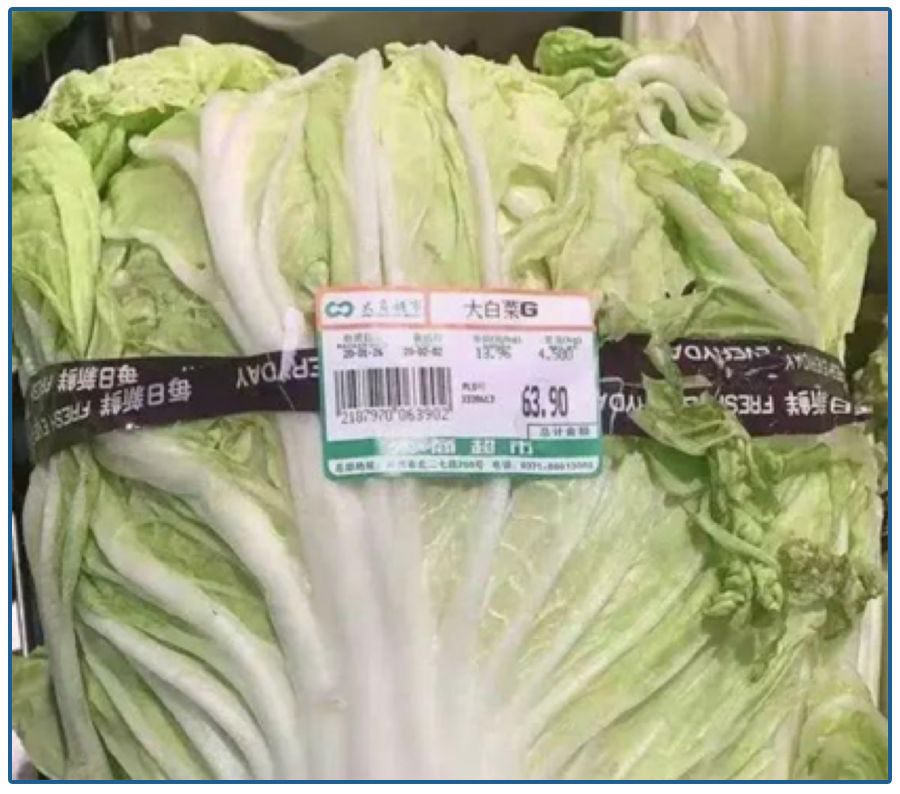
Recently, an American Chinese resident expressed concerns after learning about the exposure of “formaldehyde cabbage” in mainland China. The resident used to buy Chinese cabbage at Chinese supermarkets, but now feels hesitant to consume them due to worries about their safety. Products in overseas Chinese supermarkets are mainly imported from mainland China.
It is reported that using a formaldehyde solution to soak agricultural and aquatic products for “preservation” has been a long-standing industry practice in mainland China. Such toxic food items have been common within China, but in recent years, they may have also been exported to other countries, catching many overseas Chinese off guard.
Another American Chinese entrepreneur mentioned that in the past, the quality of exported Chinese goods used to be better than domestically consumed ones. However, under the rule of the Chinese Communist Party (CCP), the overall moral standards have been deteriorating, and the possibility of toxic products spreading overseas is a real concern.
A self-media personality named “Fish Hunt Qi Ge” released a video on August 22, exposing a cabbage base in Zhangjiakou, Hebei Province, where workers were seen dipping cabbage in a formaldehyde solution before loading them onto trucks to be transported to other provinces. The workers explained that dipping the vegetables in this solution helps preserve them for a longer period during long-distance transportation.
Upon tracking the delivery of the cabbage to a local farmers’ market, “Fish Hunt Qi Ge” purchased some of the cabbage for testing, which revealed traces of residual formaldehyde. Formaldehyde solution, also known as “formalin,” is a first-class carcinogen recognized by the World Health Organization.
The disclosure video quickly stirred up a commotion in mainland China, leading to multiple official media outlets following up on the story. Central departments such as the State Council Food Safety Office, the Ministry of Agriculture and Rural Affairs, and the State Administration for Market Regulation all intervened, calling for nationwide inspections and market surveys on perishable vegetables like cabbage.
Wu Shaoping, head of the International Human Rights Lawyers Alliance, pointed out that Chinese farmers have long endured low income levels, resorting to cheap preservation methods to keep their businesses afloat. He emphasized that responsible governments should address such issues to ensure the safety of farmers and consumers, placing the fundamental responsibility on the CCP regime.
Wu Shaoping stressed that the response from the three CCP departments was merely to “pacify the public anger,” as ultimately, such outrage would lead to dissatisfaction with the CCP system.
Zhang Jianxing, initiator of the Chinese political prisoner compensation movement, mentioned that the current public resentment in China is akin to a “pressure cooker.” While national-level departments issued directives for inspections, it is seen as a temporary measure to alleviate public anger.
The issue of “formaldehyde cabbage” was exposed online 14 years ago, extending beyond leafy vegetables to products like yam, mushrooms, lotus root, garlic sprouts, needle mushrooms, as well as meat products like tripe, beef omasum, and pickled chicken feet, aquatic products like hairtail and silverfish, and dried goods like vermicelli, beancurd sticks, and wood ear mushrooms, all falling under the industry’s “hidden rules” of using formaldehyde for preservation.
The recurring problem of toxic food in China over the past few decades, including incidents like melamine-laced milk powder, recycled cooking oil, Sudan Red duck eggs, fake eggs, tainted rice and vegetables, chemically treated meat, cosmetic shrimp, beer containing vomit-inducing toxins, and the transportation of edible oil in industrial chemical tanks, has been dubbed as “black-hearted toxic food” by netizens.
Zh…