
Amid ongoing tensions in US-China relations, a right-wing political podcaster in the United States has recently raised a highly controversial hypothesis: if a war were to break out between China and the US, should the US concentrate and detain Chinese Americans domestically? This statement has quickly sparked high concern within the Chinese and Asian communities, once again making the issue of “loyalty of Chinese Americans” a sensitive focal point.
On August 14th, during an episode of Timcast IRL, one of the hosts, Ian Crossland, expressed that he did not want to involve all Chinese Americans, as he found it “very scary”; however, he still raised the question, “How do you determine where their loyalty lies? If the situation changes, how do you know if their loyalty will not flip?”
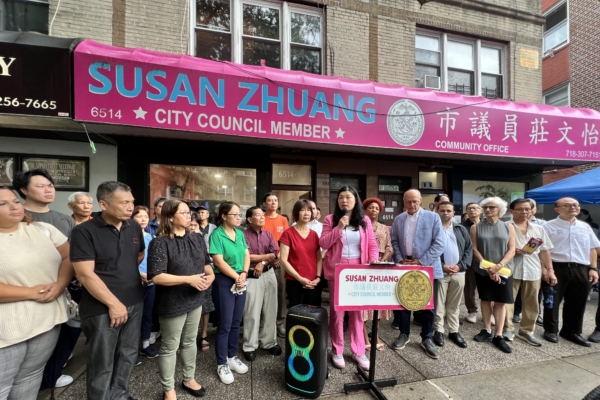
This discourse has been regarded as a dangerous signal by the Chinese community in New York. City Council Member John Doe held a press conference yesterday (1st), emphasizing that Chinese Americans are first and foremost Americans and should never be required to “prove” their loyalty to the United States based on ethnicity, ancestry, or cultural background.
John Doe stated that when someone openly advocates for the detention of Asians, society cannot simply view it as freedom of speech, as such rhetoric could create fear, encourage discrimination, and threaten the safety and dignity of millions of Chinese Americans. “We will not let fear divide our community, nor will we allow lineage to be used against us.” She pointed out that hostility towards Chinese, South Americans, Muslims, and Haitians has been on the rise, and different ethnic groups should support each other and collectively oppose hate.
District leader candidate Jane Smith pointed out that during World War II, Japanese Americans were detained, historical Chinese exclusion laws, and the atrocities suffered by Jewish people, all remind society that “specific ethnic groups cannot be subjected to collective suspicion.”
When asked about the questioning of the loyalty of Chinese people and national security screenings, Jane Smith emphasized that Chinese people, like all immigrants, came here to the United States because they identify with American values and seek a better life. The overwhelming majority of immigrants who choose to give up everything to join America have an unwavering commitment to the country. She quoted Martin Luther King Jr.’s saying, “Darkness cannot drive out darkness; only light can do that”, advocating for resolving misunderstandings through building communication bridges.
Regarding sensitive issues in recent years involving unregistered foreign agents and the influence of the Chinese government, as well as the boundaries of personal political stances, Jane Smith stated that she is not an international affairs expert, but she believes that the community should unite against any form of hate and discrimination.
State Senator Sam Sutton, District leaders Joey Saban, Alice Hsieh, and Donna Feng, as well as the head of the Pine Tree House, William Chen, and President of the Bay Parkway Association, Lee Chipoh, each also made statements. Local community members at the scene shared family histories, pointing out that ancestors had participated in the construction of the American railways and descendants have received education in America. Chinese American history itself is part of American history, vehemently opposing the use of ethnic identity as a basis for collective suspicion or detention.
In response to this controversy, Jinshan Yu, chairman of the Eastern Chinese Association, who has long been concerned with related issues, pointed out in an interview that equating “the Chinese Communist Party” with “Chinese people” is the biggest mistake in this kind of discussion.
“The Chinese Communist Party is a regime, and Chinese people are an ethnic concept, the two are completely different.” Jinshan Yu pointed out that Singaporean Chinese are Singaporeans, and American Chinese are Chinese American. Even in the event of a military conflict between China and the US, all Chinese Americans should not be regarded as enemies. He added that during World War II, in addition to Japanese Americans, there were also a significant number of Chinese, German, and Italian American soldiers, dealing with ethnic groups collectively is illogical and historically untenable.
Yu believes that the questions raised by this podcaster are mere “grandstanding,” as their basic premise is already wrong. Looking back on history, he pointed out that during World War II, about 120,000 Japanese Americans were detained, but that did not lead to the detention of all German Americans, Italian Americans, or other ethnic groups with backgrounds from enemy countries; during the Cold War, the US did not lock up all Russian Americans for supporting the Soviet Union.
However, based on historical experience, during World War II and the Korean War, Chinese Americans in the US were indeed suspected due to their similar appearances to Japanese or Korean individuals. He said that some Chinese community organizations and businesses at the time hung the flags of the Republic of China to demonstrate that they were different from Japan, Korea, or the Communist regime. He jokingly suggested that Ian Crossland’s question is actually quite easy to resolve; if an extreme war situation were to arise, Chinese people could hang the flag of the Republic of China as a symbol to show their identity and stance.
Blogger Fei Ling from Eighth Avenue believes that the Chinese community should “firmly and unitedly” oppose such remarks, while also reflecting on themselves. He reminded Chinese people not to provide the outside world with reasons to attack the Chinese community by exhibiting extreme nationalism or political stances toward China, nor should they align with extreme rhetoric.
Fei Ling emphasized that determining a person’s loyalty to the United States should be based on their “actual words and actions,” rather than their place of birth, ethnicity, or ancestry. “Just because you come from this country does not mean your loyalty should be questioned.” He cited the Japanese American issue during World War II as a comparison, pointing out that what truly raised concerns were the few individuals clearly demonstrating loyalty to the Emperor of Japan and engaging in hostile activities, not the entire group. There is currently no factual evidence to support the collective “betrayal” of Chinese Americans, and the notion of collective detention is entirely lacking in factual basis.
Fei Ling concluded that the Chinese community should not lean towards any extreme, on one hand, they should not remain silent out of fear of suspicion, and on the other hand, the community itself should avoid allowing the improper actions of individuals to represent the entire Chinese community. He believes that a mature democratic system should require political figures to maintain rationality rather than compete to adopt extreme positions to cater to public opinion.