
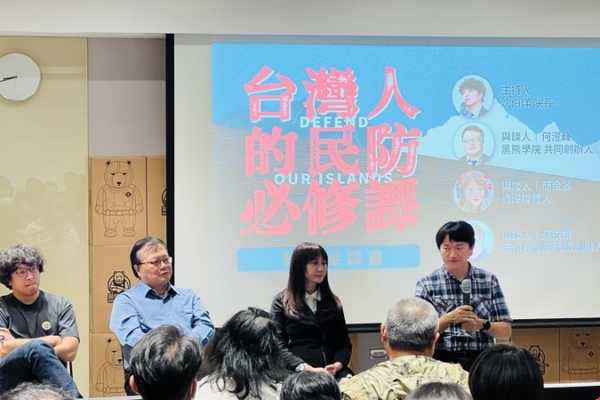
On November 26, 2024, Taiwan Black Bear Academy held a book launch seminar for “Taiwanese Civil Defense Compulsory Course” featuring the “Resilience” and “Response” sections. The co-founders emphasized the importance of enhancing the collective awareness of civil defense in Taiwan in the face of the massive and authoritarian Chinese Communist regime. They stressed the necessity of a proactive mindset for civil defense, stating, “With proactive defense, we have civil defense; with civil defense, we have national defense.”
Taiwan Black Bear Academy compiled various professional expertise and the latest civil defense experiences from around the world to publish the two-volume book “Taiwanese Civil Defense Compulsory Course.” During the book launch seminar on the 25th, co-founders including Shen Boyang, honorary president of Black Bear Academy, co-founder and chief advisor He Chenghui, Dr. Tsai Yicheng, and senior media professional Jian Yuyan discussed the chapters of the book. They urged all sectors to pay attention to the gray zone operations of the Chinese Communist Party, establish cognitive defenses against information warfare, and promote basic first aid skills that everyone can learn.
Shen Boyang pointed out the critical role of civil defense, stating that while Taiwan has a strong healthcare system, there are instances of healthcare personnel facing exhaustion and inadequate resources during crises. He highlighted the need to build capacity in civil defense, including equipping ordinary citizens with simple medical skills to alleviate pressure on medical resources.
He Chenghui emphasized that in the face of the massive and authoritarian Chinese Communist regime, democratic nations like Taiwan must enhance their citizens’ awareness. The continuous attempts by the Chinese Communist regime to suppress Taiwan’s sovereignty create significant psychological pressure on the Taiwanese people. To confront this uncontrollable risk, he reiterated the importance of proactive defense leading to civil defense and, ultimately, national defense.
He Chenghui stressed the significance of understanding and preparing to address risks through risk management. Using the analogy of driving, he explained that while there are risks on the road, it does not mean abolishing transportation but rather implementing maintenance, safety checks, and insurance. He criticized the opposition party’s boycott of civil defense budgets as irrational, highlighting the objective existence of risks regardless of political stances. Thus, enhancing cognitive defenses and awareness is vital as Taiwan faces geopolitical challenges.
Jian Yuyan shared her experiences in Israel during frequent crises to illustrate how society can maintain stability. She explained how the Israeli population demonstrated resilience and crisis management skills in the face of repeated air raid alarms and missile defense systems like Iron Dome. Despite the alerts, daily life continued normally, underscoring the essential role of mental fortitude in national stability.
Through in-depth research, Jian Yuyan analyzed the Chinese Communist Party’s information warfare tactics through media and online platforms, such as TikTok, small media outlets, and Global Times, attempting to undermine Taiwan’s cognitive defenses. She emphasized the stark differences between Chinese Communist media apparatus and Western democratic media institutions, highlighting the need for Taiwan to enhance its ability to discern misinformation.
Dr. Tsai Yicheng emphasized that learning civil defense and building cognitive defenses should not be deemed radical or subject to criticism. Addressing the tendency of self-censorship in political discussions among Taiwanese, she encouraged individuals to engage in political awareness and protection measures for the homeland without fear of being labeled politically extreme.
Dr. Tsai shared her experiences participating in Black Bear Academy activities, advocating for civil defense as not just a state-level preparation but a collective effort involving the entire population. Through courses covering survival skills and crisis simulations like power outages, water disruptions, and blocked roads, participants are taught to respond swiftly, manage resources effectively, and ensure the safety of themselves and their families during emergencies. From preparing insulation equipment and storing emergency food supplies to planning emergency gathering locations, these highly practical courses empower participants to feel more prepared and capable when crises strike.