
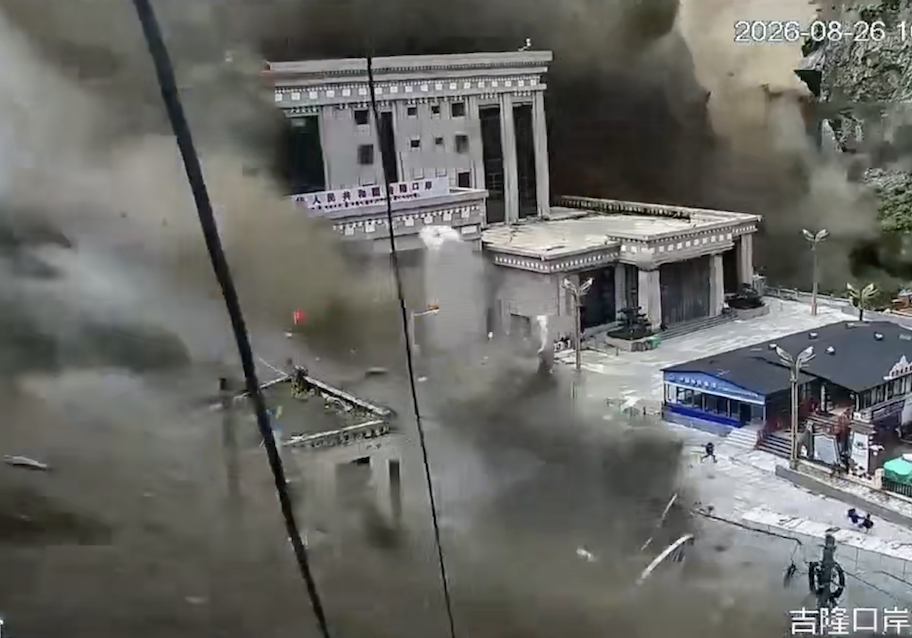
China and Nepal border recently experienced a devastating flash flood, with the Jilong Port in Tibet being engulfed by mudslides, leading to significant casualties in both countries. According to sources close to the Chinese Communist Party’s emergency system, relevant departments in Tibet had discovered the dangerous situation upstream before the incident occurred. However, local officials judged the situation to be similar to the flood at the Jilong Port in 2025, and did not raise the alert level or report to the central emergency department in a timely manner.
The state-run Xinhua News Agency reported that the mudslides resulted in approximately 0.7 square kilometers of area, 27 buildings, and associated facilities being completely destroyed. A glacier at an altitude of around 5,200 meters collapsed, rushing down 22 kilometers in about 7 minutes, reaching the Jilong Port at an altitude of approximately 1,800 meters with an average speed of about 50 meters per second. The port personnel had almost no time to escape.
A source within the Chinese Communist Party system revealed that after the mudslides from Nepal entered the port, Tibet reported to Beijing, but it was too late for personnel evacuation. The source stated, “Looking at the timeline of the disaster, it was found in Tibet that danger was detected 5 minutes before the mudslides reached the port, sending the signal towards Jilong. However, the officials in Tibet did not take it seriously, resulting in hundreds of people being buried, and the port building being lost.”
At the time of the incident, there were only a few staff members chatting in the local environmental monitoring room. Initially, they thought this perilous situation was similar to the one that occurred in 2025 and did not report to the relevant departments in Beijing in a timely manner or activate personnel evacuation arrangements. “It was not until the mudslides reached the Jilong Port that the news was reported, but by then, it was too late. This was a failure in disaster warning, and someone in Tibet must take responsibility.”
According to the official Chinese Communist Party disaster analysis, the disaster began with a glacier collapse on the northern slope of the Langtang Lirung peak in Nepal. Several tens of millions of cubic meters of ice fell from high altitudes, scraping ice debris in the channel, creating high-speed debris flow, which eventually developed into a mudslide carrying huge rocks, mud, and ice. However, there was minimal information about monitoring and warning systems minutes before the disaster struck in the official reports.
Geological expert Mr. Chen from Gansu expressed, “Although both high-altitude ice avalanches and glacial lake outburst floods can cause floods or mudslides, they differ in formation, speed, and destructive capabilities. After abnormal conditions were detected upstream by the monitoring department, the highest level of alert should have been issued first, with downstream personnel evacuated at the fastest speed, followed by assessing the scale of the disaster. However, local bureaucrats were scattered in their work, handling new dangers based on the experience of previous disasters. Every time a disaster occurs, the same situation repeats, and so many people are buried due to human factors.”
Mr. Chen angrily added, “The recent floods in Guangxi were similar; residents were not notified of dam releases or breaches. Even if they were informed, it was hours later, after the disaster had already happened. What’s the point of notification?”
The official version stated that the Ministry of Natural Resources initiated a second-level response to geological disaster defense approximately 4.5 hours after the disaster occurred.
Post-disaster remote sensing images released officially have been able to determine the location of the glacier collapse and the path of the mudslides. Yet, it did not detail what the monitoring system discovered before the disaster or whether there were reassessments on the site selection for the port, revisions to evacuation plans, and the establishment of a Sino-Nepalese cross-border early warning mechanism following the 2025 flood.
On July 8, 2025, the same valley faced a glacial lake outburst flood, where the flood destroyed the China-Nepal Friendship Bridge connecting the Jilong Port in Tibet to the Nepal Rasuwa Gadhi border post. On the Chinese side, 11 people went missing, approximately 350 people were evacuated. Nepal reported at least 9 deaths and 19 missing, including 6 Chinese construction workers among the missing.
Regarding these incidents, 90-year-old Professor Wang commented that the authorities in Tibet have yet to provide a comprehensive explanation of the warning and evacuation measures taken after the previous flood. He said, “The same thing happened with this disaster, they haven’t learned their lesson. If this systemic issue isn’t resolved, there will be another time.”
After the disaster, the Chinese Communist Party leader Xi Jinping issued instructions on the 26th, with Premier Li Keqiang also directing the response. Initially, Vice Premier Zhang Guoqing led department personnel to Tibet for guidance on rescue operations. On the afternoon of the 27th, Li Keqiang visited Jilong under the “commission of Xi Jinping,” inspecting the disaster area. Within a day, his status was upgraded from Vice Premier to Premier, showing the seriousness of the situation.
Political analyst Huang Kangnian (pseudonym) explained that while Zhang Guoqing was dispatched to the scene, Li Keqiang personally visited Tibet the next day, indicating that Beijing received information about the disaster beyond what was initially reported locally. “The authorities were concerned that the Vice Premier’s appearance might upset the families of the victims and increase the anger of Tibetans towards the Communist authorities, so they sent Li Keqiang for condolences.”
Furthermore, among the officially announced missing persons, there are 261 foreign nationals, making it impossible for the internal authorities in Tibet to handle the situation alone. Ms. Shao, a source within the Chinese Communist Party system, mentioned that the top-level of the Party took over the disaster site because there were inquiries from foreign embassies in China about the situation of their nationals in this disaster. “Over 200 foreign nationals from more than 20 countries, including 18 Americans, went missing. When the U.S. and Canadian embassies were calling to check on their citizens, the Chinese government naturally had to explain.”
On August 31, the Central Political Bureau of the Chinese Communist Party held a meeting to discuss the rescue operation for the Jilong mudslides. According to official reports, the meeting did not mention the delayed reporting by Tibetan officials nor did it specify when the upstream danger was discovered.