
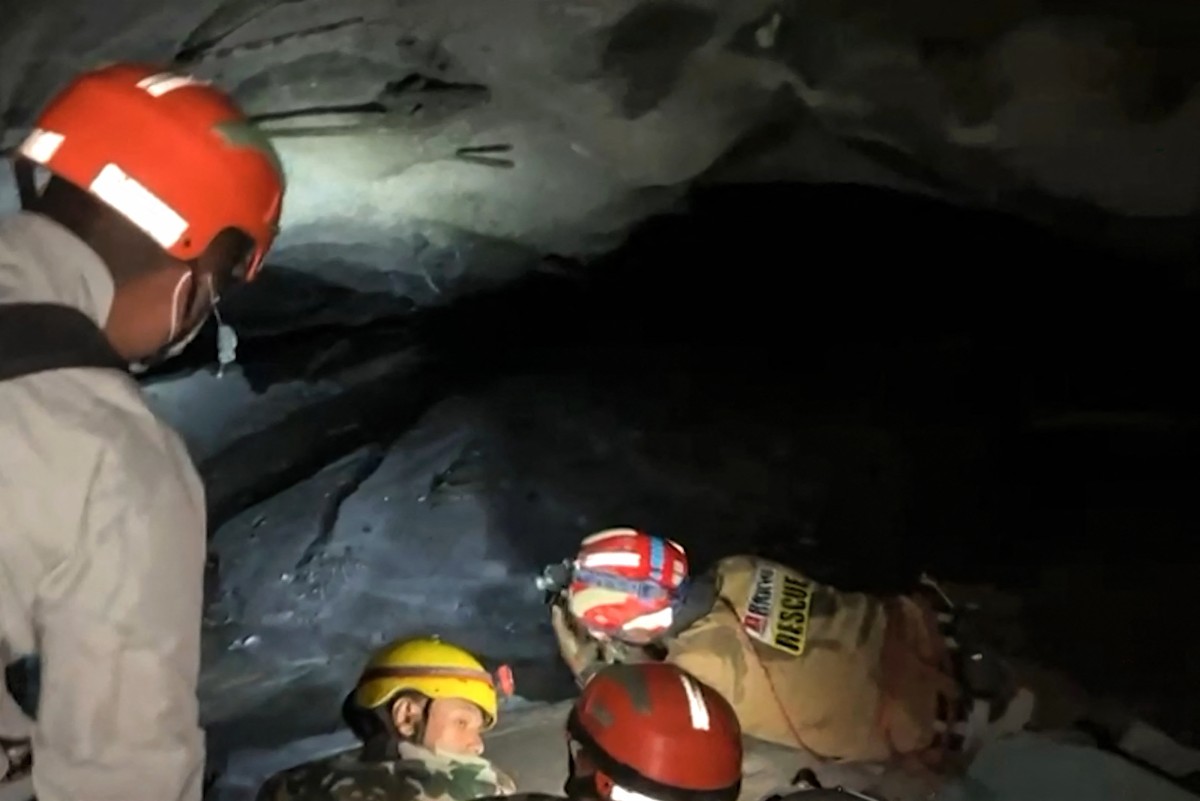
Last week, the Himalayan mountain range reportedly experienced an unprecedented glacial collapse, triggering massive flash floods and mudslides in the valleys along the border of Nepal and China, causing catastrophic destruction. The disaster has claimed over 900 lives and left nearly 5,000 people missing.
Deep underground, hundreds of meters below the surface, trapped workers still hold a glimmer of hope for survival, currently in the midst of the most challenging phase of rescue efforts – the “underground survival window.” Nepalese authorities are working in collaboration with rescue teams from countries such as India, racing against time to search and rescue nearly a thousand workers believed to be trapped in underground hydroelectric tunnels.
Data from Nepal’s disaster management agency and the Independent Power Producers Association of Nepal (IPPAN) reveal that at least 933 workers are missing from 11 hydropower projects along the Trishuli River. Among them, 42 workers are missing from the Trishuli-3A hydropower station, where the underground facility’s tunnel stretches for 4 kilometers.
Due to the tunnel entrance possibly being completely blocked by several meters of heavy mud and debris, along with the damp climate and damaged infrastructure, the rescue operation is incredibly challenging. In a bid to save the survivors underground, a joint rescue team comprising Nepalese military, police, and experts conducted a controlled explosion on the mountain early Monday morning, utilizing excavators to clear mud, pumping air into the tunnel, and transporting supplies.
Australian geologist Arnold Dix, who provided advice to rescue teams at the Trishuli-3A power station, told CNN that it is still unclear how much of the tunnel is submerged in mud or water. He stated, “So, we may only need to dig 10 meters, or we may need to dig 100 meters.”
At the station, rescue teams successfully made a large enough hole to descend inside using ropes and harnesses, pumping in air and supplying food. However, as they called out deeper into the tunnel, they have yet to receive a response.
Elsewhere, high-altitude guide Jenjen Lama, involved in the rescue operation, informed CNN on Monday that six individuals are believed to be trapped inside the Khilime hydropower station.
Lama shared a facility diagram showing a 250-meter downhill tunnel leading to a larger facility containing maintenance workshops, control rooms, and transformers. The rescue team discovered on Sunday that the tunnel had been submerged in mud up to chest level, halting at 130 meters due to infrastructure damage making helicopter landings difficult.
“There is a kitchen inside the tunnel, and there is some food… but I don’t know about the oxygen situation,” Lama stated.
According to Dix’s calculations, Nepal has up to 27 damaged hydropower stations, with approximately 12 nearly completely destroyed. Experts note that while emergency shelters and supplies may be available inside the tunnels, challenges such as depleted oxygen, drowning risks from leaking reservoir systems, and reinforced steel sheet structures near turbine rooms present “layer after layer of technical difficulties” for rescuers.
Aside from the subterranean search and rescue efforts, secondary risks stemming from the disaster continue to spread. The Nepal-China border faces overflow risks in glacial lakes formed by mudslides, with Chinese warnings indicating the potential for further collapses in surrounding glaciers.
Two Nepalese officials disclosed to Reuters that following a meeting earlier this year aimed at enhancing cooperation, China has not shared key data concerning glacier risks and water levels. Concerns on the Nepalese side over insufficient data sharing and transparency could severely weaken future disaster prevention and warning mechanisms.
In recent years, China, Nepal, and India have vigorously constructed dams and hydropower tunnels in the Himalayan region to meet energy demands. However, this cross-border calamity has sounded the alarm for infrastructure development in the Himalayan region, which is highly susceptible to the impacts of climate change and natural disasters.