
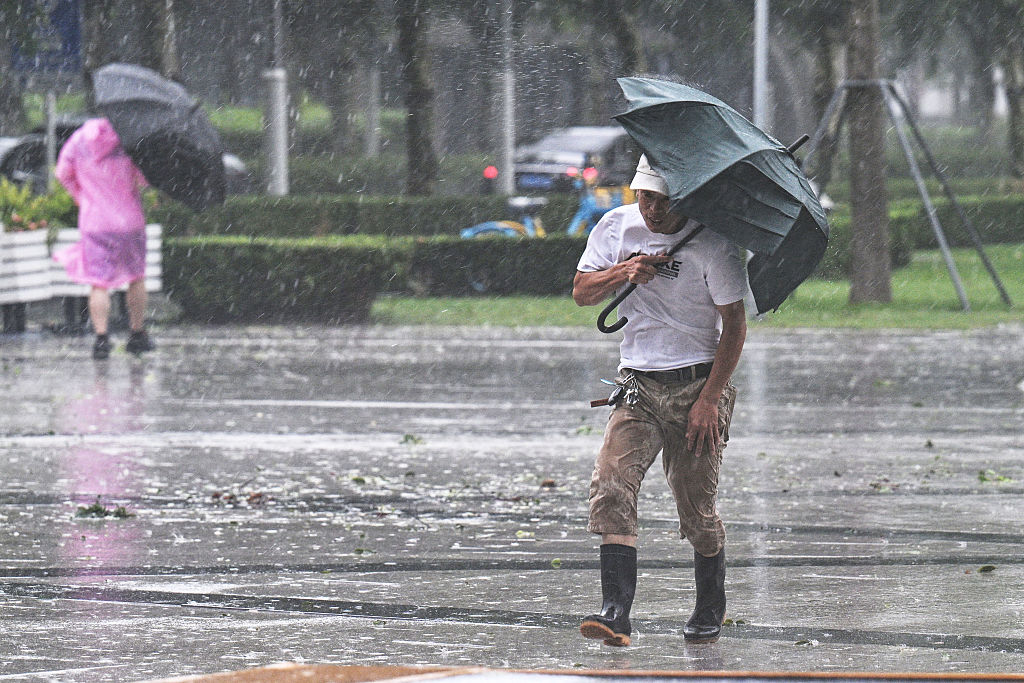
Typhoon “Shader” made landfall twice in Zhejiang on the morning of August 28th, causing a large number of flights to be canceled, some railways and ferries to suspend operations, and more than 1.18 million people in Wenzhou and Fujian to be evacuated. By the evening, the typhoon had moved further inland to Nanping, Fujian and continued its westward path, with heavy rainfall expected to move towards Jiangxi, Hunan, and other areas.
According to reports from Reuters, Shader first landed in Kanmen Street, Yuhuan City, Taizhou, Zhejiang at 8:05 a.m. with maximum wind speeds near the center reaching 12 on the Beaufort scale, or 35 meters per second. Then, at 9:10 a.m., it made a second landfall along the coast of Longwan District in Wenzhou, with maximum winds still at 12 on the Beaufort scale, or 33 meters per second.
Around 3:50 p.m., the typhoon center left Zhejiang and entered Ningde, Fujian. According to data from the China Meteorological Administration’s Central Meteorological Observatory, as of 9 p.m. on the 28th, Shader had moved to Jianyang in Nanping, Fujian, weakening to a tropical storm with maximum wind speeds of 8 on the Beaufort scale, or 18 meters per second, moving westward at a speed of 15 to 20 kilometers per hour.
Meteorological data shows that on the 28th, parts of eastern and southern Zhejiang and northeastern Fujian experienced heavy rainfall, with precipitation ranging from 100 to 153 millimeters, and in some areas, hourly rainfall reaching 30 to 81 millimeters.
Coastal areas of Zhejiang experienced gusts of 12 to 13 on the Beaufort scale, with local gusts reaching 14 to 16. Yunling Jiu Longshan in Yongjia County, Wenzhou recorded gusts of 53.5 meters per second, equivalent to 16 on the Beaufort scale; stations in Leqing and Dongtou recorded gusts of 15 and 14, respectively.
According to the South China Morning Post, Wenzhou Airport canceled 197 flights on the 28th. Lishe International Airport in Ningbo suspended operations from 11:30 p.m. on the 27th, and even after resuming at 11 a.m. on the 28th, 16 inbound and 28 outbound flights were still canceled.
Trains on segments of the Hangzhou-Shenzhen Railway in Wenzhou-Fuzhou section, the Quzhou-Ningde Railway, and others were suspended; besides the Changxing to Hengsha route, several passenger ferries in Shanghai were also suspended. In Fujian, 57 passenger ferry routes north of Quanzhou were also halted.
As of the evening of the 27th, over 940,000 people had been evacuated in Wenzhou; according to official reports from Fujian, as of 7 a.m. on the 28th, about 247,700 people had been evacuated, with the total number of evacuees exceeding 1.18 million in both regions.
The Central Meteorological Observatory forecasted at 6 p.m. on the 28th that from the evening of the 28th to the evening of the 29th, there would be heavy to torrential rain in some regions of Fujian, Jiangxi, Hunan, and other areas.
Specifically, parts of central and western Fujian, coastal regions of eastern Fujian, central Jiangxi, and central Hunan would experience heavy rainfall, with the possibility of local extremely heavy rainfall, reaching 250 to 270 millimeters; some areas could see hourly rainfall of 20 to 50 millimeters, with localized amounts exceeding 80 millimeters.
The Jiangxi Provincial Meteorological Department predicted Shader to move from southern Shangrao to northern Ganzhou in Jiangxi on the night of the 28th to the morning of the 29th, then move into Hunan on the 29th night. Parts of Jiangxi would see heavy rain, with some areas experiencing torrential rain. Wind speeds in Jiangxi’s rivers, plains, and high-altitude mountain areas could reach 8 on the Beaufort scale.
The Hunan Provincial Meteorological Observatory forecasted heavy to torrential rain in central and southern Hunan on the 29th, with heavy rain expected in Yongzhou, Hengyang, and Zhuzhou, where rainfall could reach 120 to 180 millimeters; on the 30th, some areas in Hunan could still see heavy rain, with localized amounts reaching 100 to 160 millimeters.
The Hunan meteorological department stated that the rainfall effects from Shader’s residual circulation could last until the 31st; affected by it and other weather systems, there could be heavy rainfall in parts of Hubei, Guangdong, Guangxi, Guizhou, and Yunnan as well.