
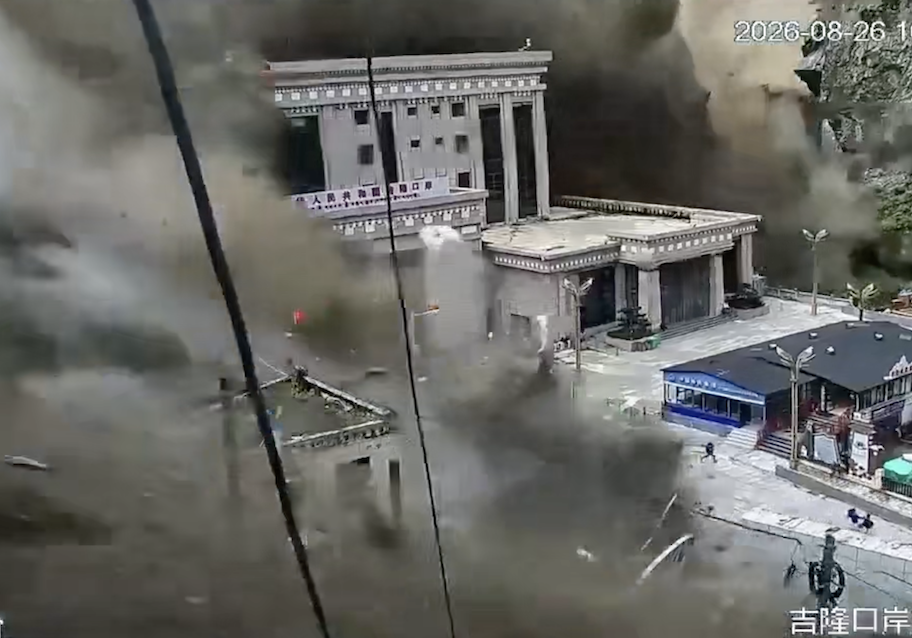
**Disaster Strikes Again at the Gyirong Port**
Over a year ago (414 days), the disaster at the Gyirong Port was reenacted, escalating from a minor catastrophe to a major disaster, while China’s disaster risk warning mechanism remained silent.
On the morning of August 26, 2026, in the Sino-Nepal border at Gyirong County, Shigatse City, Tibet, the Gyirong Port suffered a devastating blow. A massive mudslide instantly engulfed the port’s joint inspection building and surrounding structures, reducing the area where the China-Nepal “Friendship Bridge” was located to ruins.
As of the journalist’s deadline, this flood has resulted in the death of 626 people in Nepal and 7 people in Tibet, with nearly 3,000 people missing.
Compared to the tragedy a year ago, this time the scale is larger and the casualties are heavier.
Four hundred and fourteen days ago, on the early morning of July 8, 2025, in the same area (within Sal-chu Township, Gyirong County), a glacial lake outburst flood occurred, destroying the China-Nepal border Friendship Bridge, causing a total of 17 people from both sides to go missing.
A brief of the “July 8, 2025 Glacial Lake Outburst Flood Event in Gyirong Port, Tibet” published by the National Key Laboratory of Chengdu University of Technology on July 11, 2025, indicated that the event was caused by the outburst of the glacial lake on the upper reaches of Purepu Zangbu Glacier.
The report mentioned that there were 55 glacial lakes distributed in the upstream basin with a total area of approximately 3.39 square kilometers, warning of the possibility of a recurrence of glacial lake outburst floods and urging for enhanced early warning efforts for upstream floods and prompt detailed assessments of the susceptibility and risk in all glacial lakes in that basin.
Four hundred and fourteen days later, an ice-rock avalanche occurred at an altitude of about 5,300 meters, impacting the Gyirong Port in about 8 minutes, completely destroying the port.
The U.S. Geological Survey detected seismic activity equivalent to a magnitude of 5.1 to 5.2, determining it was vibration triggered by the collapse and not a tectonic earthquake. The energy of the mudslide was tremendous, carrying loose rock mass along the way, resulting in a destructive force far beyond a normal mountain flood.
The Chinese Ministry of Foreign Affairs subsequently stated that the disaster was triggered by a high-altitude glacier collapse in Nepal.
Scientists from the International Center for Integrated Mountain Development (ICIMOD) mentioned that the potential cause of this flood was the collapse of ice and rocks blocking a tributary, Lhende Khola, forming a barrier lake that burst instead of the initially suspected glacial lake outburst flood. However, due to the continuous control of information in the Tibetan disaster area by the Chinese Communist Party (CCP), the investigation into the cause of the flood remains restricted.
On August 27, the CCP officially announced sending an expert group to investigate the origin of the ice avalanche and barrier lake. However, there are concerns from the public that the CCP habitually aims to control the narrative, and therefore, the conclusions drawn by these experts will likely favor the CCP.
Two days after the disaster on August 28, the CCP Political Bureau meeting claimed to “strengthen dynamic monitoring and warning, enhance the ability to identify the risk chain of disasters,” and “strengthen the monitoring, early warning, and coordinated response of risks in the upstream and downstream areas.”
On the same day, Xu Qiang, the President of Chengdu University of Technology, nearly echoed the laboratory’s recommendations from a year ago, in an interview with the CCP’s People’s Daily, emphasizing the need for satellite remote sensing monitoring, artificial intelligence and machine learning for identifying downstream vulnerable structures, ground monitoring networks, the need for establishing a cross-border monitoring network, completing the survey and zoning of risks, enhancing engineering defense standards, adopting a strategy of “evacuation and protection,” deepening research on mechanisms, and improving cross-regional cooperation.
Chinese affairs expert Li Linyi stated that the CCP Political Bureau’s use of worn-out official jargon like “strengthen” and “enhance” holds no real meaning. Xu Qiang’s statements indirectly acknowledge that the prevention measures recommended to the authorities a year ago have not been implemented, the cross-border source monitoring is still a blind spot, and the disaster resistance level of crucial infrastructure like ports needs to be enhanced. The laboratory’s recommendations from a year ago were clear in stating the need to “strengthen” and “promptly carry out” actions, yet a year later, these are still being presented in a proposed format. This disaster is not simply an unpredictable natural calamity, but rather the inevitable result of the absence of warning, delayed decision-making, and systematic underestimation of risks.
What has the CCP done in the 414 days since the disaster?
A few days after the disaster on July 8, 2025, Chengdu University of Technology’s National Key Laboratory issued a report, pointing out that the stability of the 55 glacial lakes and glacial moraine dams was extremely poor and suggesting strengthening early warning and conducting risk assessments one by one.
After the collapse of the China-Nepal border Friendship Bridge (Rasuwa Bridge) under the impact of the flood, the port’s customs clearance came to a halt for nearly half a year. A temporary steel truss bridge was completed and traffic was restored on January 1, 2026. However, there is no visible official risk assessment basis for the decision to resume operations at the original location.
Nearly a year after the 2025 disaster, on June 2, 2026, the Tibet Autonomous Region Geological and Environmental Monitoring Station finally issued a public tender for the selection of an agent for the “Disaster Risk Warning Platform System Development Project,” with the project registered under the name of “Centralized Guided Local Scientific Research Projects.”
On June 15, 2026, the results of the selection of the agent for the “Disaster Risk Warning Platform System Development Project” showed Element Engineering Consulting Group Co., Ltd. as the chosen agency.
On July 17, the Tibet Tendering Network announced that the winning bidder for this project was the Shanghai Jiao Tong University, with subsequent developments yet to be disclosed.
It was not until the disaster on August 26 that the CCP hastily made a statement.
The Gyirong Port is positioned as the “lifeline” of China-Nepal trade and the core of the economic cooperation zone.
After the major earthquake in Nepal in 2015, the Zhangmu Port, originally serving as the main land trade route between China and Nepal, was practically closed due to severe damage, and the Gyirong Port subsequently assumed the majority of the trade functions with Nepal.
In 2024, the Gyirong Port managed import and export trade worth 4.248 billion RMB, accounting for nearly a third of the total China-Nepal trade volume and ranking first among all ports in Tibet.
When the Sino-Nepal temporary bridge was rapidly constructed and customs clearance ceremonies were held on, the official publicity highlighted the achievements in restoring trade. In contrast, there was no mention of the warnings issued by Chengdu University’s laboratory in July 2025 or the information on the database of 55 unstable glacial lakes.
An article on Ifeng.com titled “Why is Gyirong Port Frequent to Mudflows? The Problem Lies in the Deep Valley of the Himalayas” stated that academic research shows that mudslides in the Himalayas mainly occur within 8 kilometers of the fault zone, and the Gyirong Port is located precisely on such a geological fault zone.
The article noted that the Gyirong Port is situated at the confluence of three rivers with high exposure, surrounded by 55 unstable glacial lakes, located on a fault line, yet it was chosen as the sole location for the active artery of China-Nepal trade.
An expert from the Henan Geological Bureau, Yang Kun, pointed out to Dajiyuan that the port was selected near a relatively flat river channel at the time mainly to save costs; if it were built at a higher altitude, the cost would have increased significantly. “It may require several times the previous budget to complete this port.”
Lin Tinghui, the Deputy Secretary-General of the Taiwan International Law Association, told Dajiyuan that constructing the entire infrastructure of the Gyirong Port over the riverbed is “going against the natural order.” The CCP’s construction of dams, roads, and tunnels, blasting mountains, disrupting local ecology and geological stability, coupled with accelerated glacier melting causing water to seep into loosened mountains, could greatly magnify the scale and destructiveness of mudslides in case of heavy rain.
Yang Kun stated that during this flash flood, there was also no advance warning from the Chinese side. The U.S. already detected seismic signals approximately 7 to 8 minutes before the flash flood occurred. If China could provide timely and effective warnings, the casualties could have been significantly reduced.
Li Linyi stated that these opinions are in line with the recommendations from the Chinese laboratory, emphasizing that risks can be identified, monitored, and defended against. The problem is not what the CCP media claims about glacial disasters being “unpredictable, hard to transmit, difficult to judge, and insufficient time to react,” but rather if the known recommendations have been transformed into action. Despite the comprehensive cooperation framework and cross-border projects between China and Nepal, the joint warning mechanism covering from the glacial sources to downstream has not been effectively implemented. This is actually a reflection of the bureaucracy in the CCP administration, especially during the era of Xi Jinping, being in a state of stagnation.
Li Linyi said that after the second disaster, the official blame for the disaster was attributed to a high-altitude glacier collapse in Nepal, emphasizing the nature as a natural disaster. However, a year ago, under the same mechanism, an event had already caused 17 people to go missing, and the laboratory had issued a clear warning. The resumption of operations at the original site without simultaneous implementation of effective early warning and improved defenses is a display of indifference to known risks.
“Why has there been no action in a year? Because the Gyirong Port has a trade volume of 4.2 billion RMB a year. This is the reality behind the CCP’s slogan of ‘People First, Life First,’ focusing only on the economy, disregarding human life,” he said.
The mudslide disaster on the China-Nepal border has led people to criticize the long-term blind actions of the CCP, going against natural laws and causing man-made disasters.
As early as 2018, Tibetan writer Sangay Gyatso warned in an overseas publication that the CCP’s large-scale construction of reservoirs, hydropower stations, and intensive mining in Tibet over the years has become a time bomb on the heads of Tibetans.
Lin Tinghui, Deputy Secretary-General of the Taiwan International Law Association, told Dajiyuan that the CCP has been promoting large-scale projects in Tibet for a long time, constructing a large number of military bases along the China-India border, digging into mountains, concealing fighter jets in caves. Once the mountains become loose and encounter heavy rain or melting ice, it could trigger even more disasters.
Lin Tinghui stated that since the 7th and 8th centuries, the Gyirong Port has been an important passage for Tang Dynasty envoys and monks traveling to India and a vital route for Tibetan Buddhism. A disaster of such severity has never occurred in the past thousand years, yet in recent years, there have been consecutive flood disasters in the region. The CCP practices atheism and believes man can conquer nature, but people must respect the heavens; otherwise, nature will strike back.