
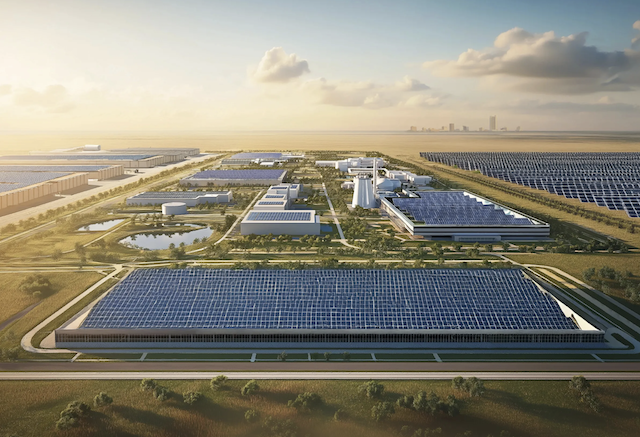
Amid the rapid expansion of the artificial intelligence (AI) industry in the United States, controversies surrounding the energy consumption, electricity costs, and environmental impacts of data centers continue to escalate. Behind the clamor of opposition, a network with 200,000 accounts has been quietly stirring the pot, as revealed by the latest findings from X Platform, owned by Elon Musk.
On Thursday, X Platform announced that its security team had uncovered a network suspected to be related to the Chinese Communist Party, known as the “Chinese bot farm,” which uses a large number of fake accounts to intervene in public discussions in the U.S. about artificial intelligence and data centers. This network covertly promotes dissent and skepticism, carrying out Influence Operations.
According to information released by X Platform’s “Global Government Affairs” account, its security team identified a network comprised of approximately 200,000 fake accounts suspected to be linked to the Chinese Communist Party.
Within this network, around 200 accounts were found to be posting content attempting to influence discussions on American AI and energy policies. This included posts opposing AI data centers, claiming that AI data centers are increasing the burden on the electrical grid and raising household electricity costs. They also shared AI-generated images depicting data center operators as entities harming the public interest.
X Platform has stated that they will suspend accounts violating their “authenticity” policy. However, it remains unclear whether these accounts and their owners will face further action.
Previously, OpenAI had also announced the banning of a cluster of ChatGPT accounts suspected to originate from China. These accounts were utilized to conduct covert Influence Operations on American audiences, spreading content about data centers increasing power demands and costs.
As the secret actions of the Chinese Communist Party to influence American public opinion come to light, domestic opposition to AI data centers in the U.S. is growing louder.
A survey conducted by the University of Pennsylvania in early August revealed that 61% of Americans oppose the construction of new data centers in their local areas, marking a 12 percentage point increase from the results of surveys conducted between February and March.
Another survey released by YouGov on August 25th indicated that 47% of respondents believe that building new AI data centers would be detrimental to the country.
Data centers are crucial infrastructure for the artificial intelligence industry, but their high energy consumption requires continuous operation of cooling systems. Consequently, some Americans are concerned that large AI projects will increase strain on the electrical grid and drive up electricity costs.
Analysts point out that despite the existence of covert foreign influencing operations, the concerns of some American citizens regarding electricity costs, land usage, and electrical grid burdens are genuine.
Artificial intelligence has become a key area of competition between the U.S. and China in technology. While the U.S. continues to expand data center construction, China actively supports domestic AI enterprises and strives to enhance its influence in the global AI industry and standard-setting.
The “AI Index 2026” report released in April by Stanford University’s Stanford Institute for Human-Centered Artificial Intelligence (HAI) stated that the U.S. currently leads the world with 5,427 data centers, surpassing Germany, the UK, and China by a considerable margin.
Regarding the issue of opinion manipulation, Democratic senator John Fetterman of Pennsylvania cautioned that amidst the U.S.-China competition for dominance in artificial intelligence and energy, an exaggerated American response to AI could benefit Beijing. He emphasized that the ability to gain and maintain an advantage in AI and energy fields is essential for U.S. national security.