
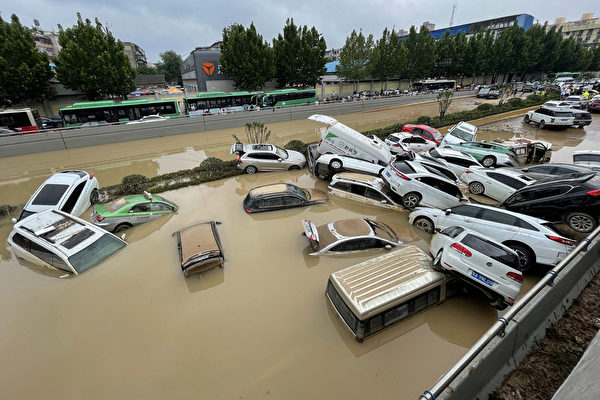
The Communist Party has been promoting the construction of “sponge cities” for over a decade, but many areas in mainland China are still experiencing repeated urban flooding during heavy rains. Experts point out that some sponge facilities have design, construction, and maintenance defects, and the source water absorption facilities struggle to cope with extreme rainfall.
According to a report by “First Financial” on August 7, from 1985 to 2024, the impermeable surfaces in the Beijing-Tianjin-Hebei, Yangtze River Delta, and Pearl River Delta urban clusters have increased from 22,500 square kilometers to 69,300 square kilometers. Over 300 urban built-up areas have a hardscape ratio of over 65%. The hardening of surfaces makes it difficult for rainwater to infiltrate, leading to a concentration of runoff during heavy rainfall, increasing the risk of urban flooding.
The concept of a “sponge city” is a method to address urban hardening and stormwater runoff issues. It involves using permeable pavements, sunken green spaces, rain gardens, and water storage facilities to allow rainwater to infiltrate, be retained, stored, slowly drained into pipes, or utilized. The Communist Party launched pilot projects in 2015 and has since expanded the initiative nationwide.
Gong Yongwei, a professor at Beijing University of Civil Engineering and Architecture, stated in July last year that early urban rainwater drainage systems could only handle rainfall occurring once every 0.5 to 1 year. In recent years, most newly constructed drainage systems are designed for rainfall events occurring once every 2 to 5 years. However, poor planning, incomplete construction, or inadequate maintenance can still lead to urban flooding even if the rainfall does not exceed design standards.
After the implementation of sponge city projects, problems arise not only from the intensity of rainfall but also from issues in the design, construction, and maintenance phases.
According to “First Financial,” Lu Qiujie, a sponge landscape expert in Shenzhen, pointed out that existing standards lack regional specificity, there is inconsistency in design expertise, and inadequate collaboration, construction, and post-maintenance measures have resulted in some projects failing to meet drainage standards after completion.
He highlighted examples such as rain gardens being built at higher levels preventing water flow, eco-ponds without water inlets at curbsides, and improper utilization of sunken green spaces, leading to long-term waterlogging of tree roots. Even after facilities are built, they may struggle to fulfill their intended functions.
A study published in the “Water Resources Protection” journal in 2018 found that suspended solids in urban stormwater runoff can block permeable bricks, severely compromising their drainage capabilities. While removing surface sediments can partially restore permeability, the effectiveness is limited.
In addition to issues with engineering quality and maintenance, source water absorption facilities cannot fully replace urban drainage networks and flood control systems.
Lü Hongliang from China Urban Planning and Design Research Institute mentioned that source water absorption facilities typically can only handle moderate rainfall of 20-30 millimeters, which is inadequate for extreme rainfall and flood events. Cities still rely on underground networks, reservoir spaces, and emergency drainage facilities.
Similar problems were previously exposed during the floods in Zhengzhou, Henan Province. A report released by the Jamestown Foundation in 2021 revealed that despite Zhengzhou’s sponge city planning and investment of 53.4 billion RMB to enhance rainwater absorption, storage, purification, and release capacities, severe underground flooding occurred in roads, tunnels, and subway stations during the 2021 Henan floods. The report suggested that without unified urban management and an effective emergency alert system, sponge city projects may struggle to fully address urban flooding issues.
Lü Hongliang also pointed out that retrofitting sponge facilities in densely populated old city areas with limited available space presents significant challenges. Lu Qiujie stated that the additional costs for some projects range from 3% to 10%, and there is still a shortage of teams that possess both drainage and landscape design capabilities.
The debate also revolves around the use of funds. Some mainland internet commentators have questioned whether some sponge city projects are being disguised as ecological endeavors but are actually new avenues for local financing and borrowing. An article from the “Water Conservancy and Hydropower Network” in 2018 mentioned that some cities, despite knowing the limited impact of these projects on alleviating urban flooding, still proceed due to the attraction of subsidies.
In response to these discussions, some netizens sarcastically remarked, “Every year, heavy investments in water conservancy, yet every year we watch the floods.” Others questioned why many cities continue to experience flooding despite years of sponge city construction efforts.