
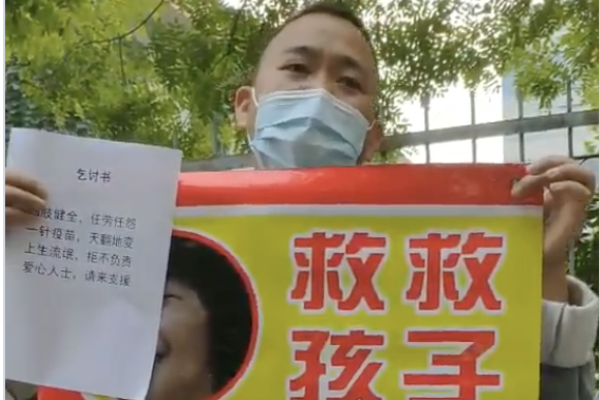
In 2018, a 6-year-old girl in Shanghai developed aplastic anemia after receiving routine vaccinations, as confirmed by the local government through three assessments. The girl’s father, Xie Zhengmao, faced oppression, physical assault, illegal detention, and abuse from authorities during his administrative appeals, judicial rights protection, and national petitioning process. Realizing the true nature of the Chinese Communist Party (CCP), Xie finally broke ties with the CCP and fled to the United States with his daughter for medical treatment.
In July 2018, Xie Zhengmao’s 6-year-old daughter received vaccinations at a community health service center in Pudong, Shanghai. That night, the child developed a low-grade fever, which persisted for days without improvement. Blood tests revealed significant decreases in immune, oxygen supply, and clotting indicators. Less than a month later, the child was diagnosed with aplastic anemia.
Aplastic anemia is a disease characterized by bone marrow failure, leading to the inability to produce blood normally, requiring bone marrow transplants for fundamental treatment.
However, the girl’s health examination results prior to vaccination showed she was healthy. This close temporal relationship led Xie Zhengmao to suspect that the vaccine was the cause of his daughter’s illness.
Reflecting on the year 2018, when the “fake vaccine” scandal involving Changsheng Bio-Technology was making headlines, Xie recalled the widespread attention to the issue. Despite friends’ suggestions to publicize his situation to help protect his rights amid the fake vaccine scandal, Xie admitted that he still believed in the CCP at that time and chose to follow official procedures.
After his daughter’s condition was officially acknowledged three times as vaccine-induced abnormality, Xie naively thought that if the government admitted the vaccine caused his child’s illness, they would help resolve all concerns if he focused on aiding his daughter’s recovery. However, when requesting the government to fulfill obligations such as compensation, medical rehabilitation, education, job placement, and long-term care, the government only offered a one-time compensation and refused further assistance, forcing him to sign a one-time agreement.
Feeling trapped in the situation where legal actions were unsuccessful, Xie turned to petitioning as the only recourse. However, he soon discovered the relentless persecution from the CCP in various forms along the petitioning path.
His efforts to seek medical treatment for his daughter at Tianjin Medical University General Hospital led to his arbitrary detention on false charges of disrupting public order, followed by further unjust imprisonment and abuses including kidnapping, assault, illegal detention, and surveillance when travelling to Beijing. Xie expressed how the CCP officials were capable of unimaginable actions.
Facing unemployment due to CCP’s suppression, Xie endured further one-month detention in 2020, with authorities coercing his wife into agreeing to one-year bail to intimidate him, leading to severe emotional distress for his wife.
Fleeing from the heart-wrenching hardships in China, Xie, in August 2025, sought medical treatment for his daughter in the United States. The stark contrast in medical standards between the US and China left a profound impact on his perceptions.
Witnessing the accessible healthcare system in the US, where children under 18 receive essentially free medical care regardless of the severity of illnesses, Xie found relief in knowing that parents need not worry about medical expenses but focus solely on their child’s health and treatment.
Acquiring medical insurance in the US alleviated Xie’s concerns over healthcare costs, reflecting on the genuine assurance provided by American insurance compared to deceptive practices in some commercial insurances in China.
In the US, Xie purchased commercial insurance for his daughter at approximately $700-800 per month, with an annual limit of $5,000, ensuring comprehensive coverage for any significant medical expenses. The assurance he felt in the US healthcare system stood in stark contrast to the dire circumstances families face in China when encountering serious illnesses.
Xie highlighted the compassionate support mechanism in the US, including personalized teaching sessions at home by school teachers to ensure his daughter’s education continuity while focusing on her recovery, depicting a compassionate and individualized approach absent in China.
While reminiscing about his tough experiences in China and the horrors endured, Xie emphasized his continued emotional hardship when discussing those memories.
Coming from a rural background in China, Xie acknowledged his initial naive trust in the government’s integrity but gradually realized the unfavorable reality and the deceitful practices of the CCP, perpetrating injustices and deceiving the Chinese people.
From his years of rights protection experiences, Xie concluded that China’s system obstructs any attempts to safeguard legitimate rights through legal means due to its oppressive design, serving as a stark reminder that the CCP prioritizes control over human rights and liberties.
Reflecting on an anecdote within his circle of acquaintances, Xie recounted a heart-wrenching incident where a father urgently needed healthcare for his critically ill daughter but could not afford even a day in the ICU with his meager savings, resulting in the tragic loss of his daughter the following day.
During the same period in 2018, multiple cases of lifelong disabilities in children following vaccinations in China were reported, including the plight of He Fangmei, the founder of “Vaccine Baby Home.” Her relentless pursuit of justice through government channels led to constant police harassment and over four years of unjust detainment.
Xie acknowledged He Fangmei’s plight in seeking justice but underscored the futile nature of legal avenues in China, devoid of true justice and inefficient in combating the CCP’s dishonest practices and facades.
In his final reflections, Xie acknowledged the ruthless character of the CCP, recognizing the futility of attempting to confront its shameless and unethical tactics. Only by taking a resolute and drastic stand, such as his own decision to step out boldly, could individuals possibly evade the looming threat of imprisonment and persecution while advocating for their rights in China.