
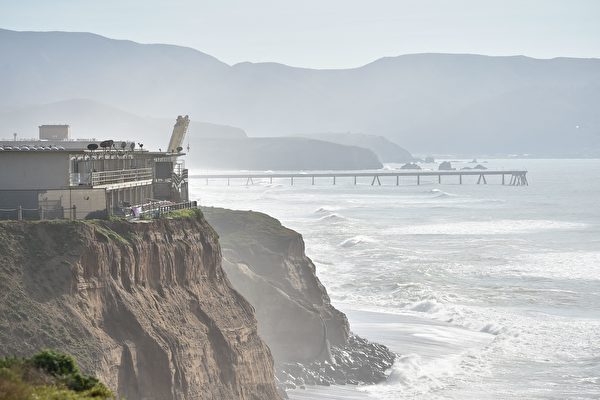
Climate scientists from the University of California, Los Angeles (UCLA) have indicated that as the unusually strong “El Niño” phenomenon gradually develops in the Pacific region, Southern California may experience an abnormally humid winter, increasing the risks of flooding, large waves, and coastal erosion.
Daniel Swain, a climate scientist from UCLA, the National Center for Atmospheric Research (NCAR), and The Nature Conservancy, stated that the temperature in the eastern tropical Pacific Ocean is a key factor in the formation of El Niño, which has already reached record highs for the same period in previous years. Forecasts also suggest that this El Niño event could be even stronger than any observed in the past.
During a media briefing conducted by the nonprofit news organization American Community Media last week, Swain discussed the developing El Niño phenomenon. When the Pacific trade winds weaken, warm ocean waters shift eastward, accumulating along the coasts of Peru and Ecuador to form El Niño. This phenomenon can alter global storm tracks and weather patterns.
Swain mentioned that this El Niño event is expected to peak between October and December, most likely reaching its peak in November. The period with the greatest impact on California is projected to extend from December to the following March, or even later.
The probability of above-average precipitation in Southern and Central California is expected to increase, thereby raising the risk of flooding in inland areas and cities.
Swain emphasized that El Niño does not guarantee a rainy winter for California. However, this year’s El Niño event could be very strong, possibly reaching historically uncommon intensity, thereby likely increasing the winter precipitation in California.
According to Swain, Southern California could be severely affected, with increased risks of flooding and coastal erosion.
Current sea temperatures along the Southern California coast are already above average, and it is expected that El Niño will temporarily raise coastal sea levels. Later this year, the higher sea levels could coincide with winter storms and seasonal high tides, increasing the likelihood of coastal flooding and erosion.
Swain pointed out that segments of the Pacific Coast Highway near Malibu and the railway corridors connecting Los Angeles and San Diego have already been affected by coastal erosion. Local agencies have begun constructing sand berms along the beaches to mitigate the increased wave action, and regional water authorities have been asked to closely monitor the developing El Niño phenomenon.
Officials are also advised to prepare for urban flooding beyond traditional mudslide high-risk areas, including some parts of Southern Los Angeles.
A warmer atmospheric environment may mean that winter precipitation in the low-elevation areas of the Sierra Nevada Mountains will predominantly fall as rain rather than snow.
Swain suggested that California could experience a “warm wet” winter, with higher rainfall amounts and above-average temperatures, while significant snowfall may be concentrated in areas above 8,000 to 9,000 feet in elevation.
However, Swain cautioned against portraying the forming El Niño as an imminent disaster, as California still has several months to prepare for most potential impacts.
“Indeed, we are set to experience a very strong El Niño event, possibly the strongest on record, which is indeed significant. But we do have a considerable amount of preparation time before most of the negative impacts may actually materialize, so we do have time to take measures to address these risks,” Swain stated.