
At a recent exhibition in mainland China, humanoid robots were frequently seen showcasing dancing, folding clothes, and moving objects. However, once they are put into factories, their efficiency in simple assembly tasks still falls short compared to human labor. An industry expert mentioned that there are hardly any real-life scenarios where large-scale applications are achieved. Several industry insiders also pointed out issues such as inadequate precision, difficulties in long-term stable operation, and a significant drop in success rate after changing scenes.
According to a report by “Caijing” on August 26, a reducer manufacturer stated that the main customers of humanoid robots still come from the fields of research, performance, and education, suggesting that in industrial applications, the hype outweighs the actual usefulness.
Wang Xingxing, the founder of Yushu Technology, mentioned that in 2024, the company collaborated with a car factory, but due to insufficient efficiency and generalization capabilities, they were unable to expand on a large scale. Although robots can complete simple assemblies, their efficiency is lower than that of human workers.
Robots trained extensively in fixed scenarios can achieve success rates close to 100%; however, any slight variation in items, lighting, or environment can significantly reduce the success rate. Even deviations of a few centimeters or millimeters at the end can lead to the failure of the entire task.
Xiong Rong, the chief scientist of Zhejiang Humanoid Robot Innovation Center, stated that robots entering factories still face four problems, including the inability to operate stably for the long term, the need to re-collect data and retrain when changing items or scenes, inadequate operational precision, and slow execution speed.
Currently, robots’ operational precision ranges from the centimeter to millimeter level, while some industrial tasks require sub-millimeter precision. Robots may also encounter problems such as unstable gripping of cups, damaging of packaging boxes, and inability to open locked cabinet doors.
Xie Shaofeng, Chairman of the Open Atom Open Source Foundation, pointed out that the current industry’s technological direction is scattered, and there is a lack of standards. The sensing configurations, motion spaces, and data structures of different manufacturers are not unified, leading companies to repeatedly adapt and engineer verification, making it challenging to reuse data collected at high cost across devices and tasks.
Huang Qingqiu, co-founder and Chief Technology Officer of Moqi Intelligence, expressed the presence of a bubble in the embodied intelligence industry. “Embodied intelligence” refers to physical devices such as robots completing tasks in real environments through sensing, understanding, and action. Huang believes that the actual value created by robots’ current application is far from matching the companies’ valuations. Meanwhile, Zhang Jianzhong, founder of Moore Line Technology, stated that embodied intelligence lags at least five years behind language models.
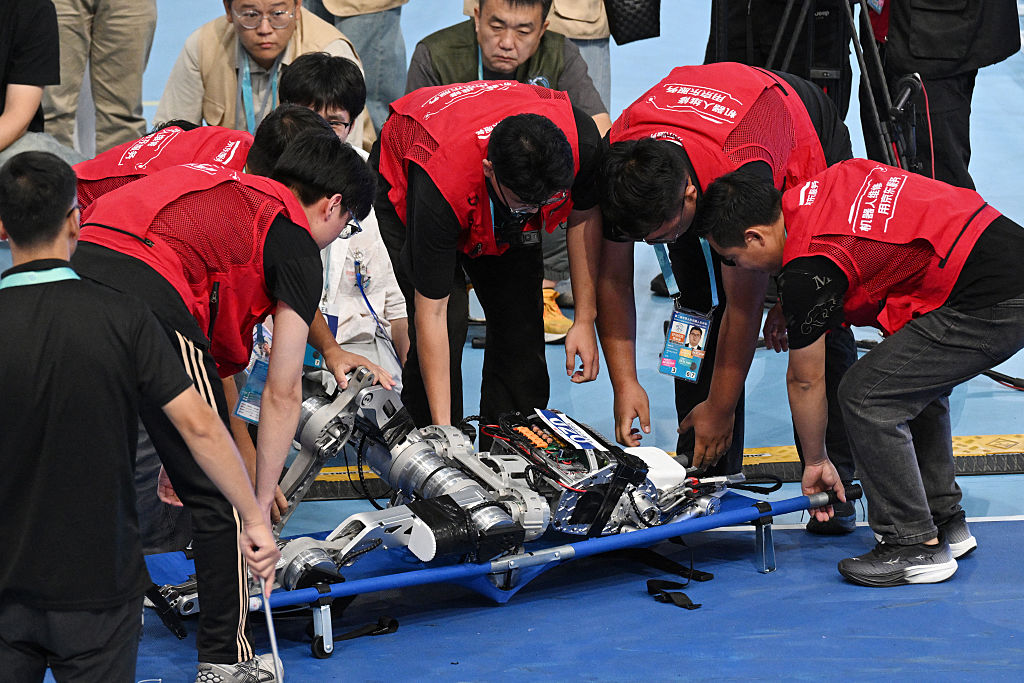
The 2nd World Humanoid Robot Games opened in Beijing on August 22. During the weightlifting competition held on August 24, a Tianzhu team robot attempted to lift a 16-kilogram dumbbell. It lifted the dumbbell to chest height before shaking, lost balance when continuing to lift it, then swung its mechanical arm towards the referee’s stand, fell to the ground, and was carried away on a stretcher by staff.
The competition has simplified weightlifting behaviors compared to humans, with robots only needing to lift the dumbbell above their heads and keep it steady for two seconds. Some competing robots even had tape wrapped around their hands to increase grip strength.
Videos of the event sparked discussion among netizens. Some described the competition as a “robot embarrassing sports meet” and a “large abstract scene.” Others joked that the staff carrying the stretcher became the “busiest person on the scene.”