
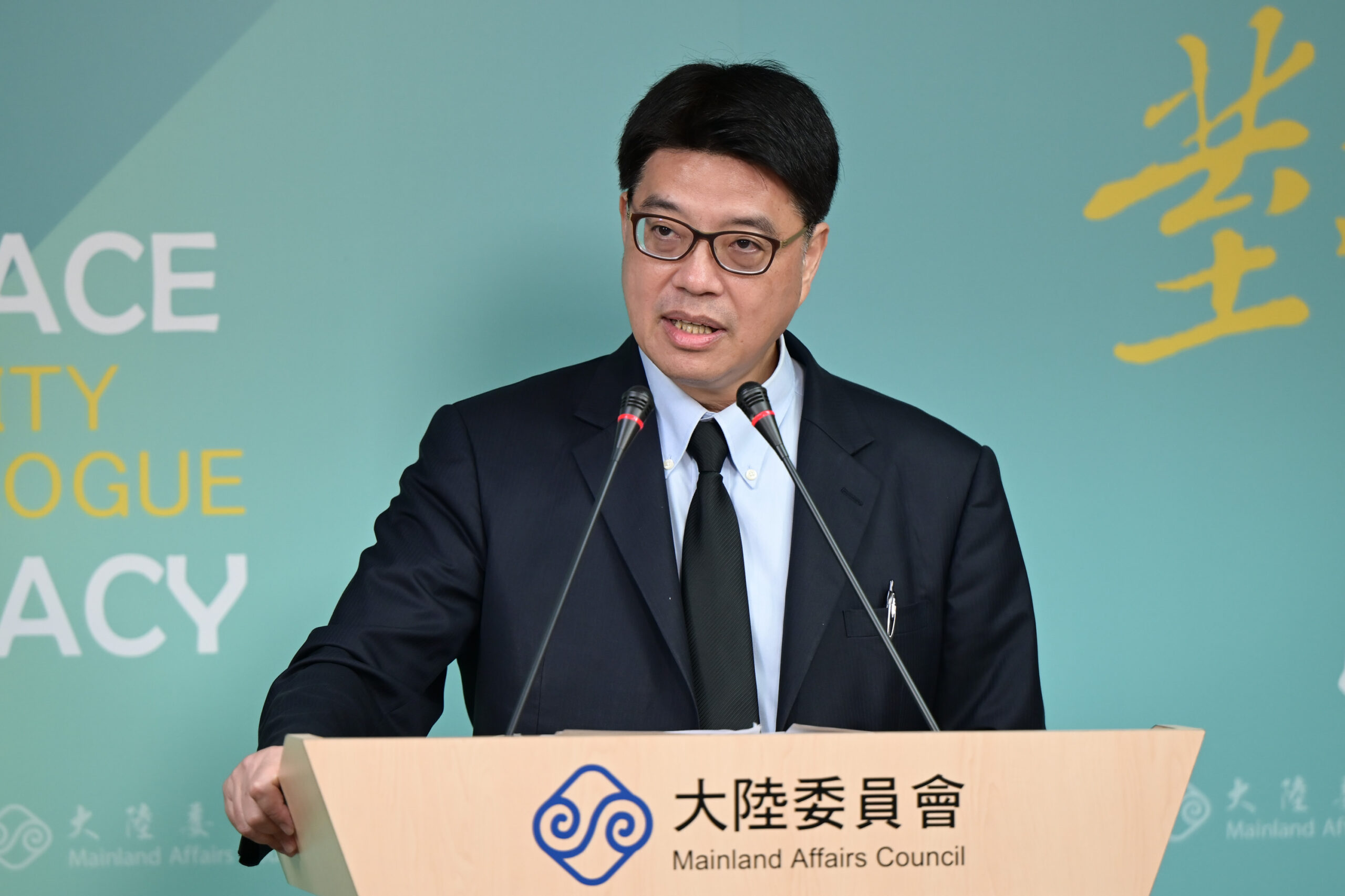
Taiwan Affairs Chairman of the Mainland Affairs Council Chiu Chui-cheng pointed out today (5th) that the Chinese Communist Party (CCP), in the light of the upcoming implementation of the “Regulations of the State Council of the People’s Republic of China on Entry and Exit Administration,” has been continuously updating national security-related laws in recent years. These changes may increase the risks for Taiwanese people traveling to the mainland, urging the public to conduct a thorough risk assessment before visiting China to ensure their safety.
Starting from September 15th, the new regulations on entry and exit management will grant the CCP government the authority to prevent individuals involved in export control or technical security from leaving the country. Additionally, the application process for entry and exit will now require individuals to provide detailed information to verify their true intentions, departing from the traditional method of simply filling out forms.
Today, the Internal Administration Committee of the Legislative Yuan of the Republic of China reviewed draft amendments to certain articles of the “Act Governing Relations between the People of the Taiwan Area and the Mainland Area” (Cross-Strait Act) and the “Act Governing Relations with Hong Kong and Macau” (HKMA Act). Chairman Chiu Chui-cheng conducted a joint media interview regarding these matters.
Chiu Chui-cheng expressed concerns about the CCP’s issuance of the “Regulations of the State Council of the People’s Republic of China on Entry and Exit Administration,” which has stirred up public anxiety. He emphasized that essentially, the CCP has always strictly managed entry and exit for mainland Chinese individuals and foreigners, but they are now making these regulations more explicit to showcase their commitment to “governing by law.”
Using an example, Chiu Chui-cheng highlighted that it is a well-known fact that mainland Chinese people face strict entry and exit controls by the CCP when wanting to study or visit Taiwan, and the current situation prohibits them from freely traveling to the island.
“The CCP has been implementing strict controls on Chinese people for a long time,” he noted. However, the lack of a rule of law in the mainland means that there is ambiguity and arbitrariness in their management, leading to situations where individuals can be arbitrarily restricted from traveling abroad by the CCP.
Chiu Chui-cheng pointed out that due to the lack of clear legal requirements and regulations, the rights of ordinary people to enter and exit have been jeopardized, which is the root cause of the general public’s concerns.
Finally, Chiu Chui-cheng warned that the CCP has been continuously updating national security-related laws in recent years, including regulations on entry and exit, which may increase the risks for Taiwanese individuals traveling to the mainland. He urged the public to be vigilant about the potential personal safety risks posed by these new regulations from the CCP and emphasized the importance of conducting a thorough assessment of the risks before traveling to China to ensure their own safety.