
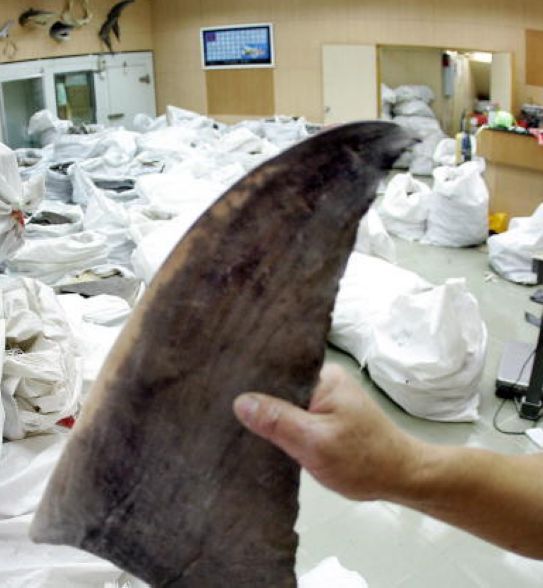
In August 26, 2026, according to reports from maritime police in the Pacific island nation of Kiribati, a Chinese vessel was detained this month for illegally fishing for sharks and cutting off their fins (known as shark finning).
The Chinese vessel was one of four ships detained between August 3rd and 14th during a large-scale maritime surveillance and enforcement operation involving 11 Pacific island nations. The operation received assistance from the U.S. Coast Guard and support from an Australian military aircraft. However, Kiribati conducted patrols with its own patrol boats.
Commander Tom Redfern of Kiribati Maritime Police told Agence France-Presse that the Chinese vessel held a permit to operate in Kiribati waters. After boarding and inspecting the vessel, Kiribati maritime enforcement officers found shark fins on board and seized the vessel for violating the conditions of its fishing permit.
Shark finning, the practice of cutting off shark fins and discarding the shark back into the sea, is prohibited in most parts of the Pacific Ocean. However, due to the demand for shark fins in East Asia and Southeast Asia, this illegal practice continues to exist. Once fins are cut off, sharks cannot regenerate them, leading to their inability to swim, feed, and survive, often resulting in their death.
“It (the Chinese vessel) has been escorted back to Christmas Island for further investigation,” Redfern said. Christmas Island is a large atoll belonging to Kiribati located south of Hawaii.
Andrew Chin, a fisheries researcher at James Cook University in Australia, stated that shark finning has led to a “significant decline” in shark populations, prompting strict control measures in the Pacific region.
“Because this behavior is now illegal, anyone still engaged in it would surely do so in a clandestine manner, making it very difficult to detect,” he said.
DNA research conducted on thousands of shark fins sold in markets in Hong Kong showed that these fins originate from the region.
“We have found evidence of illegal trade existing on both the western and eastern sides of the Pacific,” said Demian Chapman, director of the Shark and Ray Conservation Program at the Mote Marine Laboratory in Florida.
He also mentioned previous cases of Chinese vessels violating the shark finning ban.
Kiribati also hosts Chinese police, a move the U.S. believes may escalate tensions in the region. However, Kiribati has recently strengthened cooperation with France, as French military personnel are set to arrive at Christmas Island next month to rebuild the local police station.
According to CBS, in November of last year, U.S. authorities assisted the Peruvian government in seizing approximately 10,000 shark fins intended for shipment to China. Officials stated that the operation took place at an industrial port outside Lima, where three men were arrested on suspicions of involvement with a transnational crime network engaged in illegal fishing and wildlife trafficking.
In 2020, wildlife inspectors at a Miami port discovered 1,400 pounds of dried shark fins.