
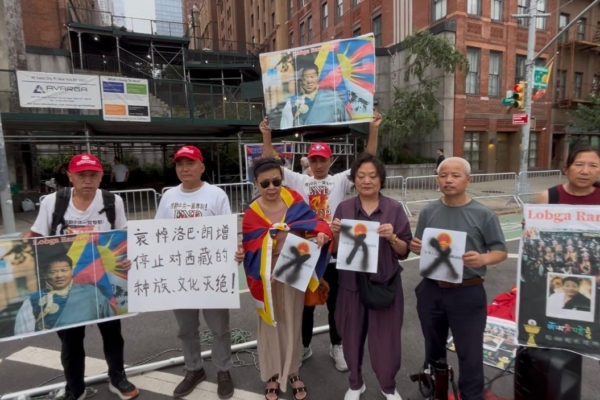
Chinese democratic and human rights groups held a memorial event on July 5 outside the United Nations headquarters in New York to commemorate Lobga Rangzen, a Tibetan independence activist who passed away due to self-immolation in protest against the Chinese Communist Party. Attendees at the event held white chrysanthemums in their hands to pay tribute to the human rights advocate who dedicated his life to advocating for Tibetan freedom. They urged the international community to continue paying attention to the human rights, religious, and cultural situation in Tibet.
Lobga Rangzen, aged 52, devoted his life to promoting Tibetan independence and freedom. On July 2, outside the UN headquarters in New York, he set himself on fire while dressed in traditional Tibetan robes, holding the snow lion flag, and displaying banners with slogans such as “China Out of Tibet” and “Free Tibet” to protest against the new draconian law called the “National Unity and Progress Promotion Law” implemented by the CCP on July 1, as well as the long-standing oppressive rule of Tibet by the Chinese government. Despite being rushed to the hospital for medical treatment, he succumbed to his injuries.
The theme of the event was “The Flames of Freedom Cannot Be Suppressed by CCP’s Draconian Laws—In Memory of Tibetan Independence Advocate Lobga Rangzen.” Banners at the venue bore the message “The Flames of Freedom Cannot Be Suppressed by CCP’s Draconian Laws,” while English slogans highlighted the “The CCP Regime Committed Crimes Against Tibetans” among other contents.
In his final testament, Lobga Rangzen pointed out that the “National Unity and Progress Promotion Law” under the guise of promoting ethnic unity actually further strengthens the policies of a single ethnic group, oppressing the cultural, religious, and identity of minority groups. He believed that Tibet would one day achieve freedom, and even if it meant sacrificing his life, he hoped to raise awareness about the plight of Tibet on the global stage.
The memorial event was attended by various democratic and human rights groups, including the Chinese Democratic Party International Alliance, the Chinese Democratic Human Rights Alliance, the Hong Kong Free Democratic Party, the International Human Rights Concern Group, and the Overseas Chinese Human Rights Lawyers Alliance. Participants paid homage to Lobga Rangzen by laying flowers and observing a moment of silence, expressing their respect and remembrance for his spirit of sacrifice.
The Chairman of the Chinese Democratic Party International Alliance, Jielijian, expressed deep sorrow over Lobga Rangzen’s lifelong struggle for Tibetan freedom which ultimately led to the sacrifice of his life. Since 1959, Tibetans have faced long-term political repression under CCP rule, with their religious beliefs, ethnic culture, and language continually under threat, even facing risks of cultural and ethnic extinction. Lobga Rangzen’s protest in the harshest manner not only voiced support for Tibet but also shed light on the suffering shared by all people living under the totalitarian rule of the CCP.
He called on the United Nations and countries around the world to pay more attention to the human rights issues in Tibet, urging them not to be swayed or infiltrated by the influence of the CCP, and to work together to help the Tibetan people break free from oppression and restore their freedom and dignity.
Yang Maosen, the founder of the Chinese New Democratic Party, stated that the root cause of this tragic outcome lies with the CCP, and in these extremely sad and painful days, this accountability falls squarely on the shoulders of the CCP.
Lobsang, the leader of the New York Tibetan organization, expressed gratitude during the memorial event to Chinese democratic activists and friends from all walks of life for their support.