
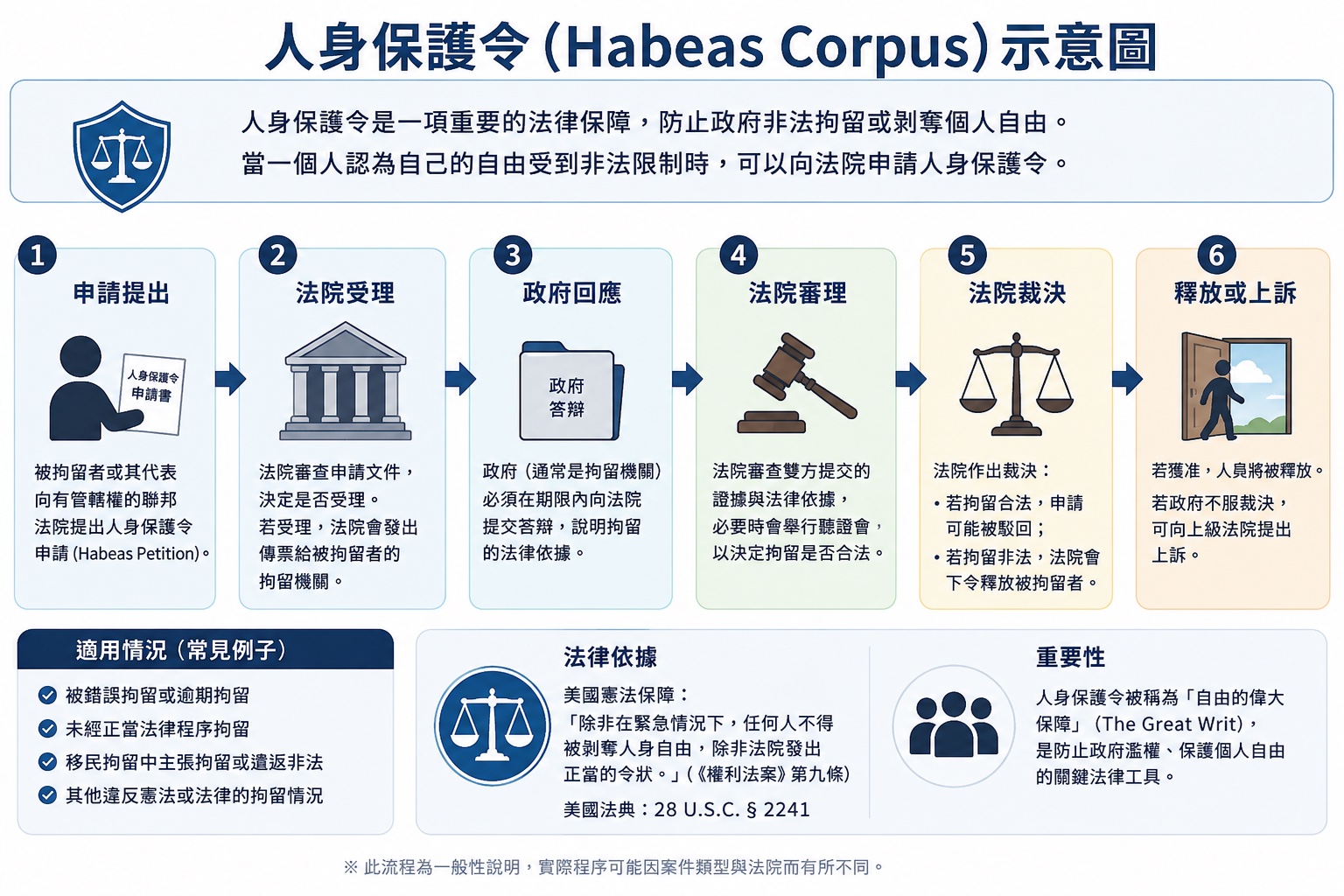
With the increased enforcement of immigration laws in the United States, some foreigners who have overstayed their visas, are awaiting immigration procedures, or applying for asylum are being detained by the Immigration and Customs Enforcement (ICE). For those in detention, besides seeking bail in immigration court, there is also a legal avenue that many are not familiar with – the Habeas Corpus.
Simply put, the core issue raised by the Habeas Corpus is: does the government have a legal basis to detain this person?
When a detainee believes that their detention lacks legal justification or serious legal issues arise from the continued detention, they can file a Habeas Corpus application to a federal court to request a review of the legality of the detention.
A recent case involving a young Chinese man’s Habeas Corpus petition illustrates how this legal process has become a pathway for long-term immigration detainees seeking freedom.
Firstly, a Habeas Corpus is not an appeal in immigration matters.
The Habeas Corpus originates from the English-American common law tradition and is an important judicial procedure in the U.S. legal system. For detained immigrants, a Habeas Corpus usually does not seek the federal court to reconsider asylum cases or directly grant green cards but challenges the current detention itself.
In other words, the question is not “Should I get immigration status?” but rather “Does the government have the right to continue detaining me?”
This sets it apart from the bail hearing in immigration courts. The Bond Hearing in the immigration court primarily discusses whether a detainee can be granted bail during the case proceedings, while the Habeas Corpus can directly request a federal court to review the legal basis for the government’s detention.
Moreover, it is not necessary to wait for a full six months.
When mentioning a Habeas Corpus in immigration detention, many associate it with “six months.” This mainly stems from the 2001 Supreme Court case of Zadvydas v. Davis. The case involved a foreign national with a final removal order but no country willing to accept them. The Supreme Court ruled that the government cannot indefinitely detain a person in situations where deportation is not actually feasible.
The court deemed that typically, six months after the final removal order can be seen as a reasonable detention period. After six months, if the detainee can present substantial reasons proving that there is little likelihood of deportation in the foreseeable future, the government must provide evidence to rebut this.
Therefore, while six months is an important legal “threshold,” it is not a strict rule of “detain for six months and release.” Equally important is that the Habeas Corpus is not only applicable to individuals detained for over six months.
A recent case involving another Chinese immigrant illustrates this point. As reported by Dajiyuan earlier, a Chinese woman named Xiao Zou, holding a C8 work visa and awaiting asylum proceedings, was detained by ICE at Newark Airport. Her lawyer quickly filed an emergency Habeas Corpus application to a federal court, and 48 minutes later, a federal judge intervened, preventing ICE from transferring her to another state. Ultimately, Xiao Zou was released after approximately 17 hours of detention.
For readers interested in the specifics of Xiao Zou’s case, they may refer to Dajiyuan’s previous coverage.
A Chinese young man with the surname Li arrived on Saipan with his parents ten years ago, where he attended middle school and college. In August 2025, on the eve of his 21st birthday, he was arrested by ICE.
According to materials provided by his lawyer, due to the unique immigration system in Saipan, foreigners there cannot apply for asylum voluntarily like in other parts of the U.S. Li was put through the immigration court process after his arrest.
In November 2025, an immigration judge approved his withholding of removal.
Here, a clear distinction needs to be made: withholding of removal is not equivalent to asylum or a green card. It mainly signifies that the U.S. government cannot deport the individual to a country where they may face persecution. Under specific conditions, such protected individuals can obtain work permits; Li later obtained an A10 work permit of this nature.
However, as per materials presented by his lawyer, ICE did not release him immediately for this reason. Li was further detained for about six months. In total, counting from his initial arrest, he spent approximately nine months in immigration detention.
His lawyer Mei Zhou believes the issue lies in Li being neither deportable to China nor accepted by any other country. If the government cannot execute deportation in the foreseeable future but continues long-term detention, constitutional due process issues may arise.
Eventually, the lawyer filed a Habeas Corpus application to a federal court to review the legality of the detention. According to the lawyer, even before the court made a final ruling after receiving the court procedure, Li was released.
This is one of the most significant impacts of the Zadvydas case on immigration detention.
A core purpose of immigration detention is to ensure the government can enforce lawful deportation decisions. However, if a person has received a deportation order, but the government cannot reasonably foresee deporting them to any country, the detention issue transforms into whether the detention is for the purpose of deportation or turning into indefinite incarceration.
The Supreme Court in the Zadvydas case placed constraints on this, stating that immigration law cannot be interpreted to allow the government to indefinitely detain someone who is practically un-deportable.
This also makes the feasibility of deportation a crucial issue in some long-term immigration detention Habeas cases.
In practical cases, a lawyer needs to first understand the detainee’s current legal status, including:
• Under which law ICE detained them;
• Whether a final order of removal exists;
• How long they have been detained;
• Whether the government has a feasible deportation plan;
• Whether there are other legal reasons supporting continued detention.
Under appropriate conditions, the lawyer can file a Habeas petition to a federal district court with jurisdiction, requesting a review of the detention’s legality.
If the case involves urgent issues such as transfer, deportation, or other severe legal matters, the lawyer may also simultaneously request the court to take emergency measures to temporarily halt related government actions.
This is another scenario highlighted by the Xiao Zou case: Habeas is not necessarily the “last resort” used after prolonged detention but can, in urgent situations, become a means to immediately request federal court intervention.
Immigration enforcement is a significant power of the federal government, but detaining an individual does not mean being exempt from judicial review.
The ultimate purpose of a Habeas Corpus is not “Is this person a legal immigrant?” but a more fundamental question: Does the government have legal grounds to deprive them of their freedom?
Hence, for some individuals detained by ICE for prolonged periods with no realistic chance of deportation, or who believe their current detention lacks legal justification, the Habeas Corpus provides another avenue: enabling detainees to directly petition a federal court to review the legal basis for the government’s continued detention.
Amidst the increasingly stringent background of immigration enforcement, this centuries-old legal procedure is gaining renewed attention in the immigration law community.