
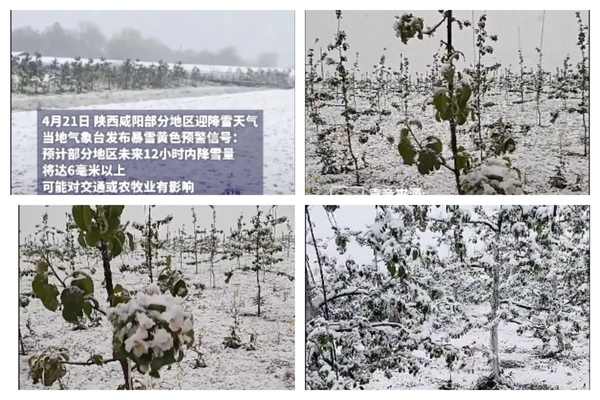
On the morning of April 21st, heavy snowfall of goose feathers suddenly hit Baoji, Tongchuan, and Xianyang in Shaanxi province. Xianyang’s Xunyi County, Changwu County, and Binzhou City in the northern regions experienced significant snowfall, with some areas accumulating noticeable amounts of snow.
The Xianyang Meteorological Observatory issued a yellow alert for road icing at 10:13 AM on April 21st, warning of possible road icing within the next 24 hours due to the cold and snowy weather. Areas in Binzhou City, Xunyi County, Changwu County, the northern parts of Yuhang County, Chunhua County, and Liquan County need to be cautious.
Similarly, the Binzhou City Meteorological Observatory issued a yellow alert for road icing at 8:47 AM, predicting possible road icing affecting transportation in areas like Taiyu Town, Shuikou Town, Hanjia Town, and Chengguan Street within the next 12 hours. Furthermore, a blue alert for frost was also in effect, with temperatures expected to drop below 0℃ overnight into the next morning.
At the same time, Xi’an, which saw temperatures soaring close to 30℃ last week, experienced rainfall bringing temperatures back to around 10℃. According to the Shaanxi Meteorological Bureau, the province underwent a precipitation process throughout the day due to the eastward movement of the westerly trough and the influence of cold air from the cold vortex, resulting in cooler and windy weather in the central and northern parts.
The snowfall, occurring just two weeks before the start of summer (May 5th), poses a significant impact on local crops. Local fruit farmer, Mr. Li, mentioned to “The Paper” that it is currently the peak flowering period for apples, and if the flowers are affected by the snow, the fruit setting ability of apples will be significantly reduced.
April is a critical period for the blossoming of fruit trees and the growth of crops, with weaker resistance to cold. Snowfall or frost during this time can easily lead to the death of flower buds and young seedlings. If the low temperatures persist, the fruit setting rate for trees such as apples and pears will decrease, leading to a significant reduction in the yield of food and cash crops.