
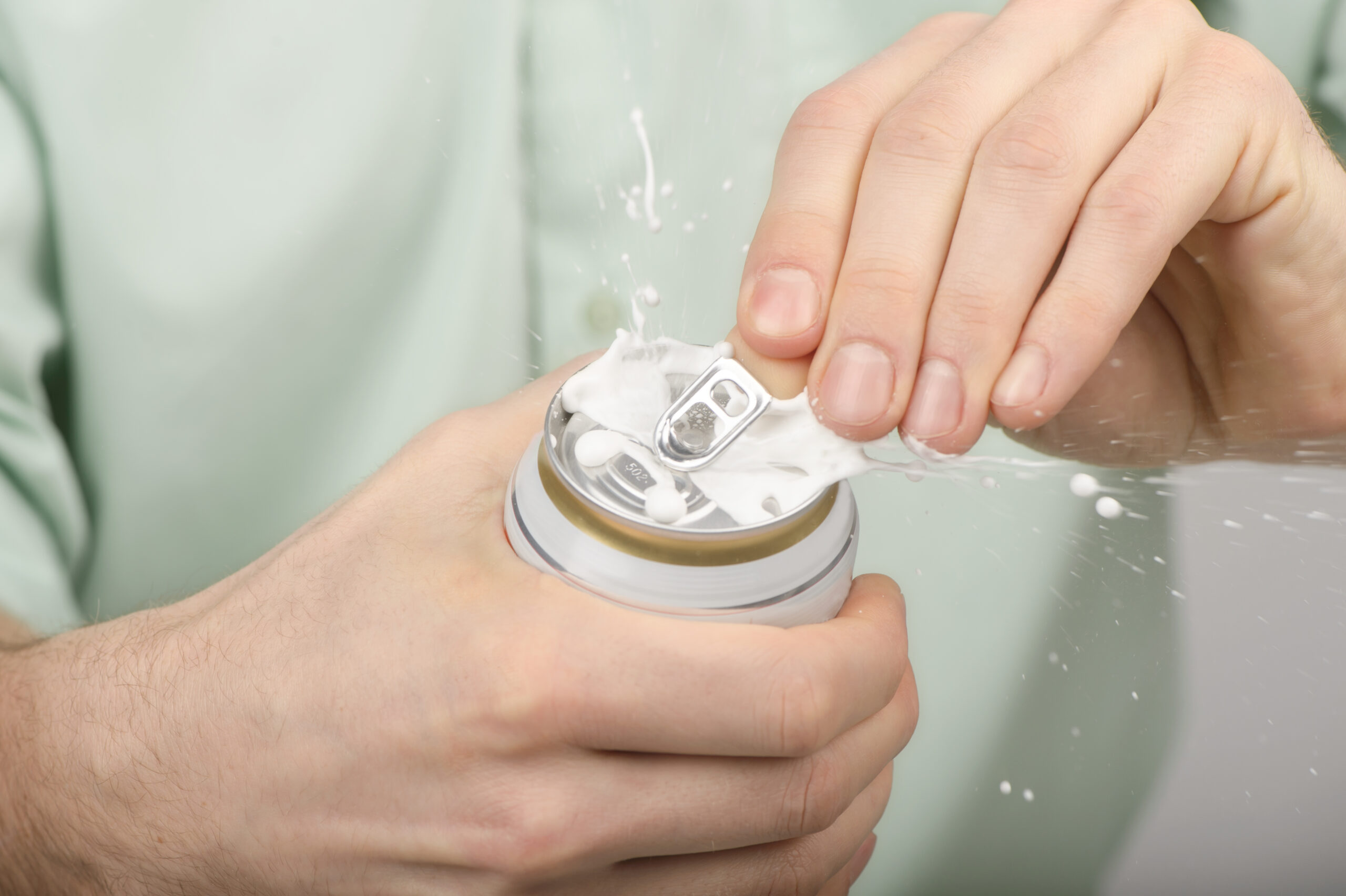
Shaking canned carbonated beverages such as soda can cause the bubbles to rush out when you open the tab. People have tried various methods to prevent this situation, including tapping the top of the can before opening it, but is this method really effective?
According to a report by LiveScience, carbonated beverages like soda, beer, or champagne, are produced by injecting carbon dioxide into the liquid under low temperature and high pressure conditions.
Roberto Zenit, an engineering professor at Brown University in the United States who studies fluid mechanics, told the website, “The formation of bubbles is due to the oversaturation of carbon dioxide.”
Oversaturation is an unstable state where the amount of dissolved substance in a liquid or gas exceeds the normal capacity under certain conditions. Due to this instability, actions like shaking the can can stimulate the generation of more bubbles.
Javier Rodríguez Rodríguez, an associate professor of fluid mechanics at Carlos III University of Madrid in Spain, explained, “Mechanical actions like tapping or shaking can create intense pressure waves inside the liquid, which then rebound on the container walls, creating low-pressure zones and resulting in the formation of tiny bubbles.”
He mentioned that given enough time, these bubbles will dissolve and disappear. The duration depends on the type of beverage and container, typically ranging from a few minutes to several tens of minutes.
However, if the bubbles are still suspended in the liquid when the tab is opened, the sudden drop in pressure upon opening can lead to the generation of more bubbles, causing a more severe overflow.
In certain special cases, people deliberately create foaming eruptions, such as when opening champagne for celebrations. Before uncorking, the bottle is usually vigorously shaken to achieve this effect.
As for whether lightly tapping the top of a soda can can prevent foam from gushing out when opened, Zenit explained that carbon dioxide bubbles form and emerge from tiny imperfections called “nucleation sites,” which may include dust particles or rough areas on the can’s surface.
Tapping the top of the can is mainly to remove any bubbles or dust particles that may exist inside the soda can. By eliminating these substances, the rate of bubble formation can be slowed down.
In theory, tapping the can a few times can dislodge bubbles clinging to the can wall, causing them to rise to the air layer above the beverage before opening. By reducing the remaining “nucleation sites” in the liquid, the rapid growth points for bubbles to form when pressure drops upon opening can also be correspondingly reduced.
However, there is an important caveat. Although tapping may dislodge a few bubbles, excessive or frequent tapping may actually generate more bubbles. The same principle applies to carbonated beverages in glass or plastic bottles. For instance, tapping a beer bottle may result in foam overflowing when it is opened.
These opposing effects make it difficult to determine whether tapping can effectively reduce foam overflow, and some experiments suggest that, overall, this method may be ineffective.
If tapping does not effectively reduce foam overflow, are there other methods to achieve this goal? You can let a shaken canned beverage stand upright for a few minutes to allow the bubbles to dissolve or rise to the air pocket at the top of the can. Keeping it at a low temperature also helps to mitigate bubble issues since carbon dioxide is more easily maintained in a dissolved state at lower temperatures.
Rodríguez also suggested another method, which is to slowly open the can so that gas can escape. He said that by partially opening the tab initially to allow foam to release, you can fully open the soda can once there is no longer the sound of gas escaping.
Speaking of opening soda cans, you might be curious about who invented the tab on easy-open cans. According to a report by Yahoo Finance, American engineer Ermal Cleon Fraze was the inventor of the easy-open can tab. His invention permanently changed the way people around the world open beer, carbonated beverages, and various canned products.
Fraze obtained the patent for the easy-open can tab in 1963. That same year, Pittsburgh Brewery Co. in Pennsylvania tested this tab on 300,000 beer cans, immediately gaining popularity among beer enthusiasts.
This innovation expanded from beer cans to the food industry, especially in citrus fruits, soups, and coffee packaging. Fraze once said, “The market response has been excellent, exceeding expectations.”