
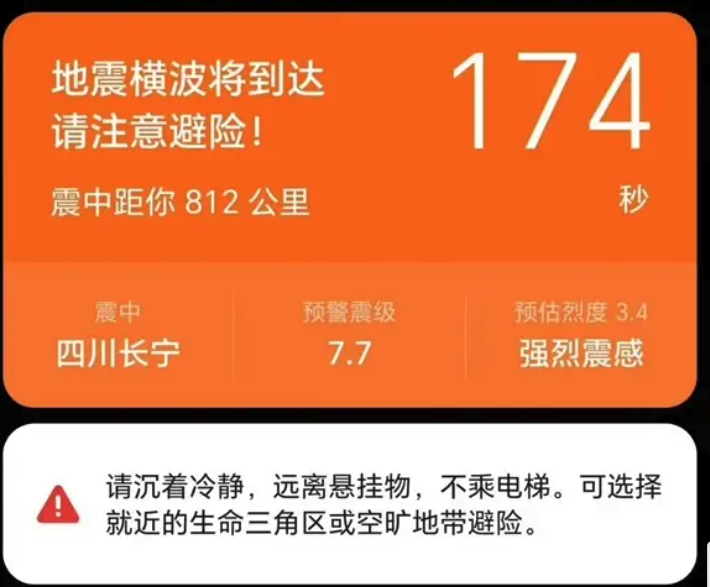
On the morning of August 24th, a 4.7 magnitude earthquake struck Changning County in Yibin City, Sichuan Province, China. The residents received a warning of a 7.7 magnitude earthquake, causing temporary panic. Following the earthquake, there was a dispute between the Sichuan Provincial Earthquake Administration and the Chengdu High-tech Disaster Reduction Research Institute regarding third-party authorization issues.
The China Earthquake Networks Center officially determined that the earthquake occurred at 8:26 am on August 24th in Changning County, Yibin City (latitude 28.33 degrees, longitude 104.98 degrees) with a depth of 5 kilometers. Chengdu, Leshan, Luzhou in Sichuan, Chongqing, and Guiyang, the capital of Guizhou Province, all felt the tremors. However, there have been no reports of casualties.
After the earthquake, panic ensued as many people received earthquake warning alerts on their mobile phones and other devices. The first warning message displayed a magnitude of 7.7, which quickly became a hot topic on social media.
Subsequently, the Chengdu High-tech Disaster Reduction Research Institute issued an apology and explanation, stating that the earthquake warning information provided by their Mainland Earthquake Early Warning Network showed a sequence of warning magnitudes: 7.7 (5 seconds after the quake), 6.4 (6 seconds), 3.7 (7 seconds), 4.1 (8 seconds), 3.9 (16 seconds), and automatically converged to 3.9 magnitude at the 17th second after the quake. They admitted that the initial 7.7 magnitude report was the largest deviation in the institute’s 15-year history.
As the incident escalated, the Sichuan Provincial Earthquake Administration announced at noon that the Chengdu High-tech Disaster Reduction Research Institute had wrongly used the name of the China Earthquake Early Warning Network to issue warnings and had terminated the third-party authorization to provide emergency earthquake information services on July 22, 2026.
The Chengdu High-tech Disaster Reduction Research Institute promptly responded with a statement, explaining that the “China Earthquake Early Warning Network” was jointly established by the China Earthquake Administration and the institute through a memorandum of cooperation signed in 2020, and it was not a misappropriated name. They clarified that they had been publicly serving society under that name since November 2020.
According to the explanation, in 2020, the former head of the China Earthquake Administration and the director of the research institute, Wang Tan, agreed during a meeting not to name the disaster mitigation institute’s early warning network the Mainland Earthquake Early Warning Network or the national earthquake early warning network. Instead, they decided on the name China Earthquake Early Warning Network, which was documented in the cooperation memorandum.
Regarding the technical reasons for the 7.7 magnitude deviation, the Chengdu High-tech Disaster Reduction Research Institute explained that the shallow depth of the earthquake at only 5 kilometers resulted in a peak acceleration of 153mg detected by the closest monitoring station, significantly higher than the usual 50mg for earthquakes with a depth of around 10 kilometers, causing the system to inaccurately predict the initial earthquake magnitude.
Public records show that the Chengdu High-tech Disaster Reduction Research Institute was established after the 2008 Wenchuan earthquake and became the first in China to breakthrough earthquake early warning technology in 2011, and in 2019, it pioneered the service of embedded earthquake early warnings in mobile phones globally.